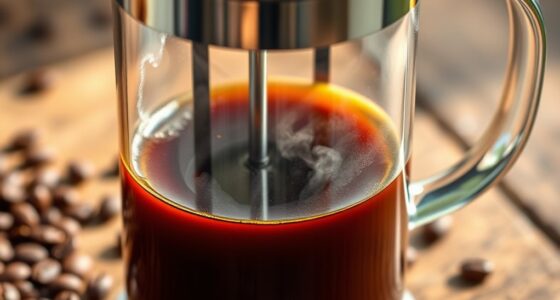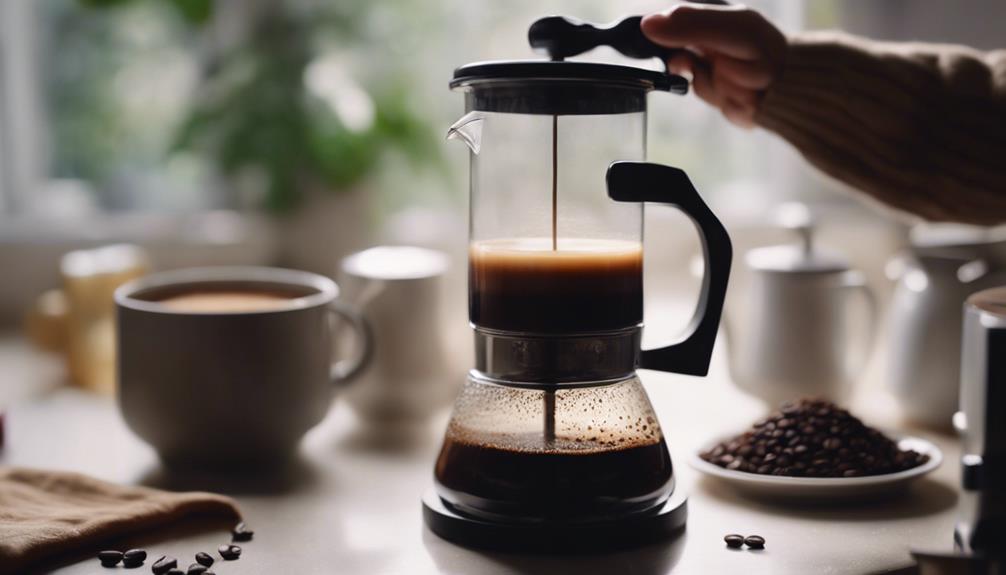
To achieve clarity when tasting single-origin coffee in a French press, focus on the right brew ratio—about 1:15 or 1:16—to prevent over- or under-extraction. Use a coarse grind and steep for around four minutes, stirring gently to guarantee even saturation. Adjust timings and ratios to bring out the unique flavors of your beans, like citrus or chocolate. Mastering these details will help you open the intricate profiles in your cup; explore more tips to enhance your experience.
Key Takeaways
- Use a precise 1:15 to 1:16 coffee-to-water ratio to enhance flavor clarity.
- Grind coffee coarsely to ensure even extraction and prevent over- or under-extraction.
- Steep for around 4 minutes, adjusting time based on desired brightness and complexity.
- Stir gently during brewing to evenly saturate grounds and highlight origin-specific notes.
- Maintain consistent brewing variables to accurately showcase single-origin flavor nuances.

Have you ever wondered how the unique flavors of a single-origin coffee shine through when brewed in a French press? It’s all about understanding how brew ratios and extraction influence the clarity of those distinctive flavor notes. When brewing single-origin beans, you want to highlight their specific characteristics—whether it’s the bright citrus notes of a Ethiopian Yirgacheffe or the rich, chocolate undertones of a Colombian Supremo. Achieving this requires precision in your brewing process, especially in how much coffee you use relative to water and how you control extraction.
Start by paying close attention to your brew ratios. A typical ratio for French press brewing is about 1:15 or 1:16. This means for every gram of coffee, you’ll use roughly 15 to 16 grams (or milliliters) of water. Using too much coffee can lead to over-extraction, which masks delicate flavor notes, making the coffee taste bitter or muddy. Conversely, too little coffee can result in under-extraction, leaving the brew weak and lacking in the complexity that single-origin beans can offer. Experiment with these ratios until you find the sweet spot that brings out the crispness, brightness, and nuanced flavors of your beans.
Adjust your brew ratio to enhance clarity and flavor nuance in your French press coffee.
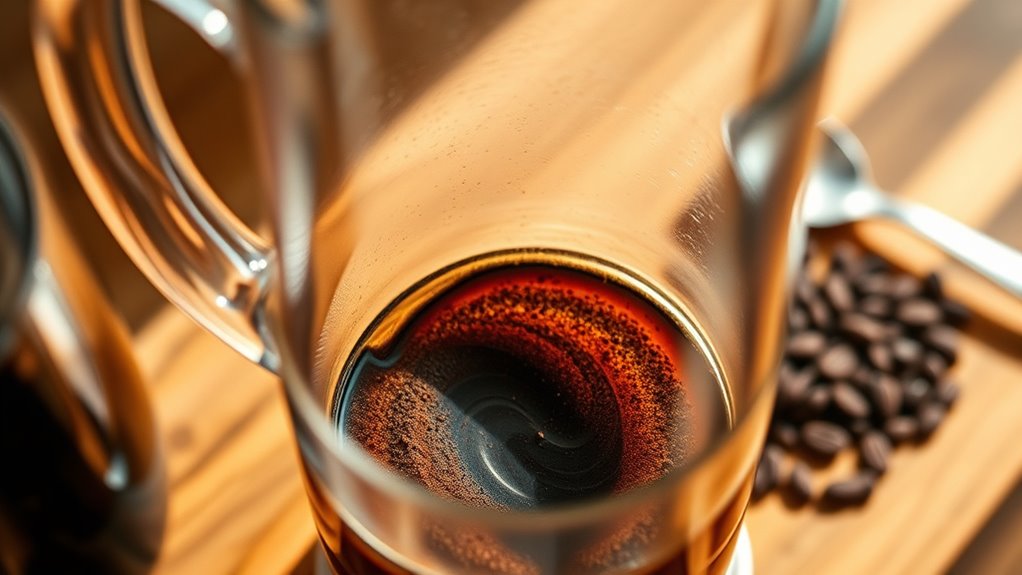
Next, pay attention to grind size. For French press, a coarse grind is best because it slows down extraction, giving you more control over flavor clarity. When you pour hot water over the grounds, give it a gentle stir to guarantee all the coffee is evenly saturated. Steeping time also plays a crucial role; usually, four minutes is a good starting point. Longer steeping can lead to over-extraction, dulling the flavor notes, while shorter times might not fully extract the subtle qualities of the single-origin beans.
As you brew, focus on how the flavor notes emerge. When you pour the coffee into your cup, take the time to notice the aroma first—this often hints at what’s to come. Then, sip slowly and identify the brightness, acidity, and body. A well-brewed French press will showcase the crispness of citrus, the sweetness of fruit, or the depth of chocolate, depending on the origin. The clarity you achieve depends on balancing your brew ratios and timing, which helps prevent over-extraction or under-extraction that can muddle flavors.
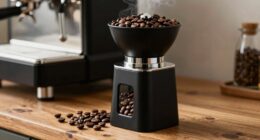
Finally, using a calibrated grinder ensures consistent particle size, leading to more predictable extraction and better flavor clarity in your brew. When you master these details, you can unlock the full potential of single-origin beans in your French press. You’ll enjoy a cup that’s vibrant, well-defined, and true to the unique profile of your chosen coffee. With practice, adjusting brew ratios and steeping times becomes second nature, transforming your brewing routine into a precise art that celebrates the distinctive flavor notes of each origin.

SHARDOR Professional 64mm Burr Coffee Grinder with 100 Grind Settings and All-Metal Chamber, Coffee Bean Grinder with Adjustable Electronic Timer and LED Display, Anti-Static,Black
64mm Flat Burr: Achieves uniform grinding with minimal heat generation, enhancing the flavor profile for a superior taste...
As an affiliate, we earn on qualifying purchases.
Frequently Asked Questions
How Does Single-Origin Taste Differ From Blended Coffees?
You’ll notice that single-origin coffees showcase distinct flavor nuances and regional characteristics, making each cup unique. They tend to have more pronounced, pure flavors compared to blended coffees, which combine beans for balance and consistency. When you taste single-origin, you’ll pick up specific notes like fruity, floral, or earthy characteristics rooted in the beans’ origin. Blends, on the other hand, offer a harmonious profile that masks individual regional traits.
What Is the Ideal Water Temperature for French Press Brewing?
Think of water temperature as the maestro conducting your coffee symphony. For French press brewing, aim for 200°F—just below boiling—this guarantees maximum extraction efficiency. Too hot, and you risk over-extraction and bitterness; too cool, and you miss out on full flavor. Using water at this ideal temperature releases the nuanced notes of your single-origin beans, delivering a balanced, vibrant cup every time.
How Long Should I Steep Coffee Grounds for Optimal Flavor?
You should steep your coffee grounds for about 4 minutes for ideal flavor. This brewing duration allows for proper extraction timing, ensuring you get a balanced and flavorful cup. If you steep too long, the coffee may become bitter, while too short can result in under-extraction. Keep an eye on the time to maximize the clarity of your single-origin brew and enjoy the nuanced flavors.
Can I Use the Same French Press for Different Coffee Origins?
While you can reuse your French press for different coffee origins, it’s best to think of it as a delicate dance—equipment compatibility matters. To enjoy each’s unique charm, clean and maintain your press thoroughly between brews. This prevents flavor cross-talk and keeps every cup vibrant. Embrace the ritual; a well-maintained French press becomes your trusted partner, revealing the true essence of each coffee origin with clarity and delight.
What Are Common Mistakes to Avoid During Single-Origin Tasting?
You should avoid common mistakes like using inconsistent grind sizes, which can ruin flavor consistency. Don’t forget to maintain aromatic preservation by keeping your brewing time precise, as over-extraction dulls delicate notes. Also, avoid using water that’s too hot, which can distort flavors. By focusing on these points, you’ll guarantee a clearer, more accurate tasting experience that highlights each single-origin coffee’s unique profile.

Neretva Espresso Grinder, 2 in 1 Professional Coffee Bean Grinder Stainless Steel Suit 51~58mm Portafilter Burr Coffee Grinder 30 Precise Setting&Anti-Static for Espresso/French Press/Drip/Moka-Silver
PROFESSIONAL CONICAL BURR COFFEE GRINDER- WIth new upgraded 3.0 conical burr grinding technoloy, the coffee grinder ensures that...
As an affiliate, we earn on qualifying purchases.
Conclusion
Now that you’ve mastered single-origin tasting in your French press, every sip becomes a journey through a world of flavor. With your newfound knowledge, you’ll uncover nuances that even the most seasoned baristas envy. Remember, this experience isn’t just coffee—it’s a revelation that can transform your mornings into a symphony of taste. So go ahead, brew boldly, and let each cup reveal secrets that are nothing short of extraordinary.
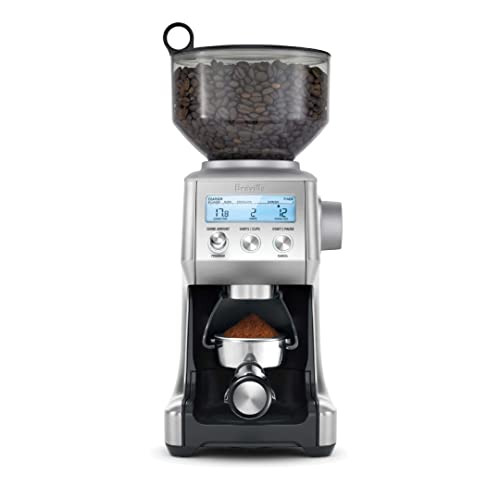
Breville BCG820BSS Smart Grinder Pro for Coffee and Espresso, Brushed Stainless Steel
The Breville Smart Grinder Pro includes 60 unique settings – this programmable conical burr grinder offers a wide...
As an affiliate, we earn on qualifying purchases.
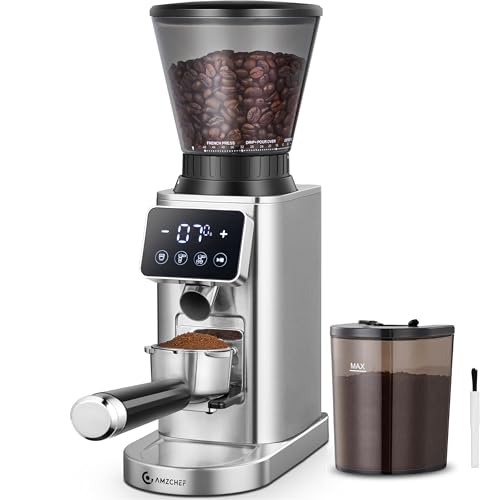
AMZCHEF Coffee Grinder, Coffee Bean Grinder for Home Use with Precise Grinding, LED Control Panel, Detachable Funnel Stand, Anti-static Design, 48 Grind Settings, Silver
DESIGN FOR ESPRESSO:We provide portafilter holder ,Portafilter holder pad and photophobic coffee ground container. It is compatible with...
As an affiliate, we earn on qualifying purchases.