
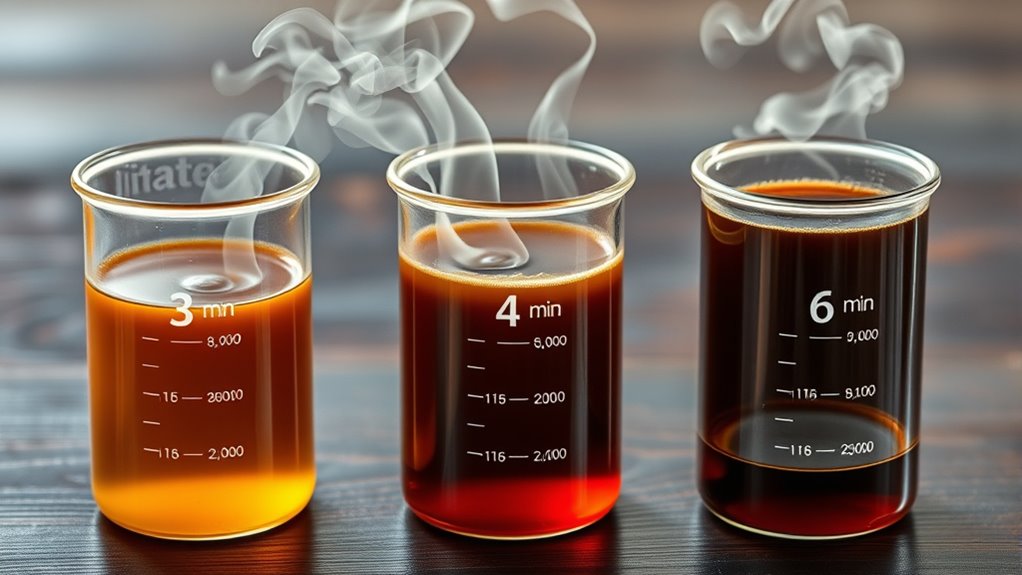
Adjusting brew times to 3, 4, or 6 minutes can change your coffee’s flavor, extraction, and overall quality. A 3-minute brew results in a lighter, more delicate taste but risks under-extraction if your grind or water temperature isn’t just right. Extending to 4 minutes balances richness without bitterness, while 6 minutes pulls out complex, full-bodied flavors but requires careful control of grind size and temperature. Keep exploring these variables to find your perfect cup.
Key Takeaways
- Shorter brew times (3 minutes) produce lighter, delicate flavors but risk under-extraction if parameters aren’t balanced.
- A 4-minute brew offers a balanced extraction, enhancing flavor complexity while minimizing bitterness with proper grind and temperature.
- Extending to 6 minutes extracts richer, more full-bodied flavors but requires coarser grind and precise temperature control to avoid over-extraction.
- Adjusting grind size and water temperature is crucial across all durations to optimize flavor and prevent undesirable notes.
- Consistent brewing parameters tailored to each time frame ensure optimal flavor balance and extraction quality.
Have you ever wondered how brewing time affects the flavor and strength of your coffee or tea? It’s a vital factor that can make or break your perfect cup. When you experiment with brew times of 3, 4, or 6 minutes, you notice noticeable differences, especially when considering your coffee grind and water temperature. These elements work together to influence extraction, which determines the taste, aroma, and potency of your beverage.
Starting with a 3-minute brew, you’re likely to get a lighter, more delicate flavor. If your coffee grind is too fine, the water might not have enough time to extract all the desirable compounds, leading to a weaker or underwhelming cup. Conversely, if your grind is too coarse, your brew might taste overly watery or insipid, because the water passes through too quickly, extracting only the surface flavors. Water temperature also plays a role here. If it’s too low, extraction slows down, resulting in a flat or sour note. If it’s too high, you risk over-extraction, which can introduce bitterness even within a short brewing time.
Short brew times favor delicate flavors; grind size and water temperature are key for optimal extraction.
Moving to a 4-minute brew, you start to strike a balance. The longer time allows for more thorough extraction, especially if you’ve adjusted your coffee grind to a medium setting. This gives the water enough contact with the coffee grounds to bring out richer flavors without becoming overly bitter. At this stage, water temperature remains critical. Ideally, it should be around 195°F to 205°F, ensuring ideal extraction without scorching the coffee or tea. If your water is too hot, you risk extracting undesirable bitter compounds; if too cool, the brew might taste flat or sour.
A 6-minute brew takes things further, extracting the most complex flavors from your grounds. For this longer process, a slightly coarser grind can help prevent over-extraction and bitterness. Your water temperature should still be within that ideal range, maintaining consistency for balanced flavor. The extended time allows for a fuller-bodied, richer profile, but it also increases the chance of extracting bitter or astringent notes if your grind is too fine or your water is excessively hot. Fine-tuning both your grind size and water temperature becomes essential here to avoid overpowering your brew with unwanted flavors. Additionally, understanding the Gold IRA Rollovers process can help diversify your investment portfolio for long-term financial stability, much like how adjusting brewing parameters ensures the perfect cup.
Frequently Asked Questions
How Does Brew Time Affect Caffeine Content?
You’ll find that longer brew times generally increase caffeine content because the water extracts more compounds from the coffee grounds. If your grind size is coarse, it slows extraction, so a longer brew like 6 minutes helps. Conversely, with a fine grind, a shorter time suffices. Water temperature also plays a role; hotter water extracts caffeine faster, so adjusting temperature alongside brew time impacts the final caffeine level.
What Is the Ideal Brew Time for Different Coffee Beans?
You should adjust brew time based on your coffee beans, considering temperature control and grind size. For light roasts, aim for a slightly longer brew time to extract full flavor without bitterness, while dark roasts benefit from shorter times. Fine grind sizes need shorter brewing, whereas coarser grinds require longer. By controlling temperature and matching grind size to brew time, you’ll optimize flavor and caffeine extraction for each bean type.
Can Longer Brew Times Cause Over-Extraction?
Longer brew times can indeed cause over-extraction, turning your coffee into a bitter brew that masks its true flavor. Think of it as pulling too hard on a guitar string—your coffee’s strength and brewing consistency suffer. You risk extracting harsh compounds, which dulls the nuanced tastes. To keep your coffee balanced and flavorful, stick to ideal brew times, ensuring you control over-extraction and enjoy a richer, smoother cup every time.
How Do Brew Times Influence Flavor Profiles?
You’ll notice that brew times greatly influence flavor profiles, especially with temperature control and grind size. Longer brew times extract more solubles, often resulting in bolder, more bitter flavors, while shorter times preserve brighter, lighter notes. Adjust your grind size to match your desired brew time; a finer grind increases extraction, enhancing flavors, whereas a coarser grind slows the process. Experiment to find the perfect balance for your taste preferences.
Are There Health Risks With Shorter or Longer Brew Times?
Shorter brew times might risk under-extracting coffee, leaving you with weak flavor and potential health concerns from residual sediment. For example, a quick 3-minute brew at high temperature could produce more sediment, increasing your intake of unwanted compounds. Longer brewing, like 6 minutes, ensures better extraction but could over-extract, releasing bitter compounds. Always balance brew time with temperature to minimize health risks from sediment and maximize flavor.
Conclusion
Your brew time experiment shows that even a minute difference can impact flavor. For example, brewing for 4 minutes yields a balanced taste, while 6 minutes boosts richness but risks over-extraction. notably, studies reveal that coffee brewed for exactly 3 minutes retains more delicate aromatics. So, experimenting with your preferred time allows you to craft a cup perfectly suited to your taste buds. Keep tweaking—your ideal brew might just be a minute away.