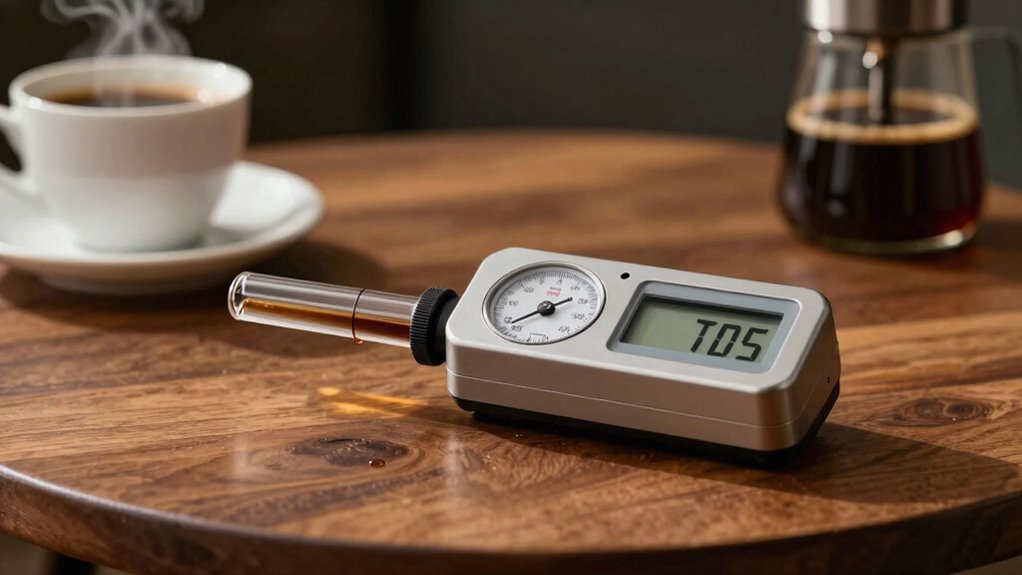

A refractometer helps you measure the Total Dissolved Solids (TDS) in your coffee, giving you quick data to fine-tune your brew for consistency and strength. While TDS lets you compare concentration levels, it doesn’t reveal flavor complexity, balance, or overall quality. It’s a useful tool when combined with taste tests and other factors. Want to discover how to use TDS effectively and understand its limitations? Keep exploring to learn more.

Get coffee and tea gear delivered free with Prime
- Fast, free delivery on millions of items
- Prime Video, Amazon Music and more included
- Member-only deals all year
Key Takeaways
- TDS measures the concentration of dissolved solids in coffee, helping calibrate brew strength and consistency.
- TDS indicates brew body and intensity but does not assess flavor complexity or balance.
- TDS readings alone cannot determine coffee quality or sensory attributes like aroma and taste nuances.
- A refractometer aids in replicating successful recipes but should be used alongside tasting and other data.
- Environmental factors and water quality influence TDS readings, so consistent conditions are essential for reliable results.
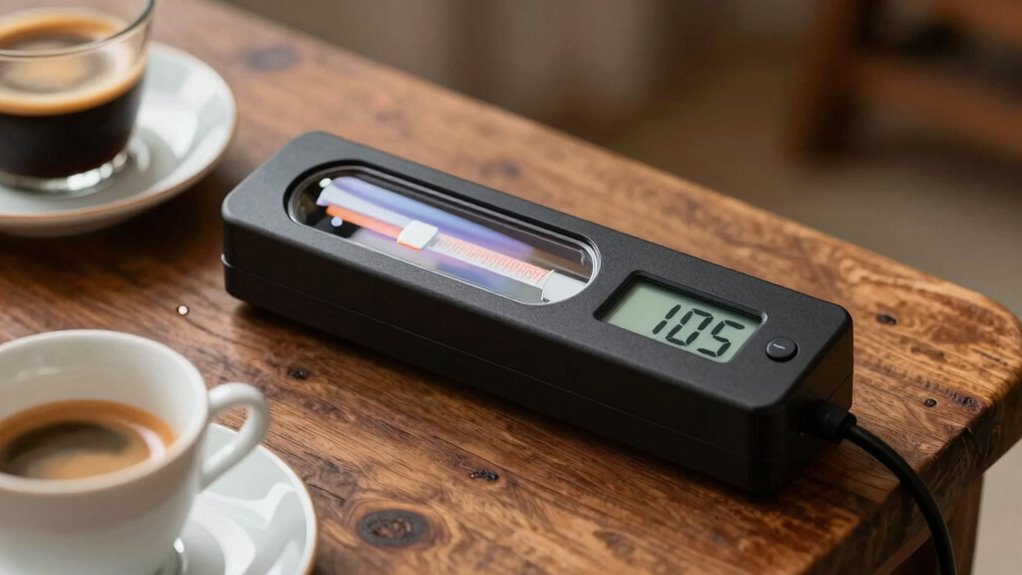
If you’re serious about brewing perfect coffee, a refractometer can be an invaluable tool. It measures the Total Dissolved Solids (TDS) in your brew, giving you real-time data that helps you fine-tune your process. This allows for precise brew calibration, ensuring that every cup hits the desired strength and consistency. With accurate TDS readings, you can replicate successful batches and avoid over- or under-extraction. But beyond just measuring strength, a refractometer can also aid in flavor profiling. By tracking how different parameters influence taste, you can adjust variables like grind size, brew time, and water temperature to craft a profile that aligns with your flavor goals.
However, it’s important to understand what TDS readings can and can’t tell you. TDS primarily indicates the concentration of dissolved solids, which correlates with the strength or body of the coffee. Higher TDS often means a bolder, more intense flavor, while lower readings suggest a lighter cup. But TDS alone doesn’t reveal the complexity, balance, or nuanced flavors in your brew. It doesn’t tell you about acidity, sweetness, or bitterness, which are critical components of flavor profiling. To truly understand how your coffee tastes, you need to consider TDS as just one piece of the puzzle, complemented by sensory evaluation and other brewing data.
Using a refractometer for brew calibration is straightforward once you get familiar with its readings. You’ll want to establish a target TDS based on your preferred style or recipe. As you brew, measure the TDS and adjust variables accordingly, whether that’s changing your grind size or brew time. Over time, these adjustments help you develop consistency and refine your technique, making every cup as good as the last. Keep in mind that environmental factors like water quality and temperature can influence readings, so consistent conditions are key to reliable calibration. Additionally, understanding the role of color accuracy in your brewing process can help you better visualize and evaluate your results.
While refractometers offer valuable insights, they aren’t a magic solution that guarantees perfect coffee. They’re best used as tools for data-driven adjustments rather than definitive judgments of quality. The real art lies in interpreting TDS data alongside your tasting notes. When combined with flavor profiling, TDS measurements can guide you toward a more refined, consistent brewing process, elevating your coffee from good to exceptional.
coffee refractometer for TDS measurement
As an affiliate, we earn on qualifying purchases.
As an affiliate, we earn on qualifying purchases.
Frequently Asked Questions
How Often Should I Calibrate My Coffee Refractometer?
You should calibrate your coffee refractometer regularly, ideally before each use or at least weekly, to guarantee accurate readings. Incorporate proper maintenance tips, like cleaning the prism after each use and storing it properly. Calibration frequency depends on how often you use it and environmental conditions. Staying consistent with calibration helps maintain precision, so make it part of your routine to keep your measurements reliable and your coffee tasting perfect.
Can TDS Readings Predict the Flavor Quality of Coffee?
You can’t rely solely on TDS readings for flavor prediction because they have limitations, like not capturing aroma, body, or mouthfeel. While TDS gives a quick measure of dissolved solids, it doesn’t account for complex flavor nuances. So, don’t assume higher TDS equals better flavor. Use TDS as a tool, but complement it with sensory evaluation to truly assess coffee quality.
Are There Specific Brands of Refractometers Recommended for Coffee?
You should consider coffee-specific refractometer models from trusted brands like Atago, Milwaukee, or Hanna. These brands offer reliable refractometer brands designed for coffee, providing accurate TDS readings essential for brewing consistency. Look for models with features tailored to coffee, such as easy calibration and robust build quality. By choosing reputable coffee-specific models, you guarantee more precise measurements, helping you optimize your brew and achieve the desired flavor profile.
How Does Temperature Affect TDS Measurements in Coffee?
Temperature critically impacts TDS measurements in coffee; fluctuations can cause inaccurate readings. To guarantee accuracy, maintain temperature stability during testing and use proper calibration techniques. Calibrate your refractometer at a consistent temperature, ideally matching your coffee’s serving temperature, to minimize errors. Regularly check calibration with a standard solution, and avoid testing in environments with wide temperature swings. This approach helps you get reliable, precise TDS readings every time.
Can Refractometers Be Used for Cold Brew or Only Hot Coffee?
You can absolutely use a refractometer for cold brew, but keep in mind that temperature stability is key. Cold brew’s lower temperature affects TDS readings, making them less accurate if not properly calibrated. While refractometers are designed for hot coffee, with proper adjustments and temperature compensation, you can get reliable measurements for cold brew too. Just verify your device is suitable for the lower temperatures involved.
Conclusion
While refractometers reveal the richness and robustness of your brew through TDS, they don’t decipher the subtle secrets of flavor or finesse. Remember, they’re a tool—trust your taste buds more than metrics alone. By balancing the brilliance of numbers with your palate’s perceptions, you’ll brew better, brighter cups. So, embrace the science, but savor the sensory. Perfect coffee is about passion as much as precision—because in the end, flavor always steals the show.
Halloween Picks
halloween
As an affiliate, we earn on qualifying purchases.