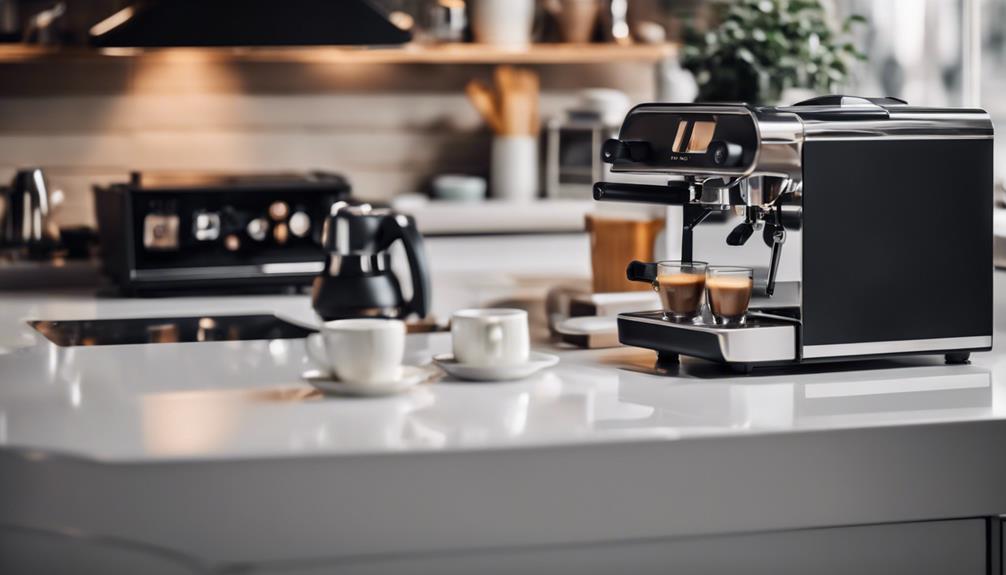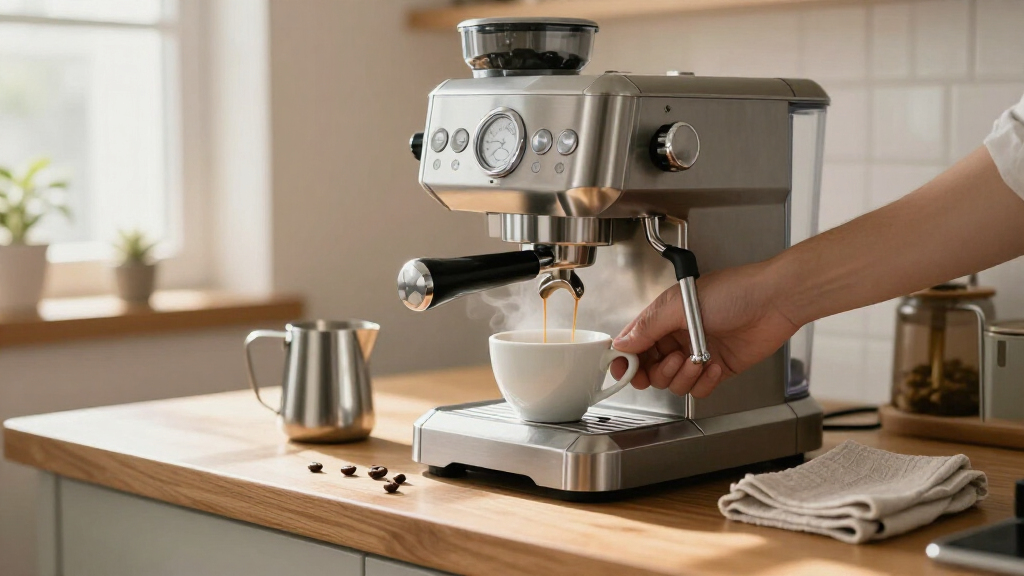
Shopping for espresso machines under $200 means accepting one core tradeoff: you can get real 15-to-20-bar pump pressure and a working steam wand at this price, but usually not build quality, temperature stability, or a built-in grinder — unless you compromise somewhere else. My top pick is the CASABREWS 5418PRO, which pairs fast heating with a genuine steam wand and the most consistent shot extraction in this lineup. The De’Longhi Stilosa stands out as the best beginner buy thanks to a trusted brand and manual control that teaches real technique, while the AMZCHEF with grinder is the rare under-$200 option that eliminates the need for a separate grinder. The biggest split in this category is between true pump machines (20-bar models like the Gevi and SHARDOR) and cheaper 3.5-bar steam-driven units (KEENSTAR, HBN, XIXUBX), which produce milder, less authentic espresso. Keep reading for the full breakdown of all 15 machines and which one fits your kitchen, budget, and milk-drink habits.

Get coffee and tea gear delivered free — and shop member deals
- Fast, free delivery on millions of items
- Access to Prime Big Deal Days deals on October 6–7
- Prime Video, Amazon Music and more included
Complete the kit


Key Takeaways
- True pump machines (15–20 bar) dominated the top of this ranking; the 3.5-bar steam-driven models like the KEENSTAR and HBN landed at the bottom because they produce weaker, less crema-rich shots.
- Only one machine in this lineup — the AMZCHEF with 44 grind settings — includes a built-in grinder, which is why it earns a premium slot despite tradeoffs in heating speed.
- CASABREWS appears three times in this comparison, and the 5418PRO clearly leads the family with faster heating and better steam pressure than the CM5418 and 3700.
- Compact footprints (CHULUX Slim, Neretva, XIXUBX) came at a cost: smaller water reservoirs and less stable temperatures for back-to-back drinks.
- The De’Longhi Stilosa is the only machine here from a legacy espresso brand, and its manual workflow makes it the best learning platform even though it lacks convenience features.





More Details on Our Top Picks
Gevi 20 Bar Compact Espresso Machine with Milk Frother for Home Latte & Cappuccino
This pick makes the most sense for buyers who want café-grade extraction control without stepping over the budget line. The combination of a pressure gauge, NTC temperature control, and pre-infusion is rare at this price — the SHARDOR offers a touchscreen but no way to visually verify extraction pressure, and the Chefman CraftBrew runs a lower 15-bar pump with fewer tuning options. The stainless steel housing also feels more durable than the ABS-and-steel construction of the Atatix. Tradeoffs are real, though: you can’t brew and steam at the same time, and the semi-automatic controls assume you’re willing to learn dialing-in basics. Compared with simpler 3.5-bar machines like the KEENSTAR, this demands more from you but rewards it with genuinely better shots.
Pros:- 20-bar pump with pressure gauge and NTC temperature control for repeatable extraction
- Pre-infusion smooths out uneven grounds for balanced flavor
- Powerful steam wand with removable nozzle for easy cleaning
- Hot water function handles Americanos, tea, and cup warming
Cons:- Semi-automatic operation requires skill to get the best results
- Cannot brew and froth milk simultaneously
Best for: Home baristas who want pressure and temperature feedback to refine their shots over time
Not ideal for: Buyers who want one-touch simplicity — semi-automatic operation and gauge-watching require practice
- Pump Pressure:20 bar
- Material:Stainless steel
- Frother:Steam wand with removable nozzle
- Controls:Semi-automatic
- Special Features:NTC temperature control, pre-infusion, pressure gauge, hot water function
- Warranty:12 months with lifetime tech support
Our verdict“If you want the most controllable espresso under 200 and don’t mind a learning curve, this is the machine to beat.”
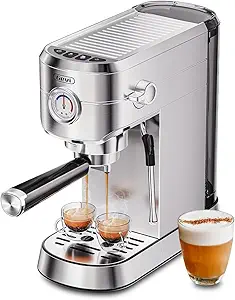
SHARDOR 20 Bar Espresso Machine with Milk Frother and Touchscreen, Stainless Steel
Where the Gevi asks you to interpret a pressure gauge, this option hands you an LED touchscreen with single/double cup presets, three temperature settings, and one-touch descaling — the friendliest interface in this batch. That makes it better suited to first-time espresso owners than the Atatix, which leans on manual extraction modes that assume you know what a good shot looks like. The 45 oz removable tank is generous for the footprint, and the slim 5.12-inch width fits tighter counters than the wider Chefman CraftBrew. The tradeoff: presets simplify things but cap how far you can grow as a barista, and the machine still needs regular descaling to keep that 1350W heater performing. Compared with the De’Longhi Stilosa’s analog dials, this is far less intimidating on day one.
Pros:- Touchscreen with single/double cup presets and three temperature settings
- Powerful 1350W motor and 20-bar pump for rich extraction
- Professional steam wand capable of latte-art foam
- Slim footprint with a large 45 oz removable water tank
Cons:- Requires regular descaling to maintain performance
- Preset-driven design limits room to grow beyond guided settings
Best for: First-time espresso buyers who want guided presets instead of guesswork
Not ideal for: Tinkerers who want manual pressure or extraction control beyond preset temperature options
- Pressure:20 bar
- Wattage:1350 watts
- Water Tank Capacity:45 oz
- Filter Size:51mm reusable
- Operation Mode:Semi-Automatic
- Dimensions:8.14″D x 5.12″W x 15.27″H
- Auto Shutoff:After 15 minutes
Our verdict“The easiest on-ramp to home espresso in this lineup — buy it if you value guided simplicity over manual control.”
Atatix Espresso Machine with Milk Frother, 20-Bar Pressure
This model stands out for flexible extraction at a lower price point — automatic single and double shots plus a manual mode that runs up to 102 seconds for those who want to experiment. That manual option gives it more room to grow than the SHARDOR, but less feedback than the Gevi’s pressure gauge, so you’re adjusting by taste rather than by numbers. A 30-second preheat is quick for morning routines, and the detachable tank, drip tray, and included portafilter, funnel, and tamper mean there’s nothing extra to buy — a real advantage over barebones picks like the KEENSTAR. The compromises are typical of value machines: ABS-heavy construction rather than full stainless, an unspecified tank capacity that may mean more frequent refills, and manual mode requires patience to master.
Pros:- Automatic and manual extraction modes in one machine
- Fast 30-second preheat for quick morning drinks
- Complete accessory kit — portafilter, funnel, and scoop/tamper included
- Detachable tank and drip tray simplify cleanup
Cons:- Manual extraction requires trial and error to dial in brew time
- Unspecified water tank capacity and ABS-heavy build compared with stainless rivals
Best for: Budget-conscious buyers who want accessories included and room to experiment with manual shots
Not ideal for: Anyone who wants full stainless durability or a large, clearly specified water tank
- Pressure:20 bar
- Temperature Control:90–96°C
- Preheat Time:30 seconds
- Automatic Single Shot:25–40 g in 28 seconds
- Automatic Double Shot:55–85 g in 42 seconds
- Manual Extraction:Up to 102 seconds; 180–350 g
- Materials:ABS and stainless steel
Our verdict“The smart pick if you want 20-bar performance and manual experimentation without paying for premium materials.”
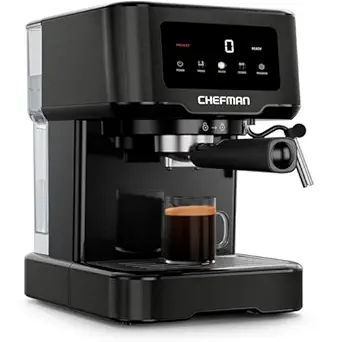
Chefman CraftBrew Espresso Machine with Steam Wand, 15-Bar Pump, and 1.5 L Reservoir
This option stands out for its 1.5-liter reservoir — larger than anything else in this batch — which means fewer refills when you’re steaming milk for back-to-back lattes. The built-in wand and adjustable shot volume via touch controls make it a straightforward path from espresso to cappuccino, and the stainless black finish looks at home in a modern kitchen. Compared with the Gevi, you give up the pressure gauge and pre-infusion; compared with the SHARDOR, its footprint is noticeably wider at nearly 9 inches. The 15-bar pump is lower than the 20-bar competition, though in practice 15 bar is plenty for proper extraction — the real limitation is manual steaming, which takes practice, and the grounds-only design, since the AMZCHEF grinds beans built-in for similar money.
Pros:- Large 1.5 L removable reservoir minimizes refills
- Touch controls adjust shot volume for single or double drinks
- Built-in steam wand handles cappuccino and latte milk
- Classy stainless black finish at a mid-tier price
Cons:- Manual steaming with the wand takes practice to master
- Ground coffee only — no integrated grinder like the AMZCHEF
Best for: Latte and cappuccino drinkers who brew multiple milk drinks a day and hate refilling tanks
Not ideal for: Whole-bean purists who want integrated grinding, and tight counters under 9 inches wide
- Operation Mode:Semi-automatic
- Pump Pressure:15 bar
- Wattage:1350 watts
- Coffee Input:Ground coffee
- Water Reservoir:1.5 liters
- Dimensions:10.8 × 8.9 × 11.9 inches (D × W × H)
- Special Feature:Built-in steam wand
Our verdict“Choose this if milk drinks are your priority and tank capacity matters more than extraction gadgets.”
AMZCHEF Espresso Machine with Grinder, Temperature Control, 44 Grind Settings
This is the only machine in the entire roundup that grinds and brews in one unit, and that changes the math completely — every other pick here, from the Gevi to the De’Longhi Stilosa, assumes you already own a grinder or buy pre-ground coffee. With 44 grind settings and precision temperature control from 190°F to 201°F, it offers bean-to-cup freshness that pre-ground machines simply can’t match. The 60 oz tank also outclasses the Chefman’s 1.5 L reservoir. The flip side is complexity: compared with the preset-driven SHARDOR, 44 grind settings plus temperature tuning is genuinely overwhelming for newcomers, and the footprint is the largest in this batch — plan counter space before buying. If you’ve outgrown entry-level machines but can’t justify a full café setup, this is the upgrade path.
Pros:- Integrated grinder with 44 settings — true bean-to-cup convenience
- Precision temperature control (190°F–201°F) to match different roasts
- Powerful steam wand produces microfoam for latte art
- 60 oz water tank and one-touch cold brew mode add versatility
Cons:- Steep learning curve with 44 grind and temperature variables
- Large footprint takes up significant counter space
Best for: Intermediate home baristas who want fresh-ground espresso without buying a separate grinder
Not ideal for: Complete beginners who’d be paralyzed by 44 grind settings, or kitchens with limited counter space
- Temperature Range:190°F–201°F
- Grind Settings:44
- Water Tank Capacity:60 oz
- Steam Wand:8mm stainless steel
- Heating Power:1350W
- Display:IMD HD touch screen
Our verdict“The closest thing to a full bean-to-cup setup under 200 — worth it only if you’ll actually use the control it offers.”
CASABREWS 5418PRO Espresso Machine with Fast Heating and Steam Wand
Most budget espresso machines leave you waiting between pulling a shot and steaming milk, which is where the CASABREWS 5418PRO separates itself. Its Flashheat technology reaches brewing temperature in under five seconds and shifts to steam in about three — a genuine time advantage over the Neretva 20-Bar, which relies on a conventional 1350W boiler and its typical warm-up rhythm. The PID temperature control paired with a pressure gauge gives you visual feedback most sub-$200 machines skip, so dialing in a shot is less guesswork. The tradeoff: there’s no cup warmer (the Neretva has one), and ground-coffee-only operation rules out pods entirely. Compared with the original CASABREWS CM5418, this model is clearly aimed at buyers who value temperature stability and speed over convenience features.
Pros:- Heats to brewing temperature in under 5 seconds
- Switches between brewing and steaming in about 3 seconds
- PID temperature control and pressure gauge support more controlled extraction
- Compact stainless steel design for smaller kitchens
Cons:- Not compatible with espresso pods
- No built-in cup warmer
Best for: Impatient daily drinkers who want near-instant shots and temperature feedback without a long warm-up ritual
Not ideal for: Pod loyalists and anyone who wants warm cups waiting — it supports ground coffee only and skips a cup warmer
- Model:5418PRO
- Machine type:Semi-automatic espresso machine
- Heating system:Flashheat technology
- Time to brewing temperature:Under 5 seconds
- Pump pressure:20 bar
- Temperature control:PID
- Features:Pre-infusion, pressure gauge, steam wand
- Coffee compatibility:Pre-ground and freshly ground coffee; no pods
Our verdict“This pick makes the most sense for buyers who hate waiting and want readouts that make dialing in shots easier.”
XIXUBX Compact Espresso & Cappuccino Machine with Steam Wand, 3.5 Bar
At 3.3 pounds and roughly 6 inches wide, this little XIXUBX is less an espresso machine and more a portable coffee station — and that’s exactly its appeal. Unlike the De’Longhi Stilosa or the CHULUX Slim, this one fits in an RV cabinet, a dorm shelf, or an office drawer, and its one-knob mechanical control means there are no fragile electronics to fail on the road. The honest catch is the 3.5-bar pressure: true espresso needs roughly 9 bars, so what you get is closer to strong moka-style coffee. If you care about dense crema and balanced extraction, the XIXUBX 20-bar silver model below is the better sibling. But if your priority is microfoam lattes in a tiny footprint with zero fuss, this stands out in a way the bigger machines can’t match.
Pros:- Ultra-compact and lightweight, ideal for small spaces and travel
- Simple one-knob control with no fragile electronics
- Steam wand with cool-touch grip produces silky microfoam
- Safety lock and BPA-free Tritan cup make it family-friendly
Cons:- Low 3.5-bar pressure cannot produce true espresso-level extraction
- Mechanical design lacks programmable settings or advanced features
Best for: Dorm residents, RV travelers, and office-dwellers who want milk drinks in a tiny footprint
Not ideal for: Espresso purists — 3.5 bars cannot produce true 9-bar extraction, so shots come out milder
- Pressure:3.5 bar
- Power:800W
- Dimensions:8.3″D x 6″W x 11.8″H
- Weight:3.3 lbs
- Controls:One-knob (Brew, Steam, Off)
- Cup Material:BPA-free Tritan
- Warranty:1 year
Our verdict“Buy this if portability and simplicity matter more to you than authentic espresso strength.”
Neretva 20-Bar Espresso Machine, Compact Espresso Coffee Maker
The Neretva 20-Bar is the pick here for buyers who want shots that actually taste like café espresso. Its combination of 20-bar pressure, low-pressure pre-infusion, and 198°F temperature control produces a fuller, more balanced extraction than the 3.5-bar XIXUBX could ever manage, and the pressurized reusable filters forgive uneven grinds — a real benefit if you don’t own a burr grinder like the AMZCHEF with built-in grinding offers. It also includes a cup warmer, which the faster CASABREWS 5418PRO omits. The downsides are real, though: at 17 pounds it’s the heavyweight of this group, and semi-automatic operation demands practice before your shots stop tasting sour or bitter. Compared with the CHULUX Slim, you trade a narrower footprint for a more substantial, café-oriented build.
Pros:- 20-bar pressure helps produce café-style espresso extraction
- Precise temperature control and pre-infusion support balanced brewing
- Powerful steam wand enables milk frothing and latte art
- Includes cup warmer and reusable pressurized filters
Cons:- Semi-automatic operation may require practice for new users
- No built-in grinder — ground coffee only
- 17-pound weight is heavy for a compact espresso machine
Best for: Home baristas prioritizing shot quality who will tolerate a heavier machine and a learning curve
Not ideal for: Absolute beginners who want push-button drinks, and anyone with limited counter strength or space given its 17-pound build
- Operation mode:Semi-automatic
- Output pressure:20 bar
- Wattage:1350 watts
- Water tank:1.3L removable
- Temperature:198°F precise water temperature
- Coffee input:Ground
- Dimensions:11 in D x 12 in W x 9.1 in H
- Weight:17 pounds
Our verdict“This model is better suited to drinkers who judge a machine by its shots and accept some practice to get there.”
CHULUX Slim Espresso Machine with Milk Frother for Home Cappuccino
The CHULUX Slim solves the classic small-kitchen dilemma: full-size espresso capability in a 5.5-inch-wide body. Where the Neretva feels like a small tank at 17 pounds, this machine squeezes in a 20-bar pump, pressure gauge, pre-infusion, and a 40 oz tank without hogging counter space. That tank is generous for the footprint — you’ll pull many shots before refilling, which the smaller XVIXUBX travel units can’t claim. The 30-second heat-up sits between the CASABREWS 5418PRO’s near-instant Flashheat and conventional boiler machines, so impatient drinkers have a faster option elsewhere. Real tradeoffs: it’s ground-coffee only, milk frothing is fully manual, and the slim build limits high-volume entertaining. For one or two milk-drink drinkers a day, though, the balance here is hard to beat.
Pros:- Fast 1350W heating with 20-bar pressure for rich espresso and crema
- Compact 5.5-inch-wide design saves counter space
- Steam wand creates creamy microfoam for lattes and cappuccinos
- Pressure gauge, pre-infusion, 40 oz tank, and auto shut-off add everyday convenience
Cons:- Uses ground coffee only, less convenient than pod machines
- Manual espresso and milk frothing may require practice for beginners
- Compact design limits high-volume use
Best for: Apartment dwellers with limited counter space who still want gauge-guided espresso and microfoam
Not ideal for: Households brewing for a crowd — the compact design and manual frothing slow down high-volume use
- Pump pressure:20 bar
- Power:1350 watts
- Heating time:30 seconds
- Water tank capacity:40 oz
- Width:5.5 inches
- Pressure gauge:Yes
- Auto shut-off:25 minutes
- Coffee type:Ground coffee
Our verdict“This option stands out for small-space buyers who refuse to give up pressure gauges and proper microfoam.”
XIXUBX Espresso Machine with Milk Frother for Cappuccino & Latte, Silver
What makes this silver XIXUBX the friendliest entry point is that it arrives complete with a stainless steel frothing pitcher — the one accessory most beginners forget, and something neither the CHULUX Slim nor the Neretva includes. Add a 360° rotating steam wand that’s easier to angle than fixed wands, a visible pressure gauge that teaches you what a good shot looks like, and a 42 oz tank good for ten-plus cups, and you have a low-stress on-ramp to latte making. Its 3.5-bar sibling is simpler still, but this model’s 20-bar system produces genuinely richer crema and fuller shots. The compromises: it’s beginner-focused, so tinkerers who want temperature control or programmable settings — like the CASABREWS 5418PRO’s PID — will outgrow it, and the 20-bar rating is more marketing muscle than extraction necessity.
Pros:- 20-bar pressure helps produce rich crema and café-style espresso
- Includes a stainless steel frothing pitcher in the box
- Large 42 oz tank reduces frequent refills
- 360° rotating steam wand and visible pressure gauge are beginner-friendly
Cons:- Beginner-focused feature set lacks advanced customization
- 20-bar pump is more pressure than traditional espresso requires
- Compact design won’t satisfy buyers wanting commercial-style machines
Best for: First-time espresso buyers who want everything in the box for cappuccinos and lattes from day one
Not ideal for: Experienced tinkerers — no programmable settings or fine temperature control to grow into
- Pressure:20 bar
- Water tank capacity:42 oz
- Cups per refill:10+ cups
- Steam wand:360° rotating, detachable
- Material:Stainless steel
- Included accessories:Milk frothing pitcher
- Warranty:1 year
Our verdict“If you’re starting from zero and want to pour your first latte the day the box arrives, this kit covers it.”
KEENSTAR 3.5-Bar Espresso Machine, 4-Cup
This option stands out as the most bare-bones entry point in the lineup, and that is exactly its appeal. The single control knob and four-cup glass carafe make it approachable for anyone intimidated by portafilters and tamping — you fill, twist, and wait about two minutes. Compared with the CASABREWS CM5418, the KEENSTAR gives up real espresso pressure entirely; 3.5 bar produces something closer to strong moka-pot coffee than true espresso, which matters if crema and syrupy shots are the goal. The steam wand does froth milk, though expect a learning curve and a mandatory rinse after every use. For the price of admission, this model makes the most sense for someone who wants milky coffee drinks occasionally without investing in technique.
Pros:- Brews up to four cups in about two minutes
- Steam wand handles basic milk frothing for lattes and cappuccinos
- Very compact footprint at 4.7 pounds
- One-knob operation with a useful pause function
Cons:- 3.5 bar pressure falls well short of true espresso extraction
- Steam wand must be cleaned after every single use
- Accessories are not dishwasher-safe
Best for: Dorm residents or first-time buyers who want simple cappuccino-style drinks with almost no learning curve
Not ideal for: Espresso purists — 3.5 bar pressure cannot produce authentic crema-topped shots like the 20-bar CASABREWS models can
- Pressure:3.5 bar
- Power:800 W
- Capacity:1–4 cups (up to 240 ml)
- Brewing time:About 2 minutes
- Steam wand heat-up:About 40 seconds
- Dimensions:13.1 × 7.7 × 10 in
- Weight:4.7 lb
Our verdict“A reasonable starter machine for casual milky coffee, but anyone chasing real espresso character should step up to a 20-bar model.”
HBN Espresso Machine, 3.5 Bar Cappuccino and Latte Maker
Where the KEENSTAR feels purely like a starter appliance, the HBN leans into durability and cleanability, which is why it fits better in a shared office or break room. The stainless-steel body, removable funnel, washable drip tray, and carafe with a protective steel ring all point toward machines that get handled by many people rather than one careful owner. Like the KEENSTAR, it runs on 3.5 bar and 800 watts, so the extraction ceiling is the same — expect smooth, mild coffee rather than the punchier shots a De’Longhi Stilosa or 20-bar machine delivers. The one-knob control keeps the learning curve nearly flat, and HBN recommends medium-coarse grounds, which are easier to buy pre-ground. This pick makes the most sense for small teams rather than espresso hobbyists.
Pros:- Stainless-steel construction with a protective carafe ring stands up to shared use
- Removable funnel and drip tray simplify cleanup
- Compact size fits dorms, desks, and small counters
- One-knob operation requires no training
Cons:- 3.5 bar pressure produces milder coffee than 15–20 bar competitors
- 240 ml capacity means small servings only
- Best results require medium-coarse grounds, limiting coffee choices
Best for: Office break rooms or shared spaces where multiple people need easy, low-maintenance coffee
Not ideal for: Buyers who want café-style espresso — the low pressure and small 240 ml capacity limit both quality and volume
- Pressure:3.5 bar
- Wattage:800 W
- Capacity:240 ml (2–4 cups)
- Material:Stainless steel
- Filter size:#4
- Dimensions:12.91″D × 7.28″W × 13.58″H
- Weight:4.1 lb
Our verdict“The most office-friendly budget option here, ideal for shared spaces where simplicity beats espresso quality.”
CASABREWS CM5418 Compact Espresso Machine with Milk Frothing Wand
The CM5418 earns its spot with one feature almost nothing else at this price includes: a built-in pressure gauge. That single dial turns every shot into feedback — if the needle reads low, the grind is too coarse or the tamp too loose, and the user knows exactly what to adjust. Compared with its sibling, the CASABREWS 3700 Essential, this model trades a slightly smaller 34 oz tank for that gauge, which is the smarter trade for anyone serious about improving. The 20-bar pump and 1350 W heater put it in a completely different class from the 3.5-bar KEENSTAR and HBN, producing genuine crema-topped shots. The main workflow annoyance: after steaming milk, the machine needs to cool down before brewing, so latte makers should steam first or build patience into their routine.
Pros:- Pressure gauge provides actionable feedback on every shot
- 20-bar pump delivers true espresso extraction with crema
- Removable 34 oz tank refills without moving the machine
- Brushed stainless finish looks pricier than it is
Cons:- Must cool down after steaming before brewing espresso
- Low pressure readings require users to troubleshoot grind and tamp themselves
- No built-in grinder means a separate purchase for fresh grounds
Best for: Beginners who want to develop real barista skills and understand how grind and tamp affect extraction
Not ideal for: Impatient morning brewers — the required cooldown between frothing and brewing adds time to every milk drink
- Machine type:Semi-automatic espresso machine
- Pump pressure:20 bar
- Wattage:1350 W
- Water tank:34 oz, removable
- Milk frothing:Steam wand
- Material:Brushed stainless steel
- Included:Portafilter, one- and two-cup filters, tamper with spoon
Our verdict“The best sub-$200 machine for learning cause and effect in espresso, thanks to its pressure gauge and genuine 20-bar extraction.”
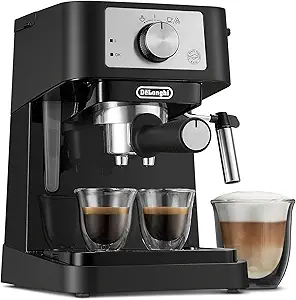
De’Longhi Stilosa Compact Manual Espresso Machine with Milk Frother
The Stilosa is the brand-reliability pick — De’Longhi’s established parts support and reputation give it an edge in confidence over newer names like XIXUBX or Atatix at similar prices. Its stainless steel boiler and included single- and double-shot filters make it a genuine manual espresso machine rather than a moka-style brewer, putting it above the KEENSTAR and HBN in extraction quality. The two-level cup holder is a small touch with real payoff, fitting both espresso demitasses and taller cappuccino mugs without awkward balancing. Compared with the CASABREWS CM5418, it lacks the pressure gauge and feedback loop, so progress depends on taste alone. Everything is manual — grinding, dosing, tamping, frothing — which is either the appeal or the chore depending on the buyer.
Pros:- Established brand with reliable parts and service availability
- Stainless steel boiler supports proper espresso extraction
- Single- and double-shot filters included
- Two-level cup holder fits espresso cups and taller mugs
Cons:- Fully manual operation demands time and technique every morning
- No automatic milk frothing — the wand requires practice
- No pressure gauge or extraction feedback
Best for: First-time espresso buyers who value an established brand, replaceable parts, and a proven manual workflow
Not ideal for: Anyone wanting push-button convenience — every step here is hands-on with no automation
- Type:Manual espresso machine
- Boiler:Stainless steel
- Milk frother:Manual steam wand
- Filters included:Single- and double-shot
- Cup holder:Two-level, adjustable
- Design:Compact countertop footprint
Our verdict“The safest brand-name entry into genuine manual espresso, best for buyers who accept a learning curve for better coffee.”
CASABREWS 3700 Essential Stainless Steel Espresso Machine with Steam Wand
This model takes the top spot in this batch because it balances capability, capacity, and simplicity better than anything around it. The 43.9 oz removable tank is the largest in this group — nearly double the CASABREWS CM5418’s — meaning fewer refills when making drinks for two. The 20-bar pump paired with 1350 W delivers real espresso extraction and a steam wand capable of microfoam suitable for latte art, something the 3.5-bar HBN and KEENSTAR simply cannot do. The tradeoff against its sibling CM5418 is the absence of a pressure gauge; buyers trade shot-by-shot feedback for capacity and a slightly simpler experience. Ground-coffee-only input and a manual wand mean there is still technique involved, but for a household upgrading from pod machines or moka pots, this is the most complete package under the price cap.
Pros:- Large 43.9 oz removable tank minimizes refills
- 20-bar pump produces rich, crema-topped extraction
- Steam wand creates microfoam fine enough for latte art
- Includes portafilter, filters, and tamper so setup is complete out of the box
Cons:- No pressure gauge to verify extraction quality
- No built-in grinder — ground coffee only
- Manual frothing and wand cleaning take practice to master
Best for: Households of one or two who want genuine espresso and latte-quality microfoam with minimal fuss
Not ideal for: Tinkerers who want extraction data — the lack of a pressure gauge makes the CM5418 the better diagnostic tool
- Model:3700 Essential
- Type:Semi-automatic espresso machine
- Pressure:20 bar
- Power:1350 W
- Water tank:43.9 oz, removable
- Coffee input:Ground coffee
- Milk system:Steam wand
- Finish:Brushed stainless steel, silver
- Included:Portafilter, one- and two-cup filters, tamper with spoon
Our verdict“The strongest all-around pick under $200, combining the largest tank here with true 20-bar espresso — ideal for daily milk-drink makers who skip the diagnostics.”
How We Picked
I evaluated each machine against what actually determines satisfaction at this price: pressure system (true 15–20 bar pump vs. 3.5-bar steam-driven), milk steaming capability (real steam wand vs. frother wand), heat-up time and temperature consistency, build quality relative to price, and daily usability — reservoir size, cleanup, counter footprint, and how forgiving the machine is for a first-time user. Machines with a genuine pump and steam wand ranked higher because they produce authentic espresso and café-style microfoam, the two things buyers at this price most often regret compromising on.
The ranking also weighs versatility and upgrade value. A machine like the AMZCHEF, which includes a conical grinder, scores highly for buyers who own no coffee gear at all, while a bare-bones manual machine like the Stilosa earns its slot for teaching transferable technique. Steam-driven 3.5-bar models were not disqualified — some buyers genuinely want a cheap latte maker — but they rank lower because their output is closer to strong drip coffee than espresso, and that difference is the single most common source of disappointment in this category.
Factors to Consider When Choosing Espresso Machines Under 200
Before picking a specific machine, it helps to understand what actually separates a satisfying under-$200 espresso experience from a disappointing one. These are the factors that shaped my ranking and the mistakes I see buyers make most often.Pump Pressure vs. Steam Pressure — The Line That Matters Most
The single biggest divide in this price bracket is between pump-driven machines (15–20 bar) and steam-driven machines (3.5 bar). A pump machine forces water through finely ground coffee at high pressure, producing the thick, crema-topped shot most people picture when they think of espresso. Steam-driven machines rely on steam pressure alone, which maxes out far lower and yields a milder, thinner extraction closer to moka pot coffee. Buyers frequently purchase a 3.5-bar model expecting café results and end up disappointed. If authentic espresso flavor is the goal, a pump machine is non-negotiable at any price point. Steam-driven units only make sense for casual milk-coffee drinkers who prioritize low cost and simplicity over intensity.
Do You Already Own a Grinder?
This question quietly determines your real budget. Espresso demands a fine, consistent grind, and pre-ground supermarket coffee will produce sour or watery shots no matter how good the machine is. If you own no grinder, you either buy one separately (a capable entry-level burr grinder often costs as much as the machine itself) or choose an all-in-one unit like the AMZCHEF with its built-in conical burr grinder. The tradeoff is that combo machines under $200 usually compromise on heating power and steam performance to fit everything into one chassis. Buyers who already own a quality grinder should skip combos entirely and put their whole budget into a stronger pump machine with a better steam wand.
Steam Wand Quality and Your Milk-Drink Habits
If you drink straight espresso, the steam wand barely matters — but if lattes and cappuccinos are the point, it matters more than the pump itself. A real steam wand (found on the De’Longhi Stilosa, CASABREWS models, and Chefman) can texture milk into glossy microfoam for latte art. A frother wand, common on cheaper units like the XIXUBX and HBN, injects air more crudely and produces bubbly foam rather than microfoam. Some compact machines also struggle to steam and brew simultaneously, which slows down making two drinks. Match the wand type to how often you make milk drinks; daily latte drinkers will regret a weak frother within a week.
Counter Space and Reservoir Size
Under-$200 machines skew compact, but compactness has hidden costs. Slim models like the CHULUX and small units like the Neretva save counter space but shrink the water reservoir, meaning constant refills if you make multiple drinks daily. Smaller boilers also lose temperature between shots, so back-to-back drinks suffer. Before buying, measure your counter and check the reservoir capacity — anything under about 1.2 liters means refilling more than once a day for a two-person household. Also check height clearance: machines with a cup warmer or tall portafilter need more vertical space than the spec sheet suggests.
Manual vs. Touchscreen Controls
This category has split into two philosophies: touchscreen convenience (SHARDOR) versus manual lever control (De’Longhi Stilosa). Touchscreens preset shot volumes and simplify the morning routine, which suits buyers who want repeatable results with no learning curve. Manual machines give you direct control over shot length, which rewards skill development and produces better shots once you’ve practiced — but the first week can be frustrating. Neither approach is objectively better; the mistake is mismatching the machine to your patience level. If you want push-button consistency, go touchscreen; if you want to grow as a home barista, go manual.
When to Skip This Category Entirely
Honesty time: some buyers should not be shopping under $200 at all. If you drink three or more milk drinks a day, live with a partner who does too, or care about latte art, a machine in the $300–600 range will deliver noticeably better temperature stability and steam power. Under $200 also means more plastic components, shorter expected lifespans, and weaker warranty support from lesser-known brands. The buyers this category serves well are beginners testing the hobby, occasional espresso drinkers, gift buyers, and anyone in a small kitchen or dorm. If you already know espresso is a daily ritual, it is usually cheaper to buy one mid-range machine than to outgrow a budget one in a year.
Frequently Asked Questions
Is a 20-bar machine really better than a 15-bar machine?
Marketing pressure numbers matter far less than buyers assume. Actual espresso extraction happens at roughly 9 bars — the 15 or 20 bar figure describes the pump’s maximum capability, not what reaches your coffee. A well-built 15-bar machine like the Chefman CraftBrew or De’Longhi Stilosa will outperform a poorly made 20-bar unit because shot quality depends on temperature stability, basket quality, and grind consistency more than peak pressure. Treat the bar rating as a signal that the machine uses a true pump rather than steam pressure, and nothing more. That distinction — pump vs. steam — is the one worth shopping on.
Should I buy the AMZCHEF with a built-in grinder or a separate machine plus grinder?
It depends entirely on what you already own. If you have no coffee equipment at all, the AMZCHEF combo is the most economical path to real espresso, because a standalone burr grinder capable of espresso-fine grinding often costs as much as an entire budget machine. Its 44 grind settings also let you dial in shots properly, which pre-ground coffee never allows. However, if you already own a decent grinder, a dedicated machine like the CASABREWS 5418PRO will deliver better steaming power and heat-up speed for the same money, since it isn’t splitting its cost between two components. The combo route trades peak performance for convenience and completeness.
Can I make real lattes with a 3.5-bar machine like the KEENSTAR or HBN?
You can make a milk-based coffee drink, but not a café-style latte. The 3.5-bar steam-driven machines extract coffee more gently, producing a lighter, less concentrated shot that gets lost in milk. Their frothing wands also aerate milk rather than texturing it, so you get airy foam instead of the silky microfoam that defines a proper latte. For buyers who enjoy mild, milky coffee and want a low-cost, low-fuss appliance, these machines are perfectly serviceable. But if the intense, balanced flavor of espresso is what you’re chasing, spending a little more on a pump machine is the difference between a coffee-flavored milk drink and actual espresso.
Which of the three CASABREWS models should I choose?
The 5418PRO is the clear leader of the family thanks to faster heat-up and stronger steam performance, making it the right choice for daily milk-drink makers. The CM5418 is the compact value option — it suits single users and small counters, but its smaller capacity shows when making back-to-back drinks. The 3700 Essential sits in between with a stainless build and solid steam wand, aimed at buyers who want a more durable-feeling machine without the PRO’s faster heating. If budget allows only a small difference between them, the 5418PRO’s heating speed is the upgrade you’ll notice every single morning.
Are touchscreen machines like the SHARDOR more reliable than manual ones?
Touchscreens add convenience but also add a failure point that manual machines don’t have. A manual lever machine like the De’Longhi Stilosa has almost nothing electronic to break, which is partly why legacy brands build them this way and why they tend to last years of daily use. The SHARDOR’s touchscreen gives you preset shot volumes and a more modern kitchen aesthetic, which genuinely improves day-to-day consistency for beginners. The tradeoff is that any display or sensor issue typically means replacing the whole unit, since budget-brand repair support is limited. If longevity is your top priority, simpler mechanical designs win; if repeatability and ease of use win, the touchscreen earns its place.
Conclusion
The right pick here depends less on specs and more on what kind of espresso drinker you are. For the best overall choice, the CASABREWS 5418PRO balances fast heating, strong steam, and consistent extraction better than anything else in this lineup. The best value goes to the De’Longhi Stilosa, a trusted-brand manual machine that costs less than most rivals while teaching skills that transfer to any future upgrade. For beginners, the SHARDOR with touchscreen removes the learning curve with preset shots and guided controls. The best premium pick is the AMZCHEF with built-in grinder — the only complete espresso station in this price class, ideal for buyers starting from zero equipment. For small kitchens, the CHULUX Slim fits where nothing else will, while casual milk-coffee drinkers on the tightest budget can fall back to the KEENSTAR with realistic expectations. Whatever you choose, remember the lesson this comparison made clear: pump pressure and a real steam wand are the two features worth protecting at this price, and everything else is negotiable.
Fall Picks
fall essentials
As an affiliate, we earn on qualifying purchases.