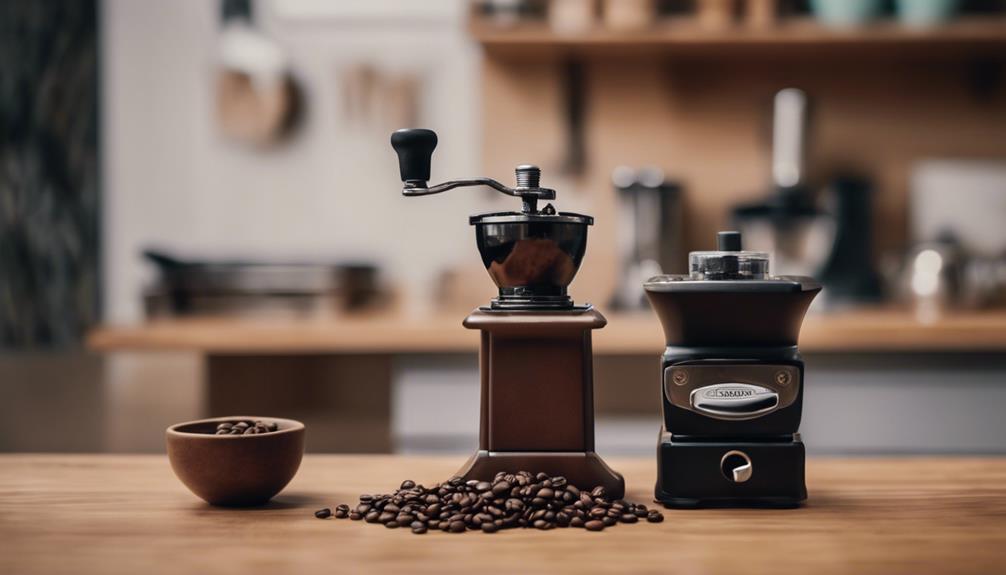

The best hand grinder for espresso is the Timemore C5 ESP PRO, which pairs a 42mm stainless steel burr with 50 stepped adjustments tight enough for dialing in espresso — something most budget hand grinders simply can’t do. Close behind are the KINGrinder K6, a premium pick with excellent grind uniformity, and the KINGrinder P2, the standout value choice for anyone grinding espresso on a tight budget. The core tradeoff in this category is between cheap ceramic-burr grinders that struggle to reach a true espresso-fine grind and steel-burr models that cost more but hold their setting under the pressure espresso demands. Capacity, adjustability granularity, and grinding effort also separate the field more than marketing suggests. Keep reading for the full breakdown of all 15 grinders and which one fits your setup.

Get coffee and tea gear delivered free with Prime
- Fast, free delivery on millions of items
- Prime Video, Amazon Music and more included
- Member-only deals all year
Complete the kit


Key Takeaways
- Steel conical burrs separated the top tier from the rest: the Timemore C5 ESP PRO, KINGrinder K6, and KINGrinder P2 reached true espresso fineness with far fewer fines and less grind drift than ceramic-burr models.
- Adjustment granularity mattered more than adjustment range — 40+ external settings (CIRCLE JOY, CEVING Mini, YQE) only help for espresso if the steps are fine enough; the C5 ESP PRO’s 50 settings are spaced with espresso in mind.
- Ceramic burr grinders like the JavaPresse and Alpaca Ventures can technically produce an espresso-fine grind, but expect long grind times, inconsistent particle sizes, and burr wobble that hurt shot-to-shot repeatability.
- Large 60g-capacity options like the CEVING 60g models trade portability for batch grinding — useful for multiple shots, but the extra size makes daily single-dose espresso grinding more cumbersome.
- The 15 grinders fall into three clear price-performance bands: precision espresso-capable (Timemore, KINGrinder), versatile all-brew-method grinders (NewlukPro M6, Chestnut C2S), and budget generalists best reserved for coarser brew methods.
| Hamiladuo Manual Coffee Grinder with Stainless Steel Conical Burr, Adjustable Grind, 20g Capacity |  | Best for Durable Travel Use | Burr type: Hexagonal conical | Burr material: Stainless steel | Burr hardness: 55–58 HRC | VIEW ON AMAZON | See Our Full Breakdown |
| NewlukPro M6 Manual Coffee Grinder for Espresso, Pour Over, French Press, and Moka |  | Best Value for Multi-Brew Use | Model: M6 | Burr type: Conical | Burr material: SUS 420 stainless steel | VIEW ON AMAZON | See Our Full Breakdown |
| JavaPresse Manual Stainless Steel Coffee Grinder with Adjustable Ceramic Burr |  | Best for Quiet, Cord-Free Brewing | Grinder type: Manual, hand-crank | Burr type: Conical | Burr material: Ceramic | VIEW ON AMAZON | See Our Full Breakdown |
| CIRCLE JOY Mini Manual Coffee Grinder with 40 Adjustable Settings |  | Best for Fine Adjustment Range | Grind settings: 40 external settings | Burr material: Ceramic | Body material: Stainless steel | VIEW ON AMAZON | See Our Full Breakdown |
| CEVING 60g Large Capacity Manual Coffee Grinder |  | Best for Larger Batches | Capacity: 60g | Grind settings: 40 external click settings | Adjustment increment: 0.05mm per click | VIEW ON AMAZON | See Our Full Breakdown |
| KINGrinder P2 Lightweight Manual Coffee Grinder |  | Best Compact Travel Pick | Body material: ABS | Burr material: SUS420 stainless steel | Weight: 330 g | VIEW ON AMAZON | See Our Full Breakdown |
| Alpaca Ventures Manual Coffee Grinder with Adjustable Conical Burr | 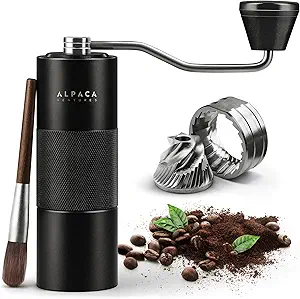 | Best for Espresso Range on the Go | Capacity: 1 oz (28 g) per fill | Body material: Aluminum alloy | Dimensions: 6.8 in tall × 1.9 in wide | VIEW ON AMAZON | See Our Full Breakdown |
| CEVING Mini Manual Coffee Grinder with 40 Adjustable Settings, Black | 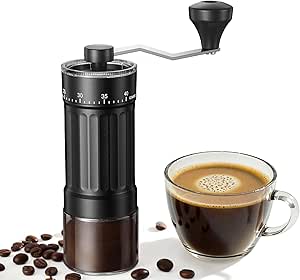 | Best Ceramic-Burr Compact Option | Brand: CEVING | Model: MCG-01 | Grind settings: 40 external adjustments | VIEW ON AMAZON | See Our Full Breakdown |
| CEVING 60g Large Capacity Manual Coffee Grinder, Black |  | Best for Larger Doses | Brand: CEVING | Model: MCG-02 | Capacity: 60 g | VIEW ON AMAZON | See Our Full Breakdown |
| Timemore C5 ESP PRO Manual Coffee Grinder, 42mm Stainless Steel Burr, 50 Adjustable Settings, All-Metal, 30g Capacity |  | Best for Precise Espresso Dialing | Brand: TIMEMORE | Model number: TM0054 | Burr: 42 mm S2C stainless steel | VIEW ON AMAZON | See Our Full Breakdown |
| NewlukPro M6 Manual Hand Coffee Grinder |  | Best All-Metal Budget Pick | Brand: NewlukPro | Burr Material: SUS 420 Stainless Steel | Body Material: Aluminum Alloy | VIEW ON AMAZON | See Our Full Breakdown |
| YQE Mini Manual Coffee Grinder with 40 External Grind Settings |  | Best Fine Adjustment for Dialing In Espresso | Grind Settings: 40 external | Burr Type: Ceramic conical | Capacity: 30 g | VIEW ON AMAZON | See Our Full Breakdown |
| TIMEMORE Chestnut C2S Manual Coffee Grinder |  | Best Overall Grind Consistency | Burr: 38mm Stainless Steel S2C Conical | Burr Hardness: 55–58 HRC | Grind Settings: Approx. 36 levels | VIEW ON AMAZON | See Our Full Breakdown |
| KINGrinder K6 Manual Coffee Grinder |  | Best Precision Adjustment | Grind Adjustment: 16 microns per click | Adjustment Range: 60 clicks per rotation, up to 4 rotations | Burr Material: Stainless steel | VIEW ON AMAZON | See Our Full Breakdown |
| Agilive Manual Coffee Grinder, Stainless Steel Burr, Portable Hand-Cranked, White | 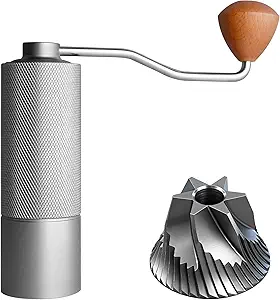 | Best Style-Conscious Budget Option | Burr Size: 38 mm | Burr Material: 420 stainless steel | Body Material: Aluminum alloy | VIEW ON AMAZON | See Our Full Breakdown |
| hand grinder for espresso | Grind settings | Burr material | Body material | Capacity |
|---|---|---|---|---|
| Hamiladuo Manual Coffee Grinde | — | Stainless steel | Aluminum alloy | 20g |
| NewlukPro M6 Manual Coffee Gri | 24 adjustable settings | SUS 420 stainless steel | Aluminum alloy | 25g |
| JavaPresse Manual Stainless St | More than 18 | Ceramic | Stainless steel | — |
| CIRCLE JOY Mini Manual Coffee | 40 external settings | Ceramic | Stainless steel | — |
| CEVING 60g Large Capacity Manu | 40 external click settings | — | — | 60g |
| KINGrinder P2 Lightweight Manu | — | SUS420 stainless steel | ABS | Up to 20 g |
| Alpaca Ventures Manual Coffee | — | — | Aluminum alloy | 1 oz (28 g) per fill |
| CEVING Mini Manual Coffee Grin | 40 external adjustments | — | — | — |
| CEVING 60g Large Capacity Manu | 40 external click settings | Stainless steel CNC conical | — | 60 g |
| Timemore C5 ESP PRO Manual Cof | — | — | — | 30 g |
| NewlukPro M6 Manual Hand Coffe | 24 | SUS 420 Stainless Steel | Aluminum Alloy | — |
| YQE Mini Manual Coffee Grinder | 40 external | — | — | 30 g |
| TIMEMORE Chestnut C2S Manual C | Approx. 36 levels | — | — | 25 g |
| KINGrinder K6 Manual Coffee Gr | — | Stainless steel | Aluminum | — |
| Agilive Manual Coffee Grinder | Adjustable click settings | 420 stainless steel | Aluminum alloy | — |
More Details on Our Top Picks
Hamiladuo Manual Coffee Grinder with Stainless Steel Conical Burr, Adjustable Grind, 20g Capacity
The Hamiladuo pairs a stainless steel conical burr with a dual-bearing shaft, a useful combination for buyers who want a compact hand grinder that can also be set for espresso. Its aluminum alloy body and 600g weight make it more substantial than a basic travel mill, while tool-free disassembly simplifies cleaning. Compared with the NewlukPro M6, it holds 5g less and does not specify a fixed number of grind settings, so the M6 offers clearer capacity and adjustment details. The tradeoff is its 20g capacity: that suits a single dose, but leaves little room for larger baskets or consecutive shots. It also needs dry, brush-based cleaning and the usual hand-cranking effort.
Pros:- Stainless steel conical burr and dual-bearing shaft are designed for consistent grinding
- Adjustable knob supports espresso and coarser brew settings
- Aluminum alloy body weighs 600g and suits travel use
- Tool-free disassembly makes brush cleaning more accessible
Cons:- 20g capacity can be tight for larger espresso doses
- Manual grinding takes more effort than using an electric grinder
- Cleaning is brush-only; the grinder cannot be rinsed with water
Best for: Espresso drinkers who want a metal-bodied grinder for single doses at home or on trips
Not ideal for: People preparing multiple shots in a row or anyone who wants a grinder that can be rinsed clean
- Burr type:Hexagonal conical
- Burr material:Stainless steel
- Burr hardness:55–58 HRC
- Body material:Aluminum alloy
- Capacity:20g
- Weight:600g
- Adjustment:Adjustable knob
- Shaft:Dual-bearing central shaft
- Cleaning:Tool-free disassembly; brush clean only
Our verdict“Choose the Hamiladuo for a sturdy, travel-friendly single-dose grinder if you can work with its 20g capacity and dry cleaning routine.”
NewlukPro M6 Manual Coffee Grinder for Espresso, Pour Over, French Press, and Moka
The NewlukPro M6 is a versatile pick for someone who wants one hand grinder to move between espresso and coarser brews. Its 24 adjustable settings, stainless steel conical burr, and double-bearing axis give buyers concrete adjustment and construction details, and the 25g capacity edges past the Hamiladuo’s 20g. That extra room can make a single espresso dose less cramped, though neither grinder is designed for preparing a crowd. The M6’s all-metal aluminum body suits travel, and its detachable design supports cleaning with the included brush. One tradeoff is reassembly: springs, washers, and bearings need careful placement after cleaning. The Timemore C5 ESP PRO lists 50 settings and a larger 30g capacity, making it a more specified option for fine adjustment, while the M6 keeps its appeal in straightforward multi-brew flexibility.
Pros:- 24 adjustable settings cover espresso through coarser brewing methods
- 25g capacity is larger than the Hamiladuo’s 20g
- Aluminum alloy body and compact design suit travel
- Detachable construction and included brush support cleaning
Cons:- 25g capacity may require repeated grinding for multiple servings
- Manual cranking takes more effort than electric grinding
- Reassembly requires care with springs, washers, and bearings
Best for: Traveling espresso drinkers who also brew pour over or French press and want stated adjustment steps
Not ideal for: Buyers who want a larger dose capacity or do not want to manage small parts during cleaning
- Model:M6
- Burr type:Conical
- Burr material:SUS 420 stainless steel
- Body material:Aluminum alloy
- Capacity:25g
- Grind settings:24 adjustable settings
- Warranty:1 year
- Included components:Cleaning brush and manual
Our verdict“Pick the M6 if you want a portable grinder with stated settings for espresso and other brew styles and are comfortable with careful reassembly.”
JavaPresse Manual Stainless Steel Coffee Grinder with Adjustable Ceramic Burr
The JavaPresse suits espresso drinkers who value a quiet, cord-free routine and want one grinder for several brew styles. Its ceramic conical burr and more than 18 settings provide range from espresso to pour over, while the hand-crank design avoids batteries and cables at home or on a trip. Compared with the NewlukPro M6, JavaPresse does not state a capacity or an exact setting count, so buyers have less information for judging dose size and adjustment granularity. That makes it harder to assess how conveniently it will handle repeated espresso shots. The stainless steel body supports a portable setup, but manual cranking still takes physical effort; quiet operation does not make grinding faster. It is a simpler fit for occasional single-dose brewing than for users who want detailed capacity specifications.
Pros:- Ceramic conical burr supports multiple grind settings
- More than 18 settings cover espresso and several other brew methods
- Cord-free design is convenient for travel and camping
- Quiet operation suits early or shared-space brewing
Cons:- No capacity is provided, making dose planning difficult
- No grind-time details are available
- Hand cranking requires physical effort
Best for: Apartment dwellers and travelers who prioritize quiet, cord-free single-dose brewing across several methods
Not ideal for: Espresso users who need a known dose capacity or detailed adjustment increments before choosing
- Grinder type:Manual, hand-crank
- Burr type:Conical
- Burr material:Ceramic
- Body material:Stainless steel
- Grind settings:More than 18
- Power:No batteries or cords required
- Brewing methods:Espresso, drip, French press, and pour over
Our verdict“Choose JavaPresse for quiet, cord-free versatility if the missing capacity and adjustment details are acceptable.”
CIRCLE JOY Mini Manual Coffee Grinder with 40 Adjustable Settings
With 40 external settings, the CIRCLE JOY gives espresso drinkers a clearly marked way to explore grind changes without opening the grinder to adjust it. Its extra-long handle adds leverage, which can make repeated hand cranking less tiring than on a compact grinder with a shorter handle. That adjustment range stands out against the JavaPresse’s more-than-18 settings, though the provided details do not say how each step translates to espresso grind size. The ceramic burrs and stainless steel body are paired with a clear glass grounds hopper, letting users see the collected dose. Glass is the weak point for travel: it is less forgiving of knocks than a metal container. Capacity and weight are also unspecified, limiting how well buyers can judge dose size and portability for daily espresso use.
Pros:- 40 external settings make adjustments accessible without disassembly
- Extra-long handle provides more leverage during hand grinding
- Ceramic burrs are designed for even grinding with less heat
- Clear glass hopper lets users see the grounds
Cons:- Glass hopper is more vulnerable to impact than a metal container
- Capacity and weight are not specified
- Manual grinding still takes physical effort
Best for: Espresso hobbyists who want external grind controls and a longer handle for experimenting with settings
Not ideal for: Frequent travelers who need a durable grounds container or buyers who require a stated capacity
- Grind settings:40 external settings
- Burr material:Ceramic
- Body material:Stainless steel
- Handle:Extra-long
- Grounds hopper:Clear glass
- Use:Home, travel, camping, and office
Our verdict“Choose the CIRCLE JOY for accessible external adjustment and added handle leverage if its glass hopper fits your routine.”
CEVING 60g Large Capacity Manual Coffee Grinder
The CEVING 60g addresses a common hand-grinder limitation: its large stated capacity lets buyers grind more beans in one session than the 20g Hamiladuo or 25g NewlukPro M6. That extra room is useful for preparing several doses, though the product information does not establish how quickly or comfortably a full load grinds. Its 40 external click settings and stated 0.05mm adjustment increments offer more detail than the JavaPresse’s unspecified capacity and setting steps. The ceramic conical burr is described as minimizing heat, and at 462g the grinder remains relatively light for carrying. The tradeoff is hand effort, especially when grinding a 60g batch. For a buyer making just one espresso, the larger bin may add bulk without improving the daily routine.
Pros:- 60g capacity exceeds the Hamiladuo and NewlukPro M6
- 40 external click settings include stated 0.05mm increments
- Ceramic conical burr is described as minimizing heat
- 462g weight supports portable use
Cons:- Grinding a large batch by hand can require considerable effort
- A 60g capacity may be unnecessary for single-dose espresso routines
- No grind-time or dose-specific performance details are provided
Best for: Home brewers or campers who prepare several espresso doses at once and want a high-capacity manual grinder
Not ideal for: Single-dose espresso drinkers who prefer a smaller grinder or want to avoid cranking a large batch by hand
- Capacity:60g
- Grind settings:40 external click settings
- Adjustment increment:0.05mm per click
- Burr type:Ceramic conical
- Weight:462g
- Dimensions:2.7 × 7.8 × 5.3 in
- Model:MCG-MEGA-Green
- Color:Green
Our verdict“Choose the CEVING if you want to grind several doses per session and can handle the extra manual work.”
KINGrinder P2 Lightweight Manual Coffee Grinder
The KINGrinder P2 is the lightest-feeling choice here by specification: its 330 g ABS body suits a travel kit where carrying weight matters more than espresso-focused construction. Its 30 clicks per rotation give some control over grind size, and tool-free disassembly makes brushing it clean simpler than a grinder that needs tools. But the listing recommends it for drip coffee, so I would rank it below the Alpaca Ventures grinder for espresso: Alpaca explicitly offers espresso-fine settings and a hardened steel burr. The P2’s 20 g capacity also means weighing and grinding a fresh dose for each shot, with little room for larger baskets or back-to-back drinks. Choose it for compactness and straightforward upkeep; skip it if espresso is your main brewing method.
Pros:- Lightweight 330 g body is easy to pack
- 30 clicks per rotation provide grind-size adjustment
- Tool-free disassembly simplifies cleaning
- Cleaning brush is included
Cons:- 20 g capacity may not suit larger espresso doses
- Recommended use is drip coffee, leaving espresso suitability less clearly established
Best for: Travelers who want a light, tool-free-cleaning grinder for occasional espresso alongside drip coffee
Not ideal for: Daily espresso drinkers seeking an explicitly espresso-oriented grinder or capacity for larger doses
- Body material:ABS
- Burr material:SUS420 stainless steel
- Weight:330 g
- Capacity:Up to 20 g
- Adjustment:30 clicks per rotation; 0.0333 mm per click
- Cleaning:Tool-free disassembly; cleaning brush included
- Recommended use:Drip coffee
Our verdict“Pick the KINGrinder P2 if low carry weight matters most and espresso is occasional; choose an explicitly espresso-oriented option for daily shots.”
Alpaca Ventures Manual Coffee Grinder with Adjustable Conical Burr
The Alpaca Ventures grinder makes the clearest espresso case among the portable options: its 45 click settings are described as spanning espresso-fine through cold brew, and the dual-bearing mechanism is intended to support smooth grinding. Its aluminum body offers a sturdier-feeling travel choice than the ABS KINGrinder P2, whose stated recommendation is drip coffee. That broader range does not make Alpaca a high-volume espresso tool, though: the chamber holds just 28 g, enough for a modest dose but limiting for larger baskets or repeated drinks. Cleaning also requires a brush or air blower; water and dishwashers are off limits. I’d choose it over the P2 when espresso adjustability matters more than minimum weight, but skip it if easy washing or a larger hopper is a priority.
Pros:- 45 settings include espresso-fine options
- Hardened stainless steel conical burr
- Aluminum body and grounds chamber suit portable use
- Dual-bearing mechanism supports smooth grinding
Cons:- 28 g capacity may require refilling for larger doses
- Cleaning is limited to a brush or air blower
- No carrying case or storage tin is included
Best for: Traveling espresso drinkers who want an aluminum-bodied hand grinder with settings explicitly covering espresso-fine grinding
Not ideal for: People who need water-washable parts, a carrying case, or capacity for frequent larger doses
- Capacity:1 oz (28 g) per fill
- Body material:Aluminum alloy
- Dimensions:6.8 in tall × 1.9 in wide
- Weight:1 lb (460 g)
- Burr:420 stainless steel conical burr, hardened to 57 HRC
- Adjustment settings:45 clicks
- Bearing mechanism:Dual bearing
- Cleaning:Brush or air blower only; do not use liquids or a dishwasher
- Intended use:Roasted coffee beans only
Our verdict“Choose Alpaca for portable espresso adjustability and an aluminum body, provided its small capacity and dry-cleaning routine suit you.”
CEVING Mini Manual Coffee Grinder with 40 Adjustable Settings, Black
The CEVING Mini pairs a 325 g body with 40 external adjustments, so changing grind size does not require opening the grinder. Its 30 g capacity gives it more room per fill than the KINGrinder P2, while keeping the portable format. The distinction for espresso is the ceramic conical burr: this makes it a different choice from the steel-burr Alpaca Ventures model, whose listing more directly calls out espresso-fine settings. CEVING does list espresso among its uses, but the supplied details give no click increment or burr hardness to judge how finely it can be dialed for a particular machine. Detachable parts and a brush help with dry cleaning, though water is discouraged. It suits compact, occasional espresso use better than buyers who need clearly specified espresso adjustment.
Pros:- 40 external grind settings are easy to adjust
- 325 g weight suits travel and camping
- 30 g capacity exceeds the KINGrinder P2’s stated 20 g
- Detachable parts can be cleaned with a brush or dry cloth
Cons:- Ceramic burrs and unspecified adjustment increments offer less detail for dialing espresso
- 30 g capacity may be limiting for larger batches
- Manufacturer advises against cleaning with water
Best for: Travelers who want a lightweight grinder with external settings for mixed brewing, including occasional espresso
Not ideal for: Espresso-focused buyers who want a stated fine-adjustment increment or prefer stainless steel burrs
- Brand:CEVING
- Model:MCG-01
- Grind settings:40 external adjustments
- Burr type:Ceramic conical burr
- Bean capacity:30 g
- Weight:325 g
- Dimensions:6.7 × 2.3 × 7.4 in
- Included components:Bean bin, user guide
Our verdict“Pick the CEVING Mini for a light, mixed-brewing travel grinder, but favor Alpaca if explicit espresso-fine settings are your priority.”
CEVING 60g Large Capacity Manual Coffee Grinder, Black
Among these five, the CEVING MCG-02 stands out for capacity: its 60 g chamber can reduce refills when making multiple drinks or grinding a larger dose. That is a practical advantage over the 30 g CEVING Mini, though capacity alone does not make espresso dialing easier. The MCG-02 has 40 external click settings and a stated 0.05 mm increment, plus stainless steel conical burrs; those details give a buyer more to work with than the Mini’s unspecified increment and ceramic burr. The tradeoff is manual effort: grinding a bigger batch still takes physical work, and the listing does not specify how its adjustment range performs at espresso settings. Its 416 g weight is portable, but less compelling if minimizing pack weight is the main goal.
Pros:- 60 g capacity reduces refills compared with the 30 g CEVING Mini
- 40 external click settings with a stated 0.05 mm increment
- Stainless steel CNC conical burrs
- 416 g weight and compact dimensions support portable use
Cons:- Grinding a larger batch still requires more hand effort
- Espresso performance is not further specified beyond the adjustment range
- Heavier than the 325 g CEVING Mini
Best for: Home or travel espresso users who want room for larger doses or several drinks before refilling
Not ideal for: Buyers who prioritize the lightest carry or need detailed confirmation of espresso-specific adjustment performance
- Brand:CEVING
- Model:MCG-02
- Capacity:60 g
- Grind settings:40 external click settings
- Adjustment increment:0.05 mm per click
- Burr material:Stainless steel CNC conical
- Weight:416 g
- Dimensions:2.7 × 7.8 × 5.3 in
- Warranty:1 year
Our verdict“Choose the MCG-02 when fewer refills matter more than minimum weight, while recognizing that its espresso adjustment performance is not fully detailed.”
Timemore C5 ESP PRO Manual Coffee Grinder, 42mm Stainless Steel Burr, 50 Adjustable Settings, All-Metal, 30g Capacity
The Timemore C5 ESP PRO earns the most espresso-focused role here through its 50 micro adjustment steps at 0.015 mm per click, giving finer stated control than the Alpaca Ventures grinder’s 45 clicks or the CEVING MCG-02’s 0.05 mm increments. That finer spacing can help when small grind changes affect shot flow, while its 42 mm S2C stainless steel burrs and all-metal build suit regular use. The cost of that focus is practical rather than monetary: it is a hand grinder, so espresso grinding takes effort, and its 30 g capacity is modest beside CEVING’s 60 g chamber. The foldable handle helps with packing, but this is a pick for repeatable single-dose dialing, not batch convenience. Choose it when adjustment precision matters most.
Pros:- 50 micro steps with 0.015 mm clicks support fine adjustment
- 42 mm S2C stainless steel burrs
- All-metal construction with a textured 53 mm body
- Foldable handle is convenient for storage and travel
Cons:- 30 g capacity is small beside the 60 g CEVING MCG-02
- Manual grinding requires physical effort
- Single-dose workflow is less convenient for multiple servings
Best for: Espresso drinkers who dial in single doses and want closely spaced adjustment steps in a metal-bodied hand grinder
Not ideal for: People who grind for several servings at once or want to avoid the effort of manual espresso grinding
- Brand:TIMEMORE
- Model number:TM0054
- Burr:42 mm S2C stainless steel
- Adjustment settings:10 macro + 50 micro steps; 0.015 mm clicks
- Capacity:30 g
- Body diameter:53 mm
- Material:All metal
- Handle:Foldable
- Included components:Cleaning brush
Our verdict“Choose the Timemore C5 ESP PRO for closely spaced espresso adjustments and durable construction, if single-dose manual grinding suits your routine.”
NewlukPro M6 Manual Hand Coffee Grinder
The NewlukPro M6 stands out for its fully metal construction with zero plastic parts, which is unusual at this price point and gives it a more solid feel than the plastic-clad JavaPresse further down the roundup. Its SUS 420 stainless steel hexagonal conical burr produces noticeably more even espresso grounds than generic ceramic burrs, and the 24 stepped settings give enough resolution to dial in a fine espresso grind without endless trial and error.
The tradeoff is maintenance: reassembly after cleaning requires careful attention to the springs, washers, and bearings, and a mistake here can throw off grind consistency entirely. Compared with the TIMEMORE Chestnut C2S, the M6 offers 24 settings versus roughly 36, so espresso dialing is a little coarser in adjustment steps. Capacity is also modest, so single or double shots are its comfort zone.
Pros:- All-metal construction with no plastic parts
- Stainless steel hexagonal conical burr produces even, consistent espresso grounds
- 24 grind settings cover espresso through French press
- Compact and tool-free disassembly for cleaning
Cons:- Careful reassembly of springs, washers, and bearings is required after cleaning
- Small capacity limits batch grinding for multiple servings
Best for: Budget-minded espresso drinkers who want all-metal build quality for home, office, or travel without paying premium-brand prices
Not ideal for: Anyone who wants a low-maintenance grinder — the multi-part reassembly after cleaning demands patience and care
- Brand:NewlukPro
- Burr Material:SUS 420 Stainless Steel
- Body Material:Aluminum Alloy
- Grind Settings:24
- Power Source:Manual
- Brew Methods:Espresso, Pour Over, Cold Brew, French Press, Moka
- Warranty:1 year
Our verdict“This pick makes the most sense for espresso drinkers who want durable all-metal construction on a budget and don’t mind a fiddly cleaning routine.”
YQE Mini Manual Coffee Grinder with 40 External Grind Settings
For espresso specifically, grind adjustment resolution is everything, and the YQE Mini’s 40 external settings put it ahead of the NewlukPro M6’s 24 steps for dialing in a shot precisely. The external dial means no disassembly between adjustments — a real workflow advantage when you’re chasing that perfect 25-second extraction and need to nudge the grind finer by one click.
The ceramic conical burr runs cool to protect aroma, but ceramic is more fragile than the stainless burrs in the TIMEMORE Chestnut C2S, and espresso grinding puts real torque on the mechanism. The 30g capacity covers one or two servings, which suits solo morning shots but not households. Grinding fine espresso by hand on ceramic also takes more cranking effort than burr-speed-focused competitors.
Pros:- 40 external grind settings adjust without disassembly
- Ceramic burr generates minimal heat to preserve aroma
- Ergonomic long handle reduces hand fatigue during fine grinding
- Lightweight and compact for travel
Cons:- Ceramic burr is less durable than stainless under espresso-level torque
- 30g capacity limits multi-serving brews
Best for: Espresso obsessives who want maximum click-level control for dialing in shots and mostly brew one or two servings at a time
Not ideal for: Households or campers grinding for several people — the 30g capacity and hand effort make multi-serving prep tedious
- Grind Settings:40 external
- Burr Type:Ceramic conical
- Capacity:30 g
- Material:Stainless steel
- Dimensions:6.7 x 2.3 x 6.7 in
- Included:Grinder, cleaning brush
Our verdict“This model is better suited to single-serve espresso tinkerers who value adjustment precision over burr durability and batch size.”
TIMEMORE Chestnut C2S Manual Coffee Grinder
The TIMEMORE Chestnut C2S earns the top spot for grind uniformity, which is the single most important factor for repeatable espresso. Its CNC-machined 38mm S2C stainless steel burr paired with double bearing central axis positioning keeps the burr stable under the heavy resistance of espresso-fine grinding, producing fewer fines than the NewlukPro M6 or the Agilive grinder in this lineup. The full metal unibody also fixes the top-cover breakage that plagued the original C2, so durability concerns from that generation are addressed.
With roughly 36 settings, it sits between the M6’s 24 and the YQE’s 40 in adjustment resolution — enough for espresso, though dedicated shot-tuners may wish for finer steps. The 25g capacity is the main limitation: fine for one double shot, tight for back-to-back brews. It’s also the heaviest-feeling premium option here relative to ultra-light travel grinders like the KINGrinder P2.
Pros:- 38mm CNC-machined stainless steel S2C burr with double bearing stability for uniform grounds
- Full metal unibody eliminates the original C2’s top-cover breakage issue
- Approximately 36 grind settings from fine espresso to coarse
- Smooth, labor-saving grinding thanks to the built-in bearing
Cons:- 25g capacity restricts batch grinding
- Adjustment steps are coarser than 40+ click competitors for precise espresso dialing
Best for: Espresso drinkers who prioritize grind consistency and burr stability above all else and typically brew one or two shots at a time
Not ideal for: Anyone grinding for a group — the 25g capacity and hand effort make multi-serving prep slow
- Burr:38mm Stainless Steel S2C Conical
- Burr Hardness:55–58 HRC
- Grind Settings:Approx. 36 levels
- Capacity:25 g
- Body Diameter:52 mm
- Weight:700 g
- Bearing Design:Double bearing
Our verdict“The strongest all-around choice for espresso quality in this batch, provided you’re grinding for one or two people at a time.”
KINGrinder K6 Manual Coffee Grinder
If the YQE Mini’s 40 clicks sound like a lot, the KINGrinder K6 goes much further: 16-micron steps with 60 clicks per rotation across four full rotations of adjustment. That’s true espresso-barista territory — fine enough to chase half-second extraction changes the way you would on a high-end electric grinder. Neither the TIMEMORE C2S nor the NewlukPro M6 comes close to this resolution.
The aluminum body, stainless steel burrs, and dual bearings keep the mechanism rigid, and hand disassembly makes travel and cleaning practical. The compromise is that all that adjustment range means a long travel distance between espresso-fine and French-press-coarse — expect plenty of spinning when switching brew methods. And like most grinders here, the 25–35g hopper means batch grinding isn’t its strength. Fine espresso grinding still demands real arm work; this is precision, not effort reduction.
Pros:- 16-micron-per-click external adjustment offers near-electric-grinder precision
- Dual bearings and stainless steel burrs keep grinding consistent under espresso resistance
- Fully hand-disassemblable for cleaning and travel
- Durable aluminum body with 25–35g hopper
Cons:- Long adjustment travel when moving between fine and coarse settings
- Hopper capacity still limits multi-serving batches
Best for: Hands-on espresso enthusiasts who want micron-level grind control to dial in shots with maximum repeatability
Not ideal for: Multi-method brewers who switch between espresso and French press often — the four-rotation adjustment range makes method changes slow
- Grind Adjustment:16 microns per click
- Adjustment Range:60 clicks per rotation, up to 4 rotations
- Burr Material:Stainless steel
- Body Material:Aluminum
- Bearing Design:Dual bearings
- Hopper Capacity:25–35 g
Our verdict“This is the pick for espresso tinkerers who treat grind adjustment as a craft and want the finest control in the roundup.”
Agilive Manual Coffee Grinder, Stainless Steel Burr, Portable Hand-Cranked, White
The Agilive covers the essentials well: a 38mm CNC-machined 420 stainless steel burr — the same burr size as the TIMEMORE Chestnut C2S — inside an aluminum body that handles espresso, moka, pour-over, and French press. The white finish also makes it one of the few grinders here that looks at home on a styled kitchen counter rather than a camp table, which matters if aesthetics are part of the buying decision.
Where it falls short of the C2S is stabilization: without the double bearing central axis, grind uniformity at espresso fineness is a step behind, so shots may be slightly less repeatable. The ABS plastic handle is also a weak point compared with all-metal competitors. And the click numbers are reference-only — expect to find your own espresso setting through experimentation rather than trusting the dial markings.
Pros:- 38mm CNC-machined stainless steel burr delivers even grounds across brew methods
- Covers espresso, moka, pour-over, and French press with one adjustable dial
- Lightweight aluminum body is easy to travel with
- Disassembles for brush cleaning with included accessories
Cons:- Cannot be washed with water or placed in a dishwasher
- Click markings are reference-only and need personal calibration
- Plastic ABS handle is less durable than all-metal rivals
Best for: Style-conscious home brewers who want capable espresso-capable grinding in a counter-friendly white design at an accessible price
Not ideal for: Anyone who wants set-and-forget repeatability — the reference-only click numbers require personal dialing in, and it can’t be washed with water
- Burr Size:38 mm
- Burr Material:420 stainless steel
- Body Material:Aluminum alloy
- Handle Material:ABS
- Grind Settings:Adjustable click settings
- Recommended Uses:Espresso, Moka, Pour-over, French press
- Cleaning:Disassemblable; brush clean only, no water or dishwasher
Our verdict“A sensible budget choice for design-minded brewers who accept some dialing-in effort in exchange for looks and price.”

How We Picked
I evaluated every grinder through a single lens: can it produce a consistent, true espresso-fine grind shot after shot? That broke down into four criteria. Grind quality at espresso range came first — burr material (steel vs. ceramic), burr size, and how uniformly the grinder produces fine particles without excessive fines. Adjustability came second: espresso dialing requires small, repeatable steps, so external stepped adjustments with fine increments scored higher than friction-style or coarse stepped dials. Third, I weighed build quality and stability, because a loose burr or flexing axle shows up immediately as inconsistent extraction. Fourth, I considered practical ergonomics — grinding effort, capacity, and how the grinder feels during the 30–60 seconds of cranking an espresso dose demands.
The ranking logic follows directly from those criteria. Steel-burr grinders with fine stepped adjustment (Timemore C5 ESP PRO, KINGrinder K6, KINGrinder P2) occupy the top because they were designed explicitly for espresso. Multi-purpose grinders like the NewlukPro M6 and Timemore Chestnut C2S sit in the middle: excellent all-rounders that handle espresso acceptably but make tradeoffs elsewhere. Budget ceramic-burr and mini grinders fill the lower tier — not bad products, but better suited to pour over, French press, or travel than serious espresso work.
| hand grinder for espresso | Body material |
|---|---|
| Hamiladuo Manual Coffee Grinde | Aluminum alloy |
| NewlukPro M6 Manual Coffee Gri | Aluminum alloy |
| JavaPresse Manual Stainless St | Stainless steel |
| CIRCLE JOY Mini Manual Coffee | Stainless steel |
| CEVING 60g Large Capacity Manu | — |
| KINGrinder P2 Lightweight Manu | ABS |
| Alpaca Ventures Manual Coffee | Aluminum alloy |
| CEVING Mini Manual Coffee Grin | — |
| CEVING 60g Large Capacity Manu | — |
| Timemore C5 ESP PRO Manual Cof | — |
| NewlukPro M6 Manual Hand Coffe | Aluminum Alloy |
| YQE Mini Manual Coffee Grinder | — |
| TIMEMORE Chestnut C2S Manual C | — |
| KINGrinder K6 Manual Coffee Gr | Aluminum |
| Agilive Manual Coffee Grinder | Aluminum alloy |
Factors to Consider When Choosing Hand Grinder For Espresso
Choosing a hand grinder for espresso involves pitfalls that don’t apply to other brew methods. These are the factors that actually change your results at the portafilter.Burr Material: Why Steel Matters for Espresso
Ceramic and steel burrs behave very differently at fine grind settings. Ceramic burrs, common on budget grinders, are harder but more brittle and often mounted with more play, which produces burr wobble — a mix of dust-fine particles and coarse chunks that over- and under-extract in the same shot. Steel burrs like those on the Timemore and KINGrinder models cut more predictably and hold alignment under the resistance of an espresso-fine grind. A common mistake is assuming any grinder labeled ‘adjustable’ can do espresso; many ceramic models bottom out coarser than espresso requires or produce a grind that chokes the machine one shot and runs sour the next. If espresso is your primary brew, treat steel burrs as the entry requirement, not an upgrade. Ceramic remains reasonable if espresso is an occasional experiment and you mostly brew pour over or French press.
Adjustment Steps: The Dialing-In Problem
Espresso is the least forgiving brew method for adjustment design. A single grind step can swing extraction from a 15-second gusher to a choked shot, so step size at the fine end matters far more than the total number of settings. A grinder with 40 coarse steps across the whole range may still be too clunky for espresso, while a grinder with espresso-focused micro-steps lets you correct a sour or bitter shot in one move. External adjustment dials also beat internal ones for espresso because you can note your setting and return to it exactly — repeatability is what turns a lucky shot into a repeatable recipe. When comparing grinders, look at whether reviewers describe the steps as ‘espresso-capable’ or ‘fine enough,’ not just the headline setting count.
Grinding Effort and Speed
Espresso doses are small — usually 16–20g — but grinding that dose fine takes real torque. Smaller burrs and cheap drive systems make each rotation less productive, so a budget grinder can take twice as long and twice the wrist strain as a 42mm-burr model for the same dose. Larger burrs (40mm+) with good bearings reduce both grind time and wobble, which is why the Timemore C5 ESP PRO feels easier than mini grinders with similar setting counts. Handle design matters too: a short or loosely attached handle multiplies fatigue over daily use. If you pull two or more shots a day, ergonomics stops being a luxury and becomes the difference between a daily ritual and a chore you start avoiding.
Capacity and Single-Dosing
Espresso is inherently a single-dose exercise, which changes how capacity should influence your choice. A 20–30g capacity is ideal: enough for a double shot or a slightly larger dose for headroom, without the bulk of large canisters. The 60g CEVING models seem appealing on paper, but that capacity serves batch brewing, not espresso, and the larger body makes dosing into a small portafilter basket clumsier. Also check whether the grinder retains grounds internally — designs with dead space below the burrs hold back a gram or more per grind, which throws off your ratio and wastes beans. Grinders marketed for ‘espresso, pour over, and French press’ versatility usually compromise capacity and adjustment design somewhere; decide which brew method you actually do daily before choosing a generalist.
Build Quality and Longevity
At espresso-fine settings, a grinder works hard, and weak points reveal themselves fast. Check for metal housings, dual bearings, and a stable central shaft — plastic bodies and single-bearing designs develop play that shows up as inconsistent particle size within weeks of daily use. Detachable, washable components matter for maintenance since coffee oils accumulate and stale flavors carry into espresso more noticeably than in milk drinks. Replacement parts availability is another quiet differentiator: established brands like Timemore and KINGrinder support their grinders, while unbranded generic models often don’t. Spending more upfront on a serviceable metal grinder usually beats replacing a cheap one every year, especially if espresso is your daily habit.
When a Hand Grinder Is the Wrong Choice
Honesty about fit saves money. A hand grinder for espresso makes the most sense for single-dose drinkers, travelers, and people upgrading from blade or pre-ground coffee without paying electric-grinder prices. It makes less sense if you pull four or more shots daily, make milk drinks for a household, or have wrist or hand issues — the manual effort compounds quickly. In those cases, even the best hand grinder here becomes a frustration, and an entry electric espresso grinder is the better investment. Also note that some ultra-budget hand grinders are essentially travel grinders for coarse brewing with an ‘espresso’ label added; buying one for espresso leads to disappointment that gets blamed on the coffee or the machine rather than the grinder.
Frequently Asked Questions
Can a cheap hand grinder actually make good espresso?
It depends on what ‘good’ means to you. Budget ceramic-burr grinders like the JavaPresse can produce something within espresso range, but the particle inconsistency means shots taste muddled rather than clean, and dialing in becomes guesswork because the same setting gives different results. If you’re using a pressurized basket or an entry-level machine, that inconsistency is masked and a budget grinder is workable. With an unpressurized basket on a decent machine, the grinder becomes the bottleneck and you’ll taste it immediately. My practical cutoff: grinders with steel burrs and fine stepped adjustment, like the KINGrinder P2, are the least you should spend if espresso quality actually matters to you.
Is 40 grind settings enough for espresso?
The setting count alone tells you almost nothing — step spacing at the fine end is what matters. A grinder could have 40 settings spread from Turkish to cold brew, leaving only four or five in the espresso range with giant jumps between them, which makes dialing in frustrating. Compare that to the Timemore C5 ESP PRO, whose 50 settings are deliberately concentrated for precision brewing. When evaluating a grinder, look at whether the adjustment is external and labeled, whether steps are described as fine or coarse, and whether the grinder was designed with espresso in mind rather than as one mode among many. External numbered dials also let you record your setting and repeat it exactly, which internal twist mechanisms rarely allow.
How long does it take to hand grind an espresso dose?
With a well-designed steel-burr grinder like the Timemore C5 ESP PRO or KINGrinder K6, a 16–18g espresso dose takes roughly 30–45 seconds of comfortable cranking. Budget and mini grinders can take a minute or longer with noticeably more resistance, because smaller burrs remove less coffee per rotation and cheap bearings waste your effort as friction. Grind time matters more than it seems: a grind that takes two minutes exposes coffee to air and static for longer and turns your morning routine into a workout. If you regularly make two shots back to back, that difference doubles. Consider effort and speed as seriously as grind quality, since the best-tasting grinder you avoid using is worth nothing.
Should I get a large-capacity grinder like the 60g CEVING for espresso?
Probably not, if espresso is your main goal. Espresso doses run 16–20g, so a 60g canister is dead weight that makes the grinder bulkier and harder to single-dose into a small basket. Large capacity genuinely helps if you also brew French press for several people or grind ahead for the office, which is why those grinders are marketed as all-purpose. But espresso rewards grinding fresh per shot, and a 20–30g capacity like the Timemore models or KINGrinder P2 fits that workflow better. The one caveat: if you want one grinder for both espresso and batch brewing and accept compromises in each, a larger-capacity model is defensible — just recognize you’re trading espresso-focused precision for versatility.
Is it worth paying more for the KINGrinder K6 over the P2?
The honest answer depends on how seriously you chase shot quality. Both share the steel-burr advantage over budget grinders, but the K6’s larger burr set and finer adjustment produce better particle distribution, which translates to sweeter, more balanced shots — a difference you’ll notice with light roasts and unpressurized baskets. The P2 covers the fundamentals well and is the smarter buy if you’re starting out, using pressurized baskets, or grinding for multiple brew methods. If you own a capable espresso machine and taste-focused setup, the K6’s refinement justifies the premium because the grinder is usually the weakest link in budget espresso chains. A middle path many people take: start with the P2, and if you find yourself wanting more clarity in the cup, upgrade later rather than buying the K6 speculatively.
Conclusion
Mapping these 15 grinders to buyer types closes the decision cleanly. For best overall, the Timemore C5 ESP PRO stands out: a 42mm steel burr, 50 espresso-focused settings, and an all-metal build at a price that undercuts premium rivals. For best value, the KINGrinder P2 delivers the steel-burr essentials without the premium price — the smartest entry point for real espresso. For best premium, the KINGrinder K6 offers the finest grind consistency in this lineup for buyers chasing the last measure of shot quality. For beginners, the NewlukPro M6 or Timemore Chestnut C2S make gentle all-rounders if espresso is one of several brew methods you’ll explore, forgiving enough for pour over and capable enough for occasional shots. For travel and portability, the CIRCLE JOY Mini and YQE fit in a bag, with the honest caveat that they’re emergency espresso tools rather than daily drivers. Whatever you choose, the dividing line in this category is firm: steel burrs with fine adjustment for serious espresso, and everything else is a compromise you should make knowingly.
Halloween Picks
halloween
As an affiliate, we earn on qualifying purchases.