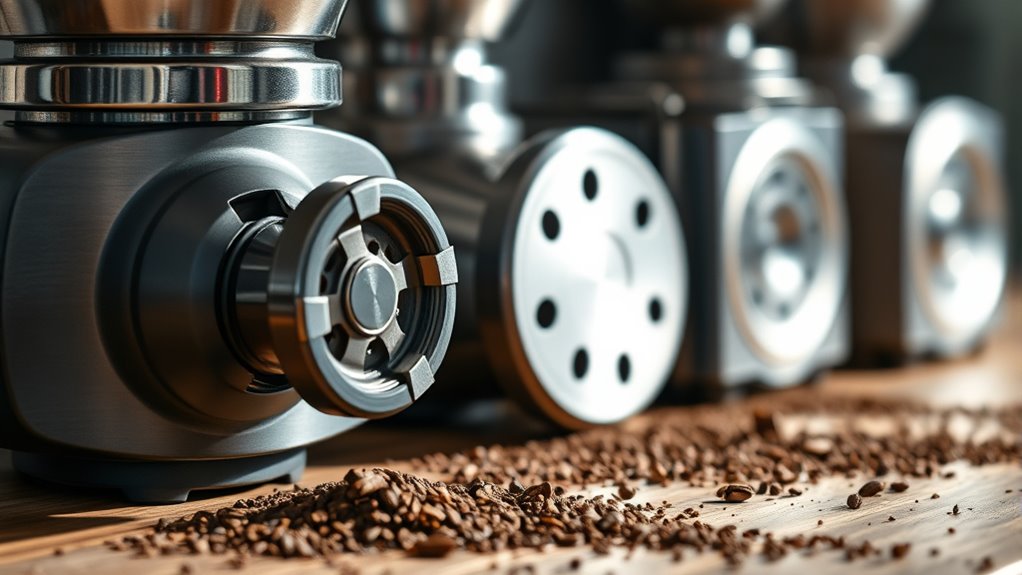

Understanding the different burr types, like conical and flat, helps you achieve a consistent grind. The shape and material of your burrs directly impact particle size and distribution, which in turn affects flavor extraction. Proper maintenance, including cleaning and alignment, keeps your burrs performing well. Uniform particles promote better extraction and taste. If you want to fine-tune your grinder for ideal results, exploring how burrs and particle distribution work together will give you the edge you need.

Get coffee and tea gear delivered free with Prime
- Fast, free delivery on millions of items
- Prime Video, Amazon Music and more included
- Member-only deals all year
Key Takeaways
- Different burr types (flat, conical) influence grind consistency and particle size distribution.
- Proper burr maintenance ensures uniform particle size and optimal extraction quality.
- Burr wear and misalignment cause uneven particle distribution, affecting brew flavor.
- Regular particle size analysis helps fine-tune grinder settings for specific brewing methods.
- Consistent burr condition and calibration lead to uniform grind size and better flavor extraction.
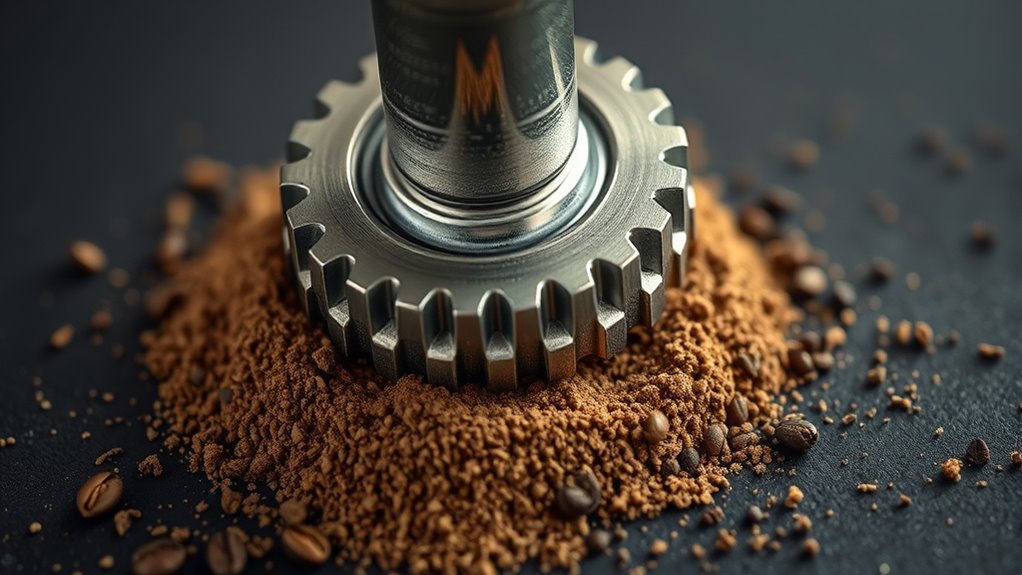
Have you ever wondered what makes a perfect grind for your coffee or spices? Achieving that ideal consistency isn’t just about turning a grinder on; it’s about understanding the mechanics behind how your grinder produces those particles. One essential factor is the type of burrs your grinder uses. Burrs come in different shapes and materials, and each influences the grind quality and consistency. Proper burr maintenance is necessary to keep them functioning at their best. Over time, burrs can become dull or misaligned, leading to uneven particle distribution. Regularly inspecting and cleaning your burrs ensures that they cut evenly, producing uniform particles that extract flavors consistently. When burrs are well-maintained, you’ll notice a significant improvement in the consistency of your grind, whether you’re brewing espresso or preparing spices.
Particle size analysis plays a critical role in understanding how well your grinder performs. The size of particles affects extraction in coffee brewing and the overall flavor profile. If particles are too varied, your brew might taste under-extracted or over-extracted, resulting in a bitter or sour flavor. Conversely, a very uniform particle size leads to a more balanced and predictable brew. To achieve this, you can use a particle size analysis — a process that measures and evaluates the distribution of particle sizes produced by your grinder. This helps you identify whether your grind is consistent enough for your preferred brewing method. For example, espresso demands a fine, uniform grind, whereas French press calls for a coarser, more uneven texture. Understanding the particle size distribution allows you to adjust your grinder settings accordingly, ensuring each brew is as perfect as possible.
Maintaining your burrs isn’t just about cleaning; it’s also about understanding their wear patterns and replacing them when needed. As burrs wear down, they produce more inconsistent particles. Regular burr maintenance, combined with particle size analysis, helps you fine-tune your grinder to deliver the desired grind size and consistency, ultimately improving flavor extraction. The process might involve checking for burr alignment, sharpening or replacing worn parts, and calibrating your grinder to produce the right particle distribution. When you pay close attention to burr maintenance and analyze particle size, you’re taking control of the grinding process. This control translates into better-tasting coffee, more flavorful spices, and a more satisfying experience every time you grind. Remember, the key to a perfect grind lies in consistency, and that starts with understanding and caring for your burrs while paying attention to the particle size distribution your grinder produces.
As an affiliate, we earn on qualifying purchases.
Frequently Asked Questions
How Do Burr Types Affect Espresso Extraction?
Burr types directly influence espresso extraction by affecting grind uniformity and consistency. You’ll notice that conical burrs often produce a more consistent grind with fewer fines, leading to a balanced extraction. Flat burrs tend to generate a more uniform particle size, which helps extract flavors evenly. Choosing the right burr shape guarantees you optimize extraction, resulting in richer, more flavorful espresso shots with better clarity and body.
What Maintenance Is Required for Different Burr Grinders?
Imagine your grinder as a finely tuned orchestra; it needs regular care to perform perfectly. You should regularly calibrate the burrs to maintain grind consistency and follow cleaning protocols to prevent buildup that affects flavor. Keep the burrs sharp and free of debris, and check for wear. Proper maintenance guarantees your espresso stays rich and balanced, turning routine upkeep into an act of brewing artistry.
Can Particle Distribution Influence Brewing Time?
Yes, particle distribution can influence brewing time. When you have good grind uniformity and tight particle size control, water flows evenly through the coffee bed, leading to consistent extraction. If the particle sizes vary widely, larger particles slow down extraction, extending brewing time, while smaller ones can cause over-extraction. By maintaining ideal grind uniformity, you guarantee a more predictable and efficient brewing process.
Are Ceramic Burrs More Durable Than Steel?
Ceramic burrs are like the steady guardians of your grinder, more resistant to ceramic wear than steel, which can dull from steel sharpening over time. You’ll find ceramic burrs hold their edge longer, making them more durable in the long run. Steel burrs, while sharp and effective initially, may need more frequent maintenance. So, if you want lasting performance, ceramic burrs are your reliable choice.
How Does Grind Size Consistency Impact Flavor?
A uniform grind improves flavor consistency because it guarantees even extraction during brewing. When your grind size is consistent, water interacts with the coffee evenly, highlighting the beans’ nuanced flavors. In contrast, inconsistent grind sizes can cause over- or under-extraction, resulting in bitter or sour tastes. By maintaining grind size consistency, you enhance the overall flavor profile, making every cup taste as intended and more enjoyable.
Conclusion
Think of your grinder as a master painter’s brush, where each burr type and particle size is a stroke shaping the perfect brew. Just as a painter’s choice influences the masterpiece, your grind choices define your coffee’s flavor and aroma. Mastering these details transforms your routine into an art form, turning simple beans into a symphony of taste. With the right tools and knowledge, you become the artist behind every exceptional cup.
Halloween Picks
halloween
As an affiliate, we earn on qualifying purchases.