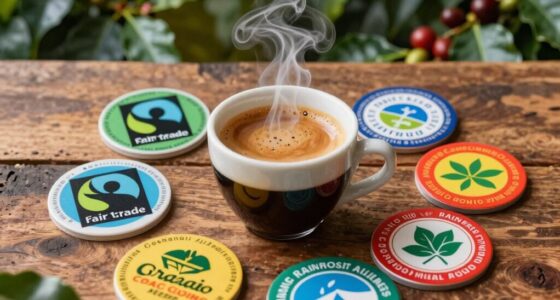

Fair Trade Coffee is certified to meet strict social, economic, and environmental standards that support farmers and promote sustainability. When you choose Fair Trade, you’re helping guarantee farmers get a fair price and fair wages, while also encouraging eco-friendly farming practices. Certifications guarantee transparency and ethical sourcing in the supply chain, giving you confidence in your coffee choice. To discover how these standards work together, keep exploring the details behind Fair Trade Coffee.

Get coffee and tea gear delivered free with Prime
- Fast, free delivery on millions of items
- Prime Video, Amazon Music and more included
- Member-only deals all year
Key Takeaways
- Fair Trade Coffee is certified coffee that meets social, economic, and environmental standards through third-party certification.
- It guarantees farmers a minimum fair price and a premium for community projects, promoting economic stability.
- The certification promotes sustainable farming practices that protect the environment and conserve resources.
- It ensures fair wages, safe working conditions, and ethical treatment for workers and farmers.
- Consumers can trust Fair Trade Coffee’s transparency and ethical sourcing, supporting responsible and sustainable coffee production.
Have you ever wondered what makes Fair Trade Coffee different from regular coffee? The key lies in the rigorous process of Fairtrade certification, which guarantees that coffee farmers and producers meet strict standards promoting sustainability, fairness, and ethical practices.
When you see the fair trade label on your coffee, it signifies that the product has undergone third-party certification, such as Fairtrade America, Fairtrade International, or Fair Trade Certified. These organizations verify that the coffee production process adheres to fair trade standards, which cover social, economic, and environmental aspects.
Fairtrade certification guarantees a minimum price for coffee, usually set above the global commodity market rate. This helps provide economic stability for coffee farmers, shielding them from volatile prices that can threaten their livelihoods.
Fairtrade guarantees a minimum price, helping coffee farmers stay stable amid market fluctuations.
Beyond just fair pay, certification also promotes sustainable sourcing by encouraging environmentally friendly farming practices that conserve resources and reduce chemical use. Farmers are supported in adopting eco-friendly methods, ensuring that coffee cultivation remains sustainable over the long term.
When a coffee is labeled as Fair Trade Certified, it means that the entire supply chain complies with established standards. These standards include fair labor practices, safe working conditions, and fair wages, which benefit coffee farmers and their communities.
The certification process involves independent audits to verify compliance, giving consumers confidence in the ethical integrity of their purchase. This transparency is crucial in the global coffee market, where supply chains can be complex and opaque.
One of the distinctive features of Fair Trade Coffee is the fairtrade premium—a financial bonus paid on top of the minimum price. Farmers and cooperatives decide how to use this extra income, often investing in community development projects such as schools, healthcare, or infrastructure.
This investment helps improve the quality of life for those involved in coffee production and supports local economies. Additionally, the certification process emphasizes transparency in supply chains, ensuring that consumers can trust the ethical standards behind their coffee choices.
Frequently Asked Questions
What Does It Mean if Coffee Is Fairtrade?
When you see a coffee labeled as fairtrade, it means the farmers and workers involved get a fair price that covers their costs and supports community projects.
It also indicates that the coffee’s produced under strict social and environmental standards, ensuring safe working conditions and sustainability.
What Is the Difference Between Fair Trade Coffee and Organic Coffee?
You’re asking about the difference between fair trade and organic coffee. Fair trade focuses on ensuring fair wages, ethical trading, and community benefits. Organic emphasizes growing coffee without synthetic pesticides, fertilizers, or GMOs.
A coffee can be both, but they’re separate certifications. Fair trade prioritizes social and economic fairness, whereas organic prioritizes environmental health.
Many coffees hold one or both certifications, but not all organic coffees are fair trade, and vice versa.
Is Starbucks Coffee Actually Fair Trade?
When you ask if Starbucks coffee is actually fair trade, you should know it varies. Some of their coffee is Fairtrade-certified, supporting fair wages and sustainable farming.
However, not all Starbucks coffee carries the Fairtrade label, as they also source through direct trade and other methods. To be sure, check the product labels, because the percentage of Fairtrade-certified coffee depends on the region and specific product.
Which Coffee Brands Are Fair Trade?
You’ll find many coffee brands that are fair trade. Major names like Ethical Bean, Kicking Horse, and Mount Hagen carry certifications ensuring ethical practices.
Nespresso works with over 110,000 farmers through sustainability programs, while Brooklyn Roasting and Gourmesso offer certified blends focused on quality.
Specialty brands like Metropolis and Twiga prioritize social impact, and retailers like Trader Joe’s and Kirkland Signature also provide fair trade options for conscious consumers.
Why Is Fair Trade Coffee More Expensive?
You might notice that fair trade coffee costs more, and that’s because it includes premiums for ethical practices and environmental standards. Producers pay certification fees and invest in sustainable farming, which raises costs.
These efforts guarantee farmers receive fair wages and support community projects, all of which boost the retail price. Fundamentally, your extra dollar helps create a more just and environmentally friendly coffee supply chain.
Conclusion
So, now you know that fair trade coffee guarantees farmers get fair pay, better working conditions, and sustainable practices. By choosing fair trade, you’re helping support ethical farming communities and protecting the environment. Every cup you enjoy can make a difference, empowering farmers and promoting a more just coffee industry. Next time you shop, consider picking fair trade coffee — it’s a simple way to make a positive impact with each sip.
Halloween Picks
halloween
As an affiliate, we earn on qualifying purchases.