
By making tiny, precise adjustments to your grinder’s burrs, you can dramatically improve your brew’s consistency and flavor. Using a micrometric control allows you to fine-tune the grind size in small fractions, which greatly impacts extraction, aroma, and strength. Even a minor turn can turn a good shot into an exceptional one. Mastering these subtle tweaks takes practice, but it’s worth the effort. Keep exploring, and you’ll discover how small changes lead to big improvements.

Get coffee and tea gear delivered free with Prime
- Fast, free delivery on millions of items
- Prime Video, Amazon Music and more included
- Member-only deals all year
Key Takeaways
- Small, precise adjustments in grind size significantly influence extraction quality and flavor in brewing.
- Micrometric dials enable incremental changes, allowing tailored particle sizes for different brewing methods.
- Consistent calibration and note-taking improve reproducibility and optimize shot quality over time.
- Minor tweaks can transform a good shot into an exceptional one by refining extraction balance.
- Mastering tiny adjustments enhances control, resulting in more predictable and superior coffee or spice results.
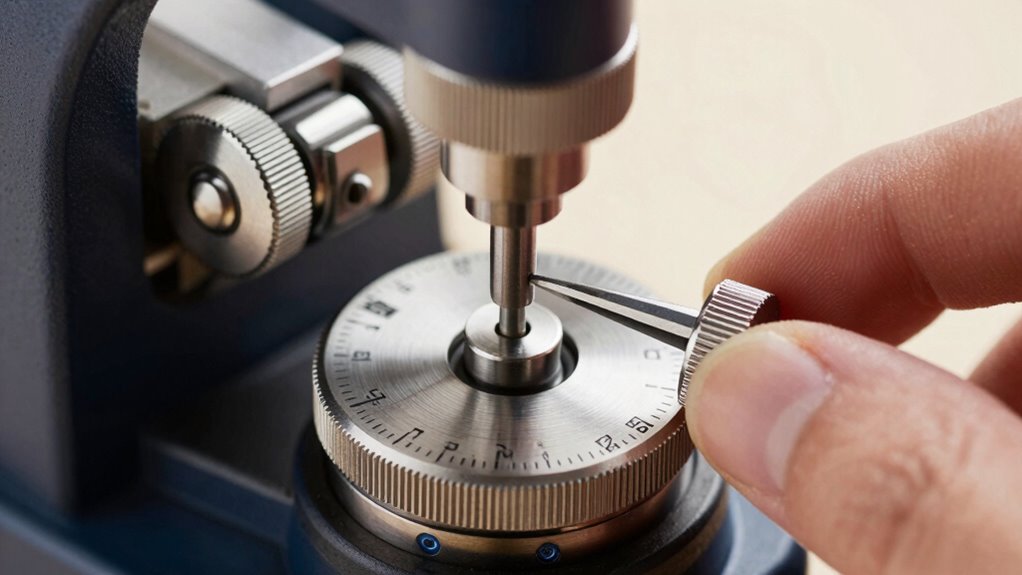
Ever wondered how to achieve flawless grind consistency on your coffee or spice grinder? The secret lies in understanding how tiny adjustments can make a big difference. When you dial in your grinder with micrometric precision, you’re fine-tuning the process to produce uniform grounds every time. This is especially important because coffee bean density varies from batch to batch, impacting how they grind. Denser beans require slightly different settings to achieve peak extraction, so your ability to make small, precise adjustments allows you to adapt to these differences effortlessly. It’s all about controlling grind size consistency, which directly influences the flavor, strength, and overall quality of your brew or spice blend.
Master micrometric adjustments for perfect, consistent grind quality tailored to each batch.
The key to mastering micrometric adjustment is recognizing that even the smallest turns of the grinder’s mechanism lead to significant changes in grind size. Many grinders feature a dial or knob with fine calibration, enabling you to incrementally tighten or loosen the burrs. When you make these tiny tweaks, you’re adjusting the distance between the grinding surfaces just enough to alter the particle size. This level of control lets you respond to subtle differences in bean density or desired grind texture — whether you need a coarse grind for French press or a fine one for espresso. The goal is to consistently produce grounds that are uniform in size, which ensures even extraction and a balanced flavor profile.
Practicing micrometric adjustments requires patience and attentiveness. Start by grinding a small amount and examining the particle size. If the grounds aren’t consistent or are too uneven, make a slight turn of the adjustment dial—no more than a fraction of a millimeter. Keep notes of your settings for different bean types and roast levels to streamline your process. Understanding the impact of grind size variation can help you better anticipate how small adjustments impact your results and improve your overall consistency. Over time, you’ll develop a sense for how each tiny change affects the grind size and extraction quality. Remember, the difference between a good shot and a great shot often hinges on these minute adjustments. When you refine your technique, you gain control over the variables that influence extraction, resulting in a richer, more flavorful cup or spice blend.
Developing an understanding of grind size variation can help you better anticipate how small adjustments impact your results and improve your overall consistency. In essence, micrometric grinder adjustment is about precision and awareness. You’re not just turning a knob; you’re fine-tuning your equipment to respond to the unique qualities of your beans or spices. This meticulous approach ensures consistent results, elevating your brewing or culinary experience. With practice, making these small, deliberate adjustments becomes second nature, allowing you to produce the perfect grind every time. It’s a small effort with a big payoff—tiny changes that lead to big shot differences in flavor, aroma, and overall quality.
micrometric coffee grinder adjustment
As an affiliate, we earn on qualifying purchases.
As an affiliate, we earn on qualifying purchases.
Frequently Asked Questions
How Often Should I Recalibrate My Micrometric Grinder?
You should recalibrate your micrometric grinder whenever you notice inconsistencies in grinding consistency or a decline in adjustment accuracy. Generally, doing it every few weeks or after changing beans or grind settings helps maintain peak performance. Regular calibration ensures tiny adjustments remain precise, preventing big shot differences. Pay attention to how your shots taste and look; if anything feels off, it’s time to recalibrate for the best espresso experience.
Can Improper Adjustments Damage the Grinder?
Improper adjustments can absolutely damage your grinder, turning it into a useless paperweight faster than you imagine. Think of it as trying to fine-tune a delicate instrument with a hammer—you’re risking the grinder’s lifespan and ruining adjustment accuracy. Over-tightening or forcing parts can grind down components, leading to costly repairs. Careful, precise adjustments protect your investment, ensuring your grinder stays sharp, accurate, and long-lasting for countless perfect espresso shots.
What’s the Best Method to Clean After Adjustment?
To clean your grinder after adjustment, start with gentle brushing to remove residual coffee grounds from the burrs and chute. Use a soft brush or a damp cloth for cleaning exterior parts. Incorporate regular cleaning techniques into your maintenance routines, like weekly burr removal and deep cleaning with grinder-specific cleaning tablets. This keeps your grinder functioning smoothly, preserves grind consistency, and extends its lifespan. Always unplug your grinder before cleaning.
Are There Specific Tools Needed for Precise Adjustments?
Think of adjustment techniques like tuning a fine instrument—you need the right tools. For precise adjustments, a dedicated calibration tool, like a feeler gauge or a screwdriver with a fine tip, is essential. I once struggled with inconsistent grinds until I used a caliper to measure and calibrate my grinder. These tools help you make tiny, accurate changes, ensuring your grinder performs at its best and produces consistent shots every time.
How Do Temperature Changes Affect Micrometric Adjustments?
Temperature changes can markedly impact your micrometric adjustments because of temperature stability and thermal expansion. When it’s warmer, metal parts expand slightly, which can cause your grind setting to shift, leading to inconsistent shots. Conversely, cooler temperatures cause contraction. To maintain precision, you should always adjust your grinder in a stable temperature environment and allow your equipment to acclimate before fine-tuning. This helps guarantee your adjustments remain accurate over time.
Conclusion
Remember, micrometric adjustments are like tuning a finely crafted instrument—you might only turn a tiny screw, but it can transform your shot from good to spectacular. By paying close attention to these minute changes, you hold the key to revealing perfect espresso every time. Think of it as guiding a delicate dance, where each small step makes all the difference. Master this art, and your coffee experience will always hit the high notes.
Halloween Picks
halloween
As an affiliate, we earn on qualifying purchases.