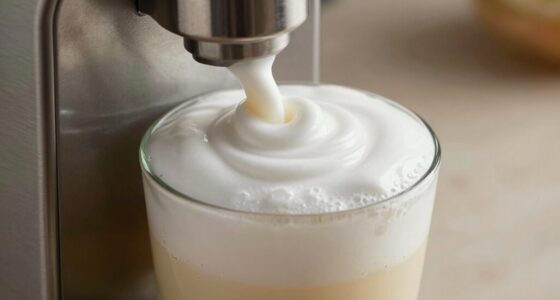

To create enthralling cappuccino art, focus on perfecting your foam texture with thick, stable microfoam. Use skillful pouring techniques, such as controlled wiggling, swirling, and starting from a higher position, to form patterns like hearts or leaves. You can also enhance your designs with etching tools for fine details. Mastering these techniques takes patience and practice, but if you keep experimenting, you’ll discover how to turn your coffee into a beautiful canvas.

Get coffee and tea gear delivered free — and shop member deals
- Fast, free delivery on millions of items
- Access to Prime Big Deal Days deals on October 6–7
- Prime Video, Amazon Music and more included
Key Takeaways
- Master proper foam texture and consistency to enable stable, detailed cappuccino art designs.
- Use controlled pouring techniques, including wiggling and swirling motions, to create patterns like hearts and rosettas.
- Start pouring from a higher position to evenly distribute foam before shaping the design.
- Employ etching tools to add fine details and enhance intricate patterns on the foam surface.
- Practice patience, steady motion, and control to improve skill and produce more precise, artistic cappuccino designs.

Ever wondered how baristas create intricate designs on your cappuccino? The secret lies in the artful manipulation of steamed milk and foam, along with precise pouring techniques. Unlike traditional latte art, which often relies on thin, silky foam, cappuccino art makes sure the foam is thicker and more stable. This texture allows for a wider range of creative possibilities, including etching and pouring designs like rosettas or hearts. When you order a cappuccino with a beautiful pattern, it’s not just about aesthetics; it’s a skillful display of control and technique.
Creating cappuccino art involves more than just pouring milk into coffee. Skilled baristas carefully control the flow of steamed milk, aiming for a consistency that’s thicker than what’s used for lattes. This thicker foam holds its shape better, making it easier to produce detailed designs. When pouring, instead of using just a steady stream, baristas often manipulate the motion—wiggling or swirling the pitcher—to form patterns. These movements, combined with the foam’s texture, help craft intricate shapes like leaves, hearts, or rosettas. The process is similar to latte art but requires adjustments due to the differing foam consistency.
Skilled baristas manipulate thick, stable foam with wiggling and swirling motions to craft intricate cappuccino patterns.
While latte art is more common on lattes, cappuccinos can also display beautiful patterns, especially when the foam is perfectly textured. Achieving this requires a specific technique; for example, some baristas start by pouring from a higher position to distribute the foam evenly, then lower the pitcher and make controlled wiggling motions to create a design. The key is to make sure the foam remains thick enough to hold the shape without collapsing. Additionally, understanding the texture stability of the foam is essential to maintain the design’s integrity during and after pouring.
Sometimes, instead of pouring, baristas use etching tools to add fine details or to enhance the design. This etching technique involves using a small stick or similar instrument to carve into the foam, which works best when the foam has a stable, dense texture.
If you want to try making cappuccino art at home, make sure to pay attention to the consistency of your steamed milk. Using cold water to clean your tools thoroughly helps maintain hygiene, but for the milk itself, focus on achieving the right foam texture. Instead of rushing, practice your pouring and wiggling motions slowly and steadily. Remember, creating beautiful cappuccino art isn’t about perfect symmetry every time—it’s about controlling your movements and understanding the foam’s behavior.
With patience and practice, you’ll be able to create stunning designs that make your morning coffee feel extra special.
Frequently Asked Questions
How to Draw Cappuccino Art?
To draw cappuccino art, you need to master steaming and pouring milk to create a thick foam perfect for designs.
Use a steady, thin stream and gentle wrist movements to form shapes like hearts or rosettas.
For more intricate patterns, etch into the foam with a toothpick.
Practice slow, controlled motions, focus on symmetry, and experiment with pouring techniques to develop your skills and create beautiful, recognizable designs.
What Are the 3 Different Styles of Latte Art Called?
You’re asking about the three main styles of latte art. First, there’s free-pour, where you pour milk directly into the espresso to create shapes like hearts and rosettas.
Next is etching, which involves using tools like toothpicks to carve designs into the foam.
Finally, stencil art uses paper stencils and powder to add detailed images on top of your coffee.
Each style offers unique results and techniques.
What Is the Difference Between Cappuccino Art and Latte Art?
You want to know what sets cappuccino art apart from latte art. The main difference lies in the foam texture: cappuccino has thicker, denser foam perfect for etching, while latte foam is thinner and more pourable for intricate pouring.
This affects the design style—cappuccino art tends to feature etched or more straightforward patterns, whereas latte art allows for more detailed, poured designs.
What Is the Trick to Latte Art?
The trick to latte art is mastering the pouring technique and milk texture. You need to control the microfoam to be velvety with tiny bubbles, making it easy to manipulate.
Keep your pour steady and at the right height, wiggling the pitcher tip to create contrast. Practice slow, deliberate movements, and execute firm cuts to form sharp, clean designs.
With patience and precision, you’ll improve your latte art skills.
Conclusion
Now that you know the basics of cappuccino art, you can start experimenting with different designs and techniques. Keep practicing to improve your skills and create stunning coffee art that impresses everyone. Remember, patience and persistence are key, so don’t get discouraged if your first attempts aren’t perfect. With time, you’ll master beautiful patterns and bring your coffee presentations to the next level. Enjoy the process and have fun making your own unique creations!
Halloween Picks
halloween
As an affiliate, we earn on qualifying purchases.