To calibrate your grinder, start by cleaning it to remove dust and old grounds. Adjust the grind size based on your brewing method—coarser for French press, medium for drip, finer for espresso—and brew a test shot. Watch for signs like sour, flat, or bitter flavors, or extraction times that are too quick or slow. Make small adjustments, repeat the process, and stay attentive to flavor and extraction to find your perfect grind. Keep learning more to refine your technique.

Get coffee and tea gear delivered free — and shop member deals
- Fast, free delivery on millions of items
- Access to Prime Big Deal Days deals on October 6–7
- Prime Video, Amazon Music and more included
Key Takeaways
- Regularly clean your grinder to remove old grounds and dust, ensuring consistent grind size.
- Adjust the grind size incrementally based on brew method and desired extraction time.
- Watch for signs like sour, flat, or bitter flavors indicating improper grind calibration.
- Test brew and taste after each adjustment to find the “sweet spot” for optimal flavor.
- Perform ongoing maintenance, check for worn burrs, and fine-tune to maintain consistent calibration.
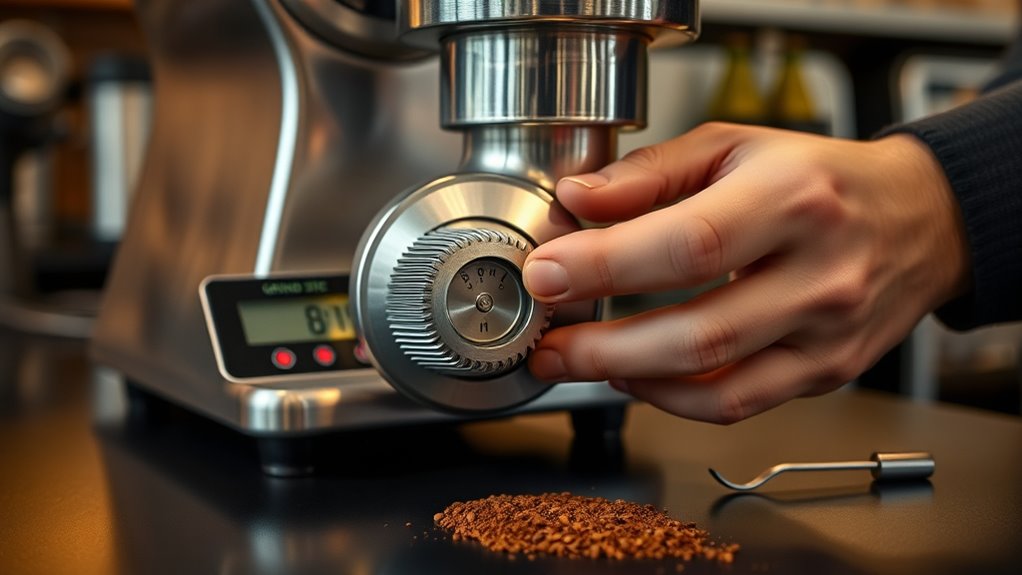
Calibrating your grinder is essential for achieving the perfect brew, as inconsistent grind sizes can lead to uneven extraction and a less flavorful cup. When your coffee tastes flat, sour, or overly bitter, it’s often a sign that your grinder needs some attention. Proper grinder maintenance is key to maintaining consistent performance, ensuring each brew delivers the rich flavors you’re aiming for. Regularly cleaning your grinder removes old grounds and dust that can clog or affect grind consistency, making it easier to adjust the grind size accurately.
Calibrating your grinder ensures consistent, flavorful brews by preventing uneven extraction and maintaining optimal performance.
Adjusting grind size might seem straightforward, but fine-tuning it requires careful attention. Start by selecting the right setting for your brewing method—coarser for French press, medium for drip, and finer for espresso. Once you’ve set your initial grind, brew a test cup. If the extraction feels too quick and the coffee is weak or sour, your grind is too coarse. Conversely, if the brew takes too long and tastes over-extracted or bitter, your grind is too fine. These signs tell you whether to make your grind coarser or finer.
Keep in mind that adjusting grind size isn’t a one-time fix; it’s an ongoing process. After each adjustment, brew again and taste the results. You want to find that sweet spot where the brew time aligns with your preferred flavor profile—usually around 25-30 seconds for espresso or 3-4 minutes for French press. If your adjustments don’t seem to improve the flavor or extraction time, it might be time to revisit your grinder maintenance routine. Dull burrs or misaligned components can hinder your ability to achieve a consistent grind, so replacing worn parts or recalibrating the burrs may be necessary.
Also, pay attention to the consistency of your grind. Even slight variations can impact extraction. Some grinders have micro-adjustments that let you fine-tune the grind size precisely. Use these features to dial in your settings. Be patient—small incremental adjustments often produce the best results. Remember, the goal is to maintain a uniform grind that allows water to extract flavors evenly from your coffee grounds. Additionally, understanding the causes of narcissism can help you navigate relationships with individuals exhibiting narcissistic traits, ensuring healthier interactions.
As an affiliate, we earn on qualifying purchases.
Frequently Asked Questions
How Often Should I Calibrate My Grinder?
You should calibrate your grinder every 1 to 2 months for peak performance, but it depends on your usage. Regular grinder maintenance is essential to keep your coffee consistent. If you notice uneven grounds, clumping, or changes in flavor, it’s a sign to check your calibration. Adjust the calibration frequency based on how often you brew and the type of beans you use to maintain perfect grind size.
Can I Calibrate My Grinder at Home?
Sure, you can totally calibrate your grinder at home—because who needs professional maintenance, right? With a little patience, you’ll improve your brewing consistency and keep your grinder functioning smoothly. Just follow some simple steps, pay attention to signs like uneven grounds or clogs, and you’ll be surprised how much better your coffee tastes. Home grinder calibration is doable, saves money, and keeps your morning routine on point.
What Tools Are Needed for Calibration?
You’ll need basic grinder maintenance and calibration tools like a digital scale, a set of calibration discs or shims, and a screwdriver. The digital scale guarantees precise measurement of grounds, while calibration discs help you adjust grind size accurately. A screwdriver is essential for making any necessary adjustments to the burrs or grinder settings. Using these tools, you can effectively calibrate your grinder at home for consistently great coffee.
How Do I Know if My Grinder Is Calibrated Correctly?
You can tell if your grinder is calibrated correctly by observing your coffee extraction. If it flows evenly and takes about 25-30 seconds for a shot, your grind size is right. Consistent grinder maintenance guarantees ideal performance. Adjust the grind if the shot pulls too quickly or slowly, and always test again. Proper calibration leads to better flavor and prevents over- or under-extraction, making your coffee truly satisfying.
Does Calibration Affect Coffee Flavor Significantly?
You might think calibration doesn’t impact flavor, but it really does. When your grinder isn’t properly calibrated, it affects consistency and can lead to uneven extraction, ultimately harming flavor preservation. Consistent grind size ensures you get the full, nuanced taste of your coffee. So, yes, calibration considerably impacts flavor because it helps maintain grinder consistency, allowing you to enjoy a richer, more balanced cup every time.
Conclusion
Think of your grinder as the compass guiding your perfect brew. When you calibrate it regularly, you’re setting a true course toward richer flavors and consistent results. Skipping this step is like sailing without a map—you’re bound to drift off course. Keep your grinder finely tuned, and let it be the steady anchor in your coffee journey. With each adjustment, you’re reaffirming your commitment to craftsmanship and the pursuit of that ideal cup.
Evergreen bestsellers Picks
bestsellers
As an affiliate, we earn on qualifying purchases.