TL;DR
Electric coffee grinders use a motor to turn whole beans into grounds, and grinding shortly before brewing helps preserve coffee aroma. Burr grinders usually give you more consistent grounds and easier adjustment than blade grinders, but the right choice depends on your brew method, budget, and workflow.
The first clue that you ground coffee too early is often the quietest one: your kitchen smells wonderful, but the brewed cup tastes flat. An electric coffee grinder turns whole beans into grounds with a motor, making it easy to grind close to brewing time and choose a size that fits your recipe.

Get coffee and tea gear delivered free with Prime
- Fast, free delivery on millions of items
- Prime Video, Amazon Music and more included
- Member-only deals all year
This guide explains how burr and blade grinders differ, what features matter in daily use, and how to match grind size to drip coffee, French press, or espresso. You’ll also get a simple way to dial in a cup and keep old coffee residue from muddying the next one.
Grind shortly before brewing to preserve more of your beans’ aroma.
Burr grinders generally give you more consistent grounds and repeatable adjustment than blade grinders.
Check a specific grinder’s espresso range and adjustment precision before buying; the burr label alone is not enough.
Use taste as a guide: try finer for sour or weak coffee and coarser for harsh or bitter coffee.
Brush out grounds regularly and follow the manual before cleaning internal parts.
Get fresher aroma by grinding just before you brew
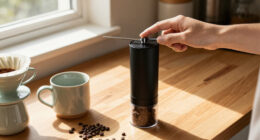
Electric coffee grinders turn whole beans into grounds using a motor, so you can grind the amount you need shortly before brewing. Compared with pre-ground coffee, fresh grinding helps preserve more of the beans’ aroma because volatile flavor compounds fade after grinding. It cannot rescue stale beans or poor water, but it can keep a good bag smelling lively for longer.
Think of grinding as opening a window: the rich smell rushes out, and the clock starts ticking. If you grind a week’s worth on Sunday, Monday’s coffee may still smell pleasant, but Friday’s scoop has spent days exposed to air. Grinding a 20-gram dose just before a morning pour-over gives you a brighter aroma with little extra effort.
The grinder also shapes how water moves through coffee. Finer grounds expose more surface area and generally extract faster; coarser grounds generally extract more slowly. A medium setting on one brand may not match another, so treat the dial as a map for that machine, not a universal measurement.
Fresh grinding improves aroma, while a suitable grind helps control extraction. You need both for a cup that tastes balanced.
Products Worth Considering

Cuisinart Caskata PerfecTemp 1.7-Liter Electric Kettle, Cordless with 1500W Fast Heat-Up and 6 Preset Temperatures

Instant Pot Pro Plus 6-Quart 10-in-1 Electric Pressure Cooker

Traeger Ranger Portable Wood Pellet Grill and Smoker with Cast Iron Griddle
As an affiliate, we earn on qualifying purchases.
Choose burrs for control or blades for a tighter budget
Electric coffee grinders use either burrs that crush beans between two surfaces or a spinning blade that chops them. Burr grinders usually produce a more even mix of particle sizes and make it easier to repeat a setting, while blade grinders cost less and take up little space. The better fit depends on how often you brew and how much control you want.
Imagine a Saturday French press: a compact blade grinder may be fine when you want an inexpensive, occasional cup. But if you brew drip coffee each morning and keep chasing a sour cup one day and a bitter one the next, more consistent burr grounds can make adjustments easier to understand. Blade grinders tend to leave both powder-fine bits and chunky pieces together, which can extract unevenly.
Burrs may be conical or flat. Either design can make good coffee; burr geometry, material, alignment, speed, and construction all play a part. A model with 40 printed settings does not automatically outperform one with fewer clicks if its adjustment is hard to repeat or its grind is inconsistent.
- Pick a burr grinder if you brew regularly or want more control.
- Consider a blade grinder if cost, compact size, and occasional use matter most.
- Check the specific model if you plan to brew espresso; not every burr grinder can grind finely or adjust precisely enough.
Match the grind range to the coffee you actually make
Electric coffee grinders need a useful grind range for your brewing method, and espresso puts the greatest demand on fine, precise adjustment. Drip coffee and French press usually use coarser grounds, while espresso needs grounds fine enough to control a short, pressurized extraction. A grinder that covers your daily brewer may not work well for every method you hope to try.
For instance, if you make drip coffee on weekdays and French press on weekends, look for a grinder with a broad range and settings you can return to. If you also want espresso, check independent reviews for that exact model’s espresso performance; the word “burr” on a product page is not proof it can dial in a shot. A stepless grinder allows continuous adjustment, which can help with small espresso tweaks, while stepped controls click into preset positions that are simpler to repeat.
Use taste and brew time as clues, not strict laws. If your coffee tastes sour or weak, try a finer grind; if it tastes harsh or bitter, try a coarser one. Change one thing at a time, since coffee, water, dose, and brewing time all affect the result.
- Start with the grinder maker’s suggested range for your method.
- Brew a measured dose and note the setting and time.
- Taste, then adjust slightly finer for sour or weak coffee, or coarser for harsh or bitter coffee.
- Record the result so you can return to a cup you liked.
Compare features by how they change your morning
Electric coffee grinders are easier to choose when you compare their daily workflow instead of counting settings or chasing the newest feature. Dose handling, retention, noise, size, and cleaning determine whether a grinder feels convenient at 6:30 a.m. A built-in scale or timer can save a step, but neither replaces burr quality or repeatable adjustment.
Picture making one espresso before work. Grinding straight into a portafilter may be fast, while a dosing cup can make it easier to weigh beans and switch between brews. If you grind a single dose at a time, low retention—the amount of grounds left inside after grinding—can reduce stale remnants and make changing coffees less messy. No grinder eliminates every leftover particle, though.
Use this comparison to focus on the tradeoffs. A café-style feature may sound impressive, yet a bulky, loud machine can be annoying in a small apartment. Choose the details that solve a real problem in your kitchen.
| Feature | Why it matters | Good fit |
|---|---|---|
| Stepped or stepless adjustment | Changes how easily you repeat or fine-tune a setting | Stepped for simple routines; stepless for fine espresso tuning |
| Timer or built-in scale | Helps control dose and speed up preparation | Useful when you want repeatable portions |
| Low retention | Leaves fewer grounds inside between doses | Helpful if you change beans or brew styles often |
| Size and noise | Affects counter space and household comfort | Worth checking for small kitchens or early starts |
Keep stale coffee oils out of tomorrow’s cup
Regular cleaning helps remove old grounds and coffee oils that can add stale or rancid flavors to a fresh brew. Brush loose particles away often, and follow the manufacturer’s directions for deeper cleaning. Burrs and internal parts are not automatically washable; water in the wrong place can damage a grinder.
For example, if you open the grounds bin and catch a dusty, oily smell, that residue can mingle with your next dose. A quick brush after grinding and a more thorough clean at the interval recommended in the manual can help keep flavors clearer. If you change from a dark, oily roast to a delicate light roast, removing leftover grounds is especially helpful.
Burrs also wear over time, particularly with heavy use, but there is no single replacement schedule for every machine. How much coffee you grind, burr material, and the maker’s design all affect their lifespan. If your grinder is clean but its results have become inconsistent, check the manual and reviews to see whether worn or misaligned burrs could be involved.
- Brush away loose grounds regularly.
- Follow the manual for deeper cleaning and avoid washing parts unless the maker says they are washable.
- Investigate persistent inconsistency after cleaning; the cause may be the beans, feed, burr condition, or setting.
Spend on the feature you will notice every day
A good grinder choice is the one that solves your brewing problem at a price and size that suit your home. If you make a single French press on weekends, a simple model may be enough; if you pull espresso shots daily, fine adjustment and repeatability deserve more weight. Paying for an app or built-in scale makes sense only if that feature improves your routine.
Consider a household where one person makes drip coffee and another experiments with espresso. One grinder may cover both, but only if its range and adjustment suit espresso as well as coarser brews. Otherwise, the “one machine for everything” promise can lead to frustration each morning, like trying to use a blunt kitchen knife for delicate slicing.
Electric grinders have increasingly borrowed café features such as compact burr sets, quieter motors, single-dose workflows, and electronic controls. Those additions can be handy, but product specifications change often and a feature list cannot tell you how a machine performs in your kitchen. Check current specifications and independent reviews for the brew methods you use, then prioritize the grounds and workflow you can judge in your own cup.
Key facts and buying advice: match the grind range to your brewers, value adjustment quality over a large setting count, and consider noise, cleaning, and counter space alongside flavor. For many regular coffee drinkers, a capable burr grinder is a practical upgrade; an occasional brewer may prefer a smaller, less expensive option.
Frequently Asked Questions
Is a burr grinder worth it?
If you brew regularly or want more control, a burr grinder is often worth the extra cost because it usually gives you more even grounds and easier adjustment. If you make coffee only now and then, a budget blade grinder may be adequate.
Can one electric grinder handle espresso and French press?
Some grinders can cover both, but grind range and adjustment precision vary by model. Espresso is the harder requirement, so check reviews for that specific grinder before relying on it for shots and coarse French press grounds.
What grind size should I start with?
Start with the range suggested for your brewing method, then adjust to taste and brew time. Try a finer setting if the cup tastes sour or weak, and a coarser one if it tastes harsh or bitter; treat those as starting points, not universal rules.
Should I grind beans right before brewing?
Usually, yes. Grinding shortly before brewing helps retain more aroma than grinding far in advance, so weigh the dose you need and grind it just before you make the cup.
Do more grind settings mean a better grinder?
No. The quality and repeatability of the adjustment matter more than the number printed on the dial. A smaller set of useful, consistent settings can be easier to work with than many settings that do not produce reliable results.
How should I clean an electric coffee grinder?
Brush loose grounds away regularly and follow the manufacturer’s directions for deeper cleaning. Do not wash burrs or internal parts unless the manual says they are safe to wash.
Conclusion
Choose your grinder around the coffee you actually make: a reliable grind range, repeatable adjustment, and a workflow you enjoy will matter more than a dial crowded with numbers. If you brew regularly and want more control, start by comparing burr models that suit your methods and kitchen.
Then grind a measured dose just before brewing, make one small adjustment at a time, and let the aroma tell you when the beans are ready.