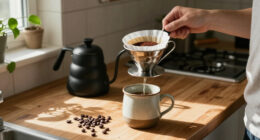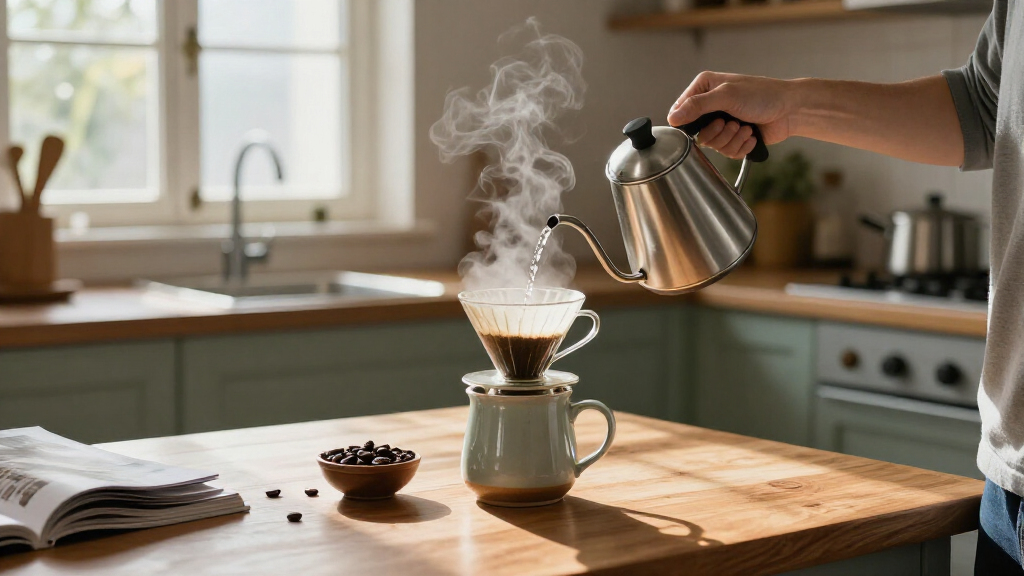
Choosing between a pour-over coffee maker and a French press is a choice between control and convenience. Both can make excellent coffee without an electric machine, but they ask for different routines and produce noticeably different cups. Pour-over rewards a steady hand and careful attention to water flow; French press is more forgiving to operate and leaves more oils and fine particles in the drink.

Get coffee and tea gear delivered free with Prime
- Fast, free delivery on millions of items
- Prime Video, Amazon Music and more included
- Member-only deals all year

AeroPress Original Coffee Press – French Press, Pour-Over & Espresso Style
- ✔ Capacity: 10 ounces
- ✔ Dimensions: 1.87 × 1.87 × 4.63 inches
- ✔ Weight: 6.4 ounces

FinalPress Original Coffee & Tea Maker Portable Stainless Steel Micro French Press
- ✔ Capacity: 1 liter (as listed)
- ✔ Dimensions: 1.3 × 1.3 × 6.5 inches
- ✔ Weight: 8.16 ounces

Pour Over Coffee Dripper Stainless Steel Reusable Filter 600 Mesh Ultra-Fine 1-2 Cup Portable
- ✔ Brand: Trekbrew
- ✔ Model: KFD-02
- ✔ Material: BPA-free stainless steel
The difference matters most if you have a preferred taste or a particular morning routine. Choose pour-over if you enjoy a lighter, clearer cup and want to adjust each brew. Choose French press if you prefer a richer mouthfeel, want to brew several cups at once, or value a straightforward method. Neither requires a large investment, though the ongoing cost and cleanup differ.
At a Glance
| Criteria | Pour-over coffee maker | French press | Winner |
|---|---|---|---|
| Cup profile | Clean, lighter-bodied, with more clarity | Fuller-bodied, with more oils and sediment | Depends |
| Control | High; adjust grind, pouring, and timing | Moderate; adjust grind and steep time | A |
| Ease of brewing | Requires a steady pour and some attention | Simple steep-and-plunge routine | B |
| Capacity | Usually one to a few cups, depending on dripper | Commonly several cups per batch | B |
| Cleanup | Paper filter goes in compost or trash; rinse dripper | Spent grounds can cling to the mesh and plunger | A |
| Ongoing costs | Recurring paper filters | No paper filters required | B |
| Best use | Careful single cups and lighter roasts | Shared servings and low-fuss brewing | Depends |
AeroPress Original Coffee Press – French Press, Pour-Over & Espresso Style
The AeroPress Original takes the top spot because it gives us the broadest range of brewing approaches in one lightweight tool. Its manual pressure system and paper micro-filters can produce coffee in French press, pour-over, or espresso-style directions, with the supplied description placing a brew at about two minutes. That flexibility makes it more adaptable than the FinalPress, which focuses on a direct-to-mug micro press, and more method-diverse than the Trekbrew, which is specifically a pour-over dripper.The tradeoff is that versatility comes with a small serving size and a little technique. At 10 ounces, it is geared toward one cup, so making coffee for several people means repeating the process. Paper filters also create an ongoing supply to manage, unlike the reusable steel filters on the other two picks. And while the grounds are designed to eject for easy cleanup, getting consistent pressure can take practice. We would choose it when experimenting with brew styles matters more than brewing a large batch in one go.
Pros:
- Supports French press, pour-over, and espresso-style brewing approaches.
- Compact and lightweight for travel, camping, or quick home brewing.
- Designed to brew a cup in about two minutes.
- Grounds can be popped out, simplifying cleanup.
Cons:
- The 10-ounce capacity may mean multiple brews for groups.
- Uses paper micro-filters that need replenishing.
- Manual pressure may feel inconsistent until the technique is familiar.
Best for: Coffee drinkers who want one portable gadget for trying several manual brewing styles and usually make one cup at a time.
Not ideal for: Buyers who want a large batch, prefer to avoid disposable filters, or do not want to learn a pressure-based brewing routine.
Bottom line: We recommend the AeroPress as the most adaptable pick for single-cup brewers willing to use paper filters and practice its manual pressure technique.
“We recommend the AeroPress as the most adaptable pick for single-cup brewers willing to use paper filters and practice its manual pressure technique.”
FinalPress Original Coffee & Tea Maker Portable Stainless Steel Micro French Press
For a compact brew made straight in a mug, the FinalPress Original has the clearest purpose in this lineup. Its collapsible, pocket-size form and stainless-steel construction are designed for coffee or tea at an office, campsite, or on the move. The maker describes a fast extraction of about two minutes using a patented plunger system with steel springs. Compared with the AeroPress, it avoids paper micro-filters; compared with the Trekbrew, it does not ask us to pour slowly through a dripper.That simplicity narrows its appeal. The FinalPress is a manual press, so we still need to push the plunger, and the maker’s claimed mess-free process does not remove the need to rinse a reusable filter. It also offers fewer distinct brewing styles than the AeroPress, while the Trekbrew gives pour-over fans a more explicitly controlled water-flow routine. The listed capacity is 1 liter, a figure worth checking against the intended mug and serving size before purchase. We see it as a travel-first choice for someone who values a compact, reusable press more than a multi-method brewer.
Pros:
- Collapsible design is suited to pocket, travel, camping, and office use.
- 304 stainless steel resists rust, bending, and warping.
- Reusable filter avoids paper filters, pods, and capsules.
- Described as brewing hot, iced, or cold coffee and tea.
Cons:
- Manual plunger operation takes effort.
- Offers a more focused press method than the AeroPress’s three-style versatility.
- The stated 1-liter capacity may not align with its micro-press form, so buyers should confirm the intended volume.
Best for: Travelers, campers, and office coffee drinkers who want a compact manual press for coffee or tea directly in a mug.
Not ideal for: People who want several brewing methods, dislike pressing manually, or need a clearly documented larger batch setup.
Bottom line: We would pick the FinalPress for compact, reusable mug brewing when portability and avoiding paper filters matter more than method flexibility.
“We would pick the FinalPress for compact, reusable mug brewing when portability and avoiding paper filters matter more than method flexibility.”
Pour Over Coffee Dripper Stainless Steel Reusable Filter 600 Mesh Ultra-Fine 1-2 Cup Portable
The Trekbrew stainless steel dripper is the specialist choice for people who like pour-over coffee and want a filter they can wash and reuse. Its double-layer 600-mesh screen has listed 20-micron pores, while spiral ribs and wide drain holes are designed to guide water through the grounds. That gives it a different feel from the two plungers: the AeroPress uses pressure to broaden the brewing styles available, and the FinalPress keeps brewing contained in a compact press. Trekbrew instead makes the pour itself central to the routine.That routine can be rewarding for a careful brewer, but the fine mesh calls for attention. The product information warns that overly fine grounds can clog it, so grind choice and rinsing matter. Its 1–2 cup capacity also limits batch size, and it will not offer the AeroPress’s pressure-based style variations or the FinalPress’s collapsible pocket form. In return, it skips paper filters and is listed as fitting standard #02 setups, including most mugs, carafes, Chemex, Kalita Wave, and V60. We would choose it when reusable filtration and pour-over compatibility are the priorities.
Pros:
- Reusable stainless-steel filter avoids disposable paper filters.
- Double-layer 600-mesh screen is designed to limit sediment.
- Lightweight, one-piece design is washable and portable.
- Fits many standard #02 pour-over setups and vessels.
Cons:
- Limited to 1–2 cups per brew.
- Fine mesh can clog with overly fine grounds and needs thorough rinsing.
- Requires a controlled pour, unlike the more contained press methods.
Best for: Pour-over drinkers who want a lightweight, reusable stainless filter for one or two cups at home, work, or while traveling.
Not ideal for: People who need larger batches, want a press-style or espresso-style option, or prefer a filter that needs little attention after brewing.
Bottom line: We recommend the Trekbrew for pour-over fans who want a reusable, compatible filter and accept the small batch size and extra mesh care.
“We recommend the Trekbrew for pour-over fans who want a reusable, compatible filter and accept the small batch size and extra mesh care.”
As an Amazon Associate we earn from qualifying purchases.
Key Differences
The largest difference is in the cup. A paper-filtered pour-over catches much of the coffee’s fine sediment and oils, which tends to make the result taste cleaner and feel lighter. French press lets more oils and particles through its metal mesh, producing a weightier texture. These are tendencies, not guarantees: bean choice, grind, water, and technique all affect the result.
The second difference is how each method fits into a routine. Pour-over gives you more ways to shape the brew, but that control depends on attention to the pour and timing. French press requires a coarse grind, a measured steep, and a plunge. It is easier to repeat without special pouring technique, though its mesh parts take more effort to clean.
For value, French press has the edge if avoiding recurring supplies and making multiple servings matter most. Pour-over is a good buy for people who value its particular cup and enjoy the brewing ritual. A costly kettle or premium brewer is not necessary to begin with either method; pay more for pour-over equipment only if greater control and consistency matter to you.
Detailed Comparison
Cup profile (major difference)
Pour-over usually wins for clarity: the paper filter removes much of the sediment and oil, allowing delicate flavors to come through with a lighter feel. French press wins for body, carrying more oils and fine particles into the cup. This is a major difference if texture is a priority, but it is a preference rather than a quality ranking. Choose based on whether you want a cleaner cup or a richer one.
Control (Pour-over coffee maker wins — moderate)
Pour-over wins by a moderate margin for hands-on adjustment. You can change the grind, water flow, pour pattern, and timing during the brew, which gives you several ways to refine a cup. French press still allows control over grind and steep time, but the process has fewer moving parts. That makes pour-over appealing to coffee hobbyists and French press easier for people who want a dependable routine.
Ease of brewing (French press wins — moderate)
French press wins by a moderate margin for ease. Add coffee and hot water, wait, then press; you do not need to keep a careful stream of water moving over the grounds. Pour-over asks for more attention while brewing, especially if you want repeatable results. For a rushed morning, French press is more forgiving; for someone who likes a focused brewing ritual, the extra steps can be part of the appeal.
Capacity (French press wins — moderate)
French press wins for making several servings in one batch. Many models are sold in sizes suited to sharing, while a single pour-over dripper is often designed around one or two cups. Larger pour-over brewers are available, so the gap depends on the setup, but batch size is a clear practical advantage for the press. Choose it if you regularly serve more than one person.
Cleanup (Pour-over coffee maker wins — minor)
Pour-over usually wins by a minor to moderate margin. Remove the paper filter and grounds together, then rinse the dripper. A French press needs its grounds removed, and coffee residue can remain caught in the mesh or around the plunger. The press is still simple to clean, but it involves more contact with wet grounds. If quick disposal matters, paper filtration is convenient.
Ongoing costs (French press wins — minor)
French press wins by a minor margin because its metal filter is reusable and does not require paper filters. Pour-over adds a small recurring expense, although some drippers can use reusable filters. The cost difference is modest for most households; it becomes more relevant with frequent brewing or a preference to avoid disposable supplies. Do not choose solely on filter cost if the cup profile matters more.
Best use (major difference)
There is no overall winner here. Pour-over suits careful single cups, experimentation, and beans whose subtler flavors you want to pick out. French press suits larger batches, fuller-bodied coffee, and a routine with fewer technique demands. The practical choice comes down to what you brew most often and how much attention you want to give the process.
Pour-over coffee maker: Pros and Cons
Pros:
- Produces a clean cup with little sediment
- Offers many opportunities to adjust flavor
- Paper filters make spent grounds quick to discard
Cons:
- Needs more attention during brewing
- Often better suited to one or two servings at a time
- Paper filters add a recurring cost
French press: Pros and Cons
Pros:
- Makes fuller-bodied coffee
- Simple steep-and-plunge method
- Reusable mesh avoids paper filter purchases
- Convenient for brewing multiple servings
Cons:
- More sediment and oils remain in the cup
- Mesh and plunger need thorough rinsing
- Less control over water flow during extraction
Who Should Choose What
Choose Pour-over coffee maker if:
- You prefer a clean, lighter-bodied cup.
- You like adjusting grind, pour, and timing to refine a brew.
- You usually make one cup and value quick disposal of grounds.
Choose French press if:
- You prefer a richer texture and do not mind some sediment.
- You want to make several servings in one batch.
- You want a simple method with no routine paper filter purchases.
Skip both if: Skip both if you need coffee ready at the push of a button or want an insulated, hands-off brewer; an automatic drip machine may fit your routine better.
Value for Money
French press is the stronger value for most people focused on cost and batch size: a basic model needs no paper filters, and one brew can serve several people. Pour-over is worth paying more for when its cleaner cup and hands-on control match what you want every day. Start with a simple dripper and a basic kettle; upgrade only if more precise pouring would improve your results enough to justify the expense. The recurring filter cost is generally small, so taste and routine should carry more weight than price alone.
Final Verdict
For most households seeking an easy, versatile manual brewer, choose French press: it is straightforward, handles multiple servings, and delivers a rich cup without recurring filter purchases. Choose pour-over if a clean profile and the ability to fine-tune each brew matter more than speed or batch capacity. The biggest deciding factor is the coffee you want to drink—clear and light points to pour-over; full and textured points to French press.
Frequently Asked Questions
Which makes stronger coffee, pour-over or French press?
Neither method is automatically stronger. Coffee-to-water ratio, grind, brew time, and bean choice affect strength. French press often feels heavier because more oils and fine particles stay in the cup, but that does not necessarily mean it contains more caffeine.
Is French press easier to use than pour-over?
Usually. French press uses a simple steep-and-plunge process, while pour-over needs a controlled pour and more attention during brewing. Both take practice to make consistently, but French press is generally more forgiving for everyday use.
Which one is better for making coffee for two or more people?
French press is often the more convenient choice because common models brew several cups at once. A larger pour-over brewer can serve multiple people too, but a small dripper may require separate rounds.
Does a pour-over require paper filters?
Many pour-over drippers use paper filters, which make grounds easy to discard and contribute to a clean cup. Reusable metal or cloth filters are alternatives, though they can change the texture and require cleaning.