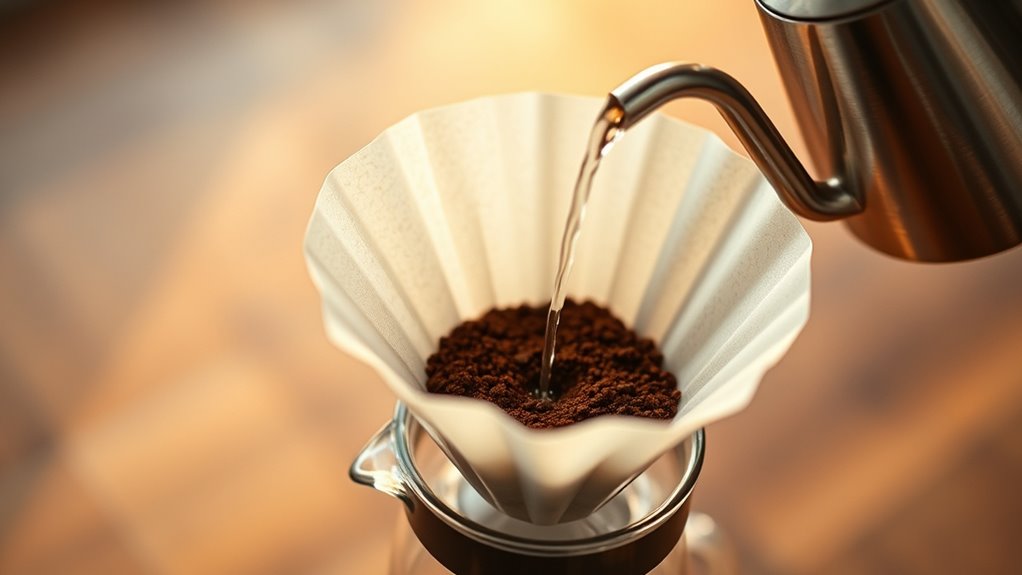
To brew a great V60 pour-over, start by using a medium grind similar to granulated sugar, which balances flow and extraction. Pour steadily over the coffee, aiming for a total brew time of about 2.5 to 3.5 minutes—adjust your grind if it’s too fast or slow. Control your pouring technique with patience and consistency to guarantee even saturation. Keep refining these steps to improve flavor, and you’ll uncover more tips for ideal results.

Get coffee and tea gear delivered free — and shop member deals
- Fast, free delivery on millions of items
- Access to Prime Big Deal Days deals on October 6–7
- Prime Video, Amazon Music and more included
Key Takeaways
- Use a medium grind similar to granulated sugar for optimal water flow and extraction.
- Pour slowly and steadily to ensure even saturation and consistent brew time.
- Aim for a total brew time of 2.5 to 3.5 minutes; adjust grind size if timing is off.
- Maintain water temperature around 200°F and use a scale and timer for precision.
- Practice and small adjustments in grind size and pouring technique improve flavor and consistency.
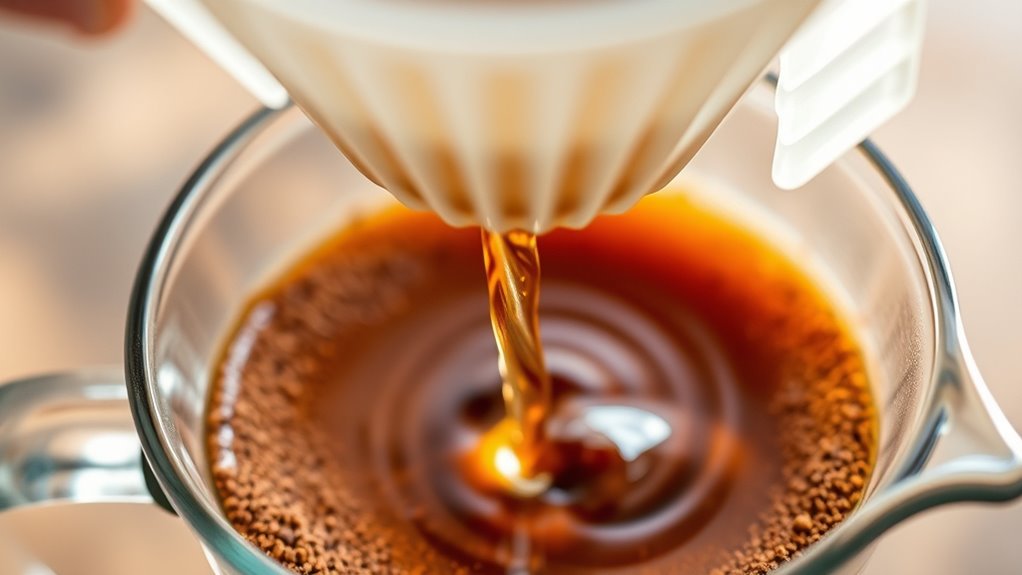
Have you ever wondered how to elevate your coffee brewing game? The secret lies in mastering the fundamentals of pour-over, especially when it comes to grind size and brewing time. These elements are vital because they directly influence the extraction process, impacting the flavor and aroma of your coffee. When you choose the right grind size, it guarantees water flows through the coffee evenly, preventing under- or over-extraction. For a V60, a medium grind—similar to granulated sugar—is typically ideal. If your grind is too fine, water struggles to pass through, leading to a bitter, over-extracted cup. Conversely, if it’s too coarse, the water rushes through too quickly, resulting in a weak, under-extracted brew. Adjusting the grind size allows you to fine-tune your extraction, giving you more control over the final flavor profile.
Brewing time is equally important; it’s the window during which your coffee interacts with water. A standard pour-over process usually takes around 2.5 to 3.5 minutes, but this can vary based on your grind size and pouring technique. When you start pouring, do so slowly and steadily, aiming for an even saturation of all the grounds. Keep an eye on the clock and your coffee’s progress—if the total brewing time stretches beyond 4 minutes, your grind might be too fine, causing resistance and longer extraction. If it finishes in under 2.5 minutes, your grind could be too coarse, resulting in a watered-down taste. Consistency in pouring technique helps maintain a steady brewing time, which in turn guarantees uniform extraction.
Additionally, automation in coffee technology is increasingly being integrated into brewing devices, helping to achieve more precise control over variables like temperature and timing, leading to better consistency. To get the best results, you want to find a balance between grind size and brewing time. You can experiment by adjusting the grind slightly finer or coarser and observing how it affects your brew’s timing and flavor. Using a scale to measure your water and a timer to track brewing time makes these adjustments more precise. Also, consider the temperature of your water—around 200°F is ideal because it extracts the flavors efficiently without scalding the coffee. As you refine your process, you’ll notice improvements in the clarity, brightness, and overall quality of your pour-over coffee. Remember, patience and small tweaks are key. With practice, you’ll develop a rhythm that produces consistently delicious cups, all by paying close attention to your grind size and brewing time.
As an affiliate, we earn on qualifying purchases.
Frequently Asked Questions
Can I Use Pre-Ground Coffee for Pour-Over?
Yes, you can use pre-ground coffee for pour-over, but it’s not ideal. Pre-ground coffee quickly loses its freshness, which affects flavor. Plus, grind consistency might not be perfect, leading to uneven extraction and a less balanced cup. For the best results, grind your beans just before brewing to guarantee ideal coffee freshness and consistent grind size, giving you a richer, more flavorful pour-over experience.
What’s the Ideal Water Temperature for V60 Brewing?
You might think boiling water is best, but actually, the ideal water temperature for V60 brewing is around 195-205°F (90-96°C). Too hot, and you risk over-extraction; too cold, and your coffee’s underwhelming. Your grind size matters too—finer for cooler water, coarser for hotter. So, get your water just right, and remember, precision beats passion when brewing a perfect cup.
How Do I Adjust the Brew Time for Different Beans?
To adjust brew time for different beans, start by changing your grind size—finer for a quicker brew, coarser for a longer one. Also, refine your pour technique; a slow, steady pour can extend extraction, while a quick pour shortens it. Experiment with these adjustments until you find the perfect balance for each bean, ensuring ideal flavor and extraction. Consistent practice helps you master how grind size and pour technique influence brew time.
Is It Necessary to Rinse the Paper Filter?
Don’t leave anything to chance; rinsing the paper filter is vital for filter preparation. It helps remove paper taste and guarantees brewing consistency. Plus, it warms the dripper and mug, stabilizing the temperature. You might think it’s extra effort, but it’s worth it for a cleaner cup. Just pour hot water through the filter before adding coffee—your brew will taste fresher and more balanced every time.
Can I Reuse the V60 Dripper for Multiple Brews?
You can reuse your V60 dripper for multiple brews, but it’s best to do filter reuse with fresh paper filters each time for best flavor and cleanliness. After brewing, always perform thorough dripper cleaning to remove coffee oils and residue, which helps prevent flavor carryover. Regular cleaning ensures your pour-over maintains great taste and prolongs the lifespan of your equipment, making each brew consistently delicious.
Conclusion
Now that you’ve mastered the V60 pour-over method, think of it like tending a garden. Just as a gardener carefully waters and nurtures each plant for ideal growth, your attention to grind size, pouring technique, and timing cultivates a perfect cup. Remember, even seasoned baristas started just like you—learning step by step. With practice, you’ll find brewing becomes second nature, and every cup becomes a rewarding harvest. Keep experimenting, and enjoy the rich, delightful results!
Halloween Picks
halloween
As an affiliate, we earn on qualifying purchases.