The right whole house water filter system for coffee lovers can transform your daily brew, because chlorine, sediment, and off-flavors from unfiltered tap water are some of the most common culprits behind flat, bitter coffee. After comparing 13 leading systems, the Express Water 3-Stage Ultimate Protection stands out as the best overall pick for its balance of thorough filtration, solid build, and reasonable upkeep. The iSpring WGB32B is the stronger choice if you want commercial-grade durability, while the A. O. Smith 600,000-Gallon system makes the most sense for buyers who hate frequent filter changes. The main tradeoff in this category is between filtration depth and maintenance burden — three-stage systems polish water for flavor but demand more cartridge swaps, while single- or two-stage setups are simpler but may leave behind the fine tastes coffee enthusiasts notice. Keep reading for the full breakdown, including who each system suits and which ones to skip.

Get coffee and tea gear delivered free with Prime
- Fast, free delivery on millions of items
- Prime Video, Amazon Music and more included
- Member-only deals all year
Complete the kit


Key Takeaways
- Three-stage systems dominated the top of the ranking because coffee flavor benefits most from the second carbon stage that strips chlorine taste and odor, not just sediment.
- Long cartridge life emerged as a hidden differentiator: the A. O. Smith 600,000-gallon system and the well-water bundles with two-year filter supplies cost less to own over time despite higher upfront demands.
- Several budget three-stage units (Aquaboon, WF3-01) filter adequately for coffee but use generic housings and thinner brackets, which matters if the system sits in a cold garage or crawlspace.
- Dedicated well-water systems earned their own tier because iron and sulfur — not just chlorine — are the flavor killers coffee drinkers on private wells need to address first.
- Two-stage systems like the iSpring WGB21B and Waterdrop WHF21-PG are the sweet spot for city-water users who want better coffee without paying for a third stage they may not need.
| Express Water 3-Stage Whole House Water Filter System – Ultimate Protection |  | Best Overall | Stages: 3-Stage Filtration | Filtration Media: Activated Carbon, KDF, Polyphosphate | Maximum Flow Rate: 17 gpm | VIEW ON AMAZON | See Our Full Breakdown |
| Aquaboon 3-Stage Whole House Water Filter System with 5 Micron 10×4.5 Filters |  | Best Value | Stages: 3 | Filter Size: 10 x 4.5 inches | Stage 1: Pleated non-woven polyester sediment filter | VIEW ON AMAZON | See Our Full Breakdown |
| Whole House Water Filter System for Well Water, 3-Stage, 2-Year Filter Supply |  | Best for Beginners | Stages: 3 | Filter Life: 6 months per cartridge set | Maximum Flow Rate: 15 gpm | VIEW ON AMAZON | See Our Full Breakdown |
| WF3-01 3-Stage Whole House Water Filtration System | 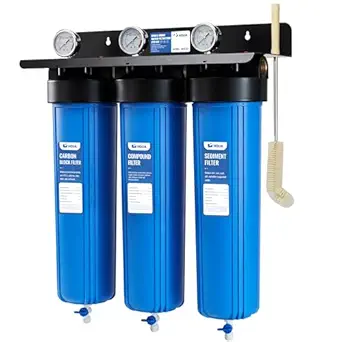 | Best Premium Filtration Range | Stages: 3 | Filter Size: 20″ x 5.5″ (each) | Contaminants Reduced: Heavy metals, chlorine, sediment, odor, VOCs | VIEW ON AMAZON | See Our Full Breakdown |
| A. O. Smith Whole House Water Filter System, 600,000-Gallon Capacity |  | Best Low-Maintenance Pick | Filtration Method: Activated carbon | Chlorine Reduction: 96.9% of chlorine taste and odor | Capacity: 600,000 gallons | VIEW ON AMAZON | See Our Full Breakdown |
| PUREPLUS 2-Stage Whole House Water Filter with Pressure Gauges |  | Best for Filter Monitoring | Stages: 2 | Filter types: Polypropylene sediment and activated carbon block | Certification: NSF/ANSI 42 | VIEW ON AMAZON | See Our Full Breakdown |
| iSpring WGB32B Commercial-Grade Whole House Water Filter System |  | Best for High-Use Households | Stages: 3 | Filtration: 5-micron sediment filter and 2 CTO coconut shell carbon block filters | Capacity: 100,000 gallons (approximately 1 year) | VIEW ON AMAZON | See Our Full Breakdown |
| Waterdrop WHF21-PG 2-Stage Whole House Water Filter System, 5 Micron |  | Best for Municipal-Water DIY Installation | Stages: 2 | Filter types: 5-micron PP sediment and coconut shell GAC | Filter size: 10 × 4.5 inches | VIEW ON AMAZON | See Our Full Breakdown |
| Waterdrop WHF3E-SKH 3-Stage Whole House Water Filter System for Well Water |  | Best for Scale Reduction | Stages and layers: 3 stages; 9 filtration layers | Listed reduction claims: Scale: 93.63%; chlorine: 98%; lead: 99.9% | Certification and testing: NSF/ANSI 372 certified; tested with reference to NSF/ANSI 42 and 53 | VIEW ON AMAZON | See Our Full Breakdown |
| iSpring WGB21B Two-Stage Whole House Water Filtration System |  | Best for Simple, Mineral-Preserving Filtration | Stages: 2 | Sediment filter: 5-micron polypropylene | Carbon filter: CTO | VIEW ON AMAZON | See Our Full Breakdown |
| GE Whole House Water Filtration System GXWH20T |  | Best Low-Maintenance Housing | Model: GXWH20T | Brand: GE | Plumbing Connection: 3/4 in. | VIEW ON AMAZON | See Our Full Breakdown |
| 3-Stage Whole House Water Filter System with Anti-Scale and Heavy Metal Filtration, Includes 3 Filter Sets (2 Years Use), 3/4″ |  | Best Value for Coffee Taste | Filtration Stages: 3 | Pipe Size: 3/4″ | Filters Included: 9 total (3 PP, 3 GAC/KDF, 3 Softener) | VIEW ON AMAZON | See Our Full Breakdown |
| Culligan Whole House Water Filter System with P5 Cartridge, 3/4-Inch Connections |  | Best for Small Budgets and Simple Sediment Control | Inlet/Outlet Connections: 3/4 inch | Included Cartridge: P5 | Compatible Cartridges: P5, CW-F, CW-MF, S1A-D | VIEW ON AMAZON | See Our Full Breakdown |
| whole house water filter systems for coffee lover | Stages | Maximum Flow Rate | Dimensions |
|---|---|---|---|
| Express Water 3-Stage Whole Ho | 3-Stage Filtration | 17 gpm | 29"L x 8.5"W x 30"H |
| Aquaboon 3-Stage Whole House W | 3 | — | — |
| Whole House Water Filter Syste | 3 | 15 gpm | 14"L x 13"W x 10"H |
| WF3-01 3-Stage Whole House Wat | 3 | — | 31" H x 23" W x 8" D |
| A. O. Smith Whole House Water | — | 7 gpm | 30.2 x 9.5 x 9.4 in |
| PUREPLUS 2-Stage Whole House W | 2 | — | — |
| iSpring WGB32B Commercial-Grad | 3 | 15 GPM | — |
| Waterdrop WHF21-PG 2-Stage Who | 2 | 15 GPM | 14.37 × 7.48 × 15.55 inches |
| Waterdrop WHF3E-SKH 3-Stage Wh | — | 15 GPM | 26.42 × 11.1 × 29.84 inches |
| iSpring WGB21B Two-Stage Whole | 2 | 15 GPM | 26 × 19 × 11 inches |
| GE Whole House Water Filtratio | — | — | — |
| 3-Stage Whole House Water Filt | — | — | — |
| Culligan Whole House Water Fil | — | 4 gpm | 6.57 × 6.18 × 15.94 inches |
More Details on Our Top Picks
Express Water 3-Stage Whole House Water Filter System – Ultimate Protection
For coffee lovers, chlorine and heavy metals are the two culprits that most reliably wreck extraction, and this Express Water 3-Stage system tackles both with carbon, KDF, and polyphosphate stages. The KDF media is what separates it from simpler setups like the Aquaboon — it actively targets dissolved metals that carbon alone leaves behind, which matters if your water reports show lead or chromium. Three pressure gauges mean you can see at a glance when a stage is clogging, instead of guessing like you would with a bare-bones single-gauge unit. The tradeoff is real, though: it’s a 63-pound freestanding rig that demands serious wall or floor space, and it won’t touch dissolved minerals that cause scale in your espresso machine — a dedicated softener or descaling routine is still on you.
Pros:- KDF stage reduces dissolved heavy metals that carbon-only systems miss
- Three pressure gauges plus release buttons make maintenance genuinely easy
- High 17 gpm flow rate supports large households without pressure drops
- Long 100,000-gallon filter capacity stretches replacement intervals
Cons:- Does not reduce TDS, so scale-forming minerals still reach your coffee gear
- Heavy and large at 63 pounds, requiring dedicated installation space
- Ongoing cartridge replacements every 6-12 months add recurring cost
Best for: Serious home brewers on municipal water with documented heavy metal concerns who want detailed monitoring
Not ideal for: Renters or anyone with a cramped utility area — the freestanding frame and 29-inch footprint dominate small spaces
- Stages:3-Stage Filtration
- Filtration Media:Activated Carbon, KDF, Polyphosphate
- Maximum Flow Rate:17 gpm
- Filter Life:6-12 months / 100,000 gallons
- Connection Size:1 inch
- Material:Stainless Steel
- Dimensions:29″L x 8.5″W x 30″H
- Item Weight:63 pounds
Our verdict“The most complete contaminant coverage here, making it the safest default for coffee drinkers whose water quality reports flag metals.”
Aquaboon 3-Stage Whole House Water Filter System with 5 Micron 10×4.5 Filters
If your water problems are mainly chlorine flavor and sediment rather than dissolved metals, the Aquaboon covers the essentials at a fraction of the complexity of the Express Water rig. Its 99% chlorine reduction is the headline for coffee: chlorine is the flavor note nobody wants fighting their Ethiopian pour-over. The pleated sediment stages also protect downstream gear from grit that can abrade espresso machine valves. Compared with the A. O. Smith single-tank unit, you get staged filtration and replaceable cartridges, but you give up that system’s six-year hands-off life. The catch is that smaller 10 x 4.5-inch filters clog faster in busy households, and flow rate can sag when the washing machine and shower run simultaneously — a real annoyance mid-brew.
Pros:- Removes up to 99% of chlorine along with sediment, rust, and odors
- Pleated polyester filters resist chemical wear and extend cartridge life
- Protects plumbing and appliances from scale and sediment buildup
- Includes pressure gauge, wrench, and mounting bracket out of the box
Cons:- No heavy-metal or TDS reduction, unlike KDF-equipped competitors
- Can reduce water pressure under heavy simultaneous household demand
- Frequent cartridge replacements drive up long-term ownership cost
Best for: Budget-conscious brewers on clean municipal water who mainly want chlorine taste gone
Not ideal for: Large households with simultaneous high water demand — the smaller housings can throttle pressure noticeably
- Stages:3
- Filter Size:10 x 4.5 inches
- Stage 1:Pleated non-woven polyester sediment filter
- Stage 2:Sediment filter (dust, sand, rust, silt)
- Stage 3:Activated carbon block with polyphosphate
- Included Accessories:Pressure gauge, wrench, bracket
Our verdict“A sensible entry point that solves the chlorine problem cheaply, as long as your water chemistry is otherwise unremarkable.”
Whole House Water Filter System for Well Water, 3-Stage, 2-Year Filter Supply
This system’s smartest move is what’s in the box: nine filter cartridges, enough for up to two years, so a first-time buyer isn’t scrambling for replacements a month in. The built-in bypass and shut-off valves make cartridge changes a twist-off job rather than a plumber call — a genuine contrast with the Express Water, which assumes more DIY confidence with its fittings and freestanding frame. At 12 pounds and roughly the size of a small cooler, it’s also far easier to place than the 63-pound Express Water. The compromise is capacity: 10,000 gallons per set means heavier water users will burn through cartridges faster than the advertised 6 months, and sedimentation-only stages won’t touch dissolved minerals that affect coffee body and scale buildup.
Pros:- Two years of filter cartridges included, eliminating near-term replacement purchases
- Bypass and shut-off valves enable tool-free cartridge swaps
- Compact 12-pound polypropylene housing fits tight utility spaces
- Works with both well and city water on standard 3/4″ plumbing
Cons:- Modest 10,000-gallon capacity per cartridge set limits its fit for big households
- No TDS reduction or heavy-metal targeting, only chlorine, sediment, and odor
- Strict 6-month change intervals demand consistent upkeep to stay effective
Best for: First-time whole-house filter buyers, especially on well water, who want everything included and a no-plumber install
Not ideal for: High-consumption households — the 10,000-gallon cartridge capacity will run dry well before the 6-month mark
- Stages:3
- Filter Life:6 months per cartridge set
- Maximum Flow Rate:15 gpm
- Capacity:10,000 gallons
- Plumbing Compatibility:3/4″ standard
- Included Filters:PP (3), GAC (3), CTO (3)
- Dimensions:14″L x 13″W x 10″H
- Item Weight:12 pounds
Our verdict“The least intimidating entry into whole-house filtration, best for lighter-use homes that value convenience over raw capacity.”
WF3-01 3-Stage Whole House Water Filtration System
The WF3-01 goes broader on contaminant coverage than anything else in this batch, cutting heavy metals, chlorine, sediment, odor, and VOCs — that VOC spec is what sets it apart from the Aquaboon and the well-water 3-stage unit, and it matters if your supply carries agricultural or industrial runoff. The oversized 20 x 5.5-inch cartridges hold more media than standard 10-inch housings, which translates to longer intervals between changes and steadier flow under load. Maintenance is thoughtfully handled: 180-day countdown timers per stage replace guesswork, and pre-installed relief and drain valves keep cartridge swaps tidy. You pay for it in real estate — 31 inches tall and 23 wide — and the ongoing cartridge costs are higher than smaller systems, so it’s a commitment rather than a starter purchase.
Pros:- Reduces heavy metals, chlorine, sediment, odor, and VOCs in one pass
- Large 20 x 5.5-inch filters extend change intervals and maintain flow
- Per-stage 180-day timers plus pressure gauges remove maintenance guesswork
- Flexible 3/4″ or 1″ NPT fittings and no required flow direction simplify install
Cons:- Big footprint at 31″ x 23″ x 8″ demands serious installation space
- Larger cartridges mean higher recurring replacement costs than compact rivals
- Still no TDS or hardness reduction, so scale control requires a separate solution
Best for: Coffee enthusiasts with complex water chemistry — metals plus VOCs — who want the widest contaminant coverage in one system
Not ideal for: Small utility closets or budget-sensitive buyers — the footprint is large and replacement cartridges aren’t cheap
- Stages:3
- Filter Size:20″ x 5.5″ (each)
- Contaminants Reduced:Heavy metals, chlorine, sediment, odor, VOCs
- Filter Life Timer:180-day countdown
- Pipe Fittings:Adapters for 3/4″ NPT or 1″ NPT
- Dimensions:31″ H x 23″ W x 8″ D
- Mounting:Bracket-mounted or free-standing
Our verdict“The pick when your water report reads like a chemistry problem and you want one system to answer most of it.”
A. O. Smith Whole House Water Filter System, 600,000-Gallon Capacity
Six years or 600,000 gallons with zero backflushing, drainage, or cartridge swaps — no other system here comes close on neglect tolerance. The A. O. Smith trades the multi-stage flexibility of the Express Water or WF3-01 for a single NSF/ANSI 42 certified carbon tank that removes 96.9% of chlorine taste and odor, which is honestly the single biggest flavor win for coffee. Compared with the Aquaboon’s three replaceable cartridges, you lose sediment staging and metal targeting, and the modest 7 gpm flow rate means a big household showering while you brew will notice. A pre-filter is recommended to keep grit from shortening the tank’s life, which quietly adds cost and a maintenance item back into the “maintenance-free” pitch.
Pros:- Six-year, 600,000-gallon filter life eliminates recurring cartridge purchases
- NSF/ANSI 42 certified chlorine reduction of 96.9% for taste and odor
- No backflushing, drainage, or wastewater during operation
- DIY-friendly single-tank design in durable fiberglass
Cons:- No softening, TDS, sulfur, or iron reduction — limited to chlorine and odor
- 7 gpm maximum flow rate can bottleneck simultaneous household demand
- Recommended pre-filter adds cost and reintroduces a maintenance item
Best for: Coffee drinkers who want set-and-forget chlorine removal and hate the chore of scheduled cartridge changes
Not ideal for: Large households or well-water users — the 7 gpm flow rate is low, and it does nothing for sediment, iron, sulfur, or hardness
- Filtration Method:Activated carbon
- Chlorine Reduction:96.9% of chlorine taste and odor
- Capacity:600,000 gallons
- Filter Life:6 years
- Maximum Flow Rate:7 gpm
- Certification:NSF/ANSI 42
- Dimensions:30.2 x 9.5 x 9.4 in
- Warranty:6-year limited warranty
Our verdict“The right choice if your only real enemy is chlorine and you’d rather never think about filters again this decade.”
PUREPLUS 2-Stage Whole House Water Filter with Pressure Gauges
The PUREPLUS two-stage system suits coffee drinkers who want to address sediment and chlorine at the point of entry while keeping an eye on filter condition. Its external pressure gauges let you compare pressure across the two stages, which can help flag a clogged cartridge before household flow noticeably suffers. The sediment stage catches rust and sand; the carbon block targets chlorine, taste, and odors that can carry through to brewed coffee. Compared with the iSpring WGB21B, PUREPLUS makes filter monitoring more visible, while the iSpring provides a stated capacity and filter life. The tradeoff is that PUREPLUS gives no replacement schedule or capacity in the supplied details, so you will need to monitor performance and source standard-size cartridges separately. It also does not target water hardness or dissolved minerals, both of which affect coffee extraction.
Pros:- Sediment and carbon stages target rust, sand, chlorine, taste, and odors
- External gauges provide a way to monitor pressure across both stages
- Fits most standard 10 × 4.5-inch housings
- NSF/ANSI 42 certification is listed
Cons:- Replacement cartridges are sold separately
- No filter capacity or replacement schedule is specified
- Does not address hardness or dissolved minerals for coffee brewing
Best for: Homeowners on municipal water who want visible pressure readings to help track sediment and carbon filter condition.
Not ideal for: Coffee enthusiasts seeking controlled brewing-water mineral content or a stated replacement interval and capacity.
- Stages:2
- Filter types:Polypropylene sediment and activated carbon block
- Certification:NSF/ANSI 42
- Housing compatibility:Most standard 10 × 4.5-inch filter housings
- Included features:External pressure gauges
- Installation:Point of entry for whole-house filtration
Our verdict“Choose PUREPLUS if visible pressure monitoring matters more than a clearly stated cartridge life or coffee-specific mineral control.”
iSpring WGB32B Commercial-Grade Whole House Water Filter System
For a busy home that wants chlorine and sediment reduction without stripping minerals, the iSpring WGB32B offers a three-stage layout with a 100,000-gallon stated capacity and flow up to 15 GPM. The sediment filter catches particles, while two coconut shell carbon blocks target chlorine, taste, and odors; preserving minerals can suit coffee drinkers who do not want reverse osmosis style demineralization across every tap. Its capacity and flow figures make it a stronger fit for heavy household use than the iSpring WGB21B, which has two stages and a 50,000-gallon capacity. The tradeoff for coffee is that neither system adjusts hardness or dissolved solids, and the WGB32B explicitly does not reduce TDS. It also uses larger 20-inch cartridges, so replacement planning and physical fit matter.
Pros:- Three stages include one sediment and two coconut shell carbon block filters
- Stated 100,000-gallon capacity
- Up to 15 GPM flow with 1-inch NPT connections
- Designed to preserve healthy minerals
Cons:- Does not reduce total dissolved solids
- Periodic cartridge replacement is required
- 20 × 4.5-inch filters need more clearance than standard 10-inch cartridges
Best for: Larger households on municipal water that want high flow and chlorine reduction while retaining dissolved minerals.
Not ideal for: Coffee brewers who need lower TDS or targeted hardness management, or homes without room for 20-inch cartridges.
- Stages:3
- Filtration:5-micron sediment filter and 2 CTO coconut shell carbon block filters
- Capacity:100,000 gallons (approximately 1 year)
- Maximum flow rate:15 GPM
- Inlet/outlet:1-inch NPT
- Filter size:20 × 4.5 inches
- Testing:Third-party tested to NSF/ANSI standards
Our verdict“Pick the WGB32B for high household flow and chlorine reduction when retaining minerals matters more than reducing TDS.”
Waterdrop WHF21-PG 2-Stage Whole House Water Filter System, 5 Micron
The Waterdrop WHF21-PG is aimed at municipal-water homes looking for a straightforward two-stage setup with a 5-micron sediment filter and coconut shell GAC. That combination targets particles and chlorine-related taste and odor, while the product data also lists reductions for lead and mercury. For coffee, that can improve the incoming water’s smell and taste, but it does not tune hardness or mineral balance for a particular brew method. Compared with the Waterdrop WHF3E-SKH, this unit is smaller and more oriented toward DIY installation, with an included wrench; the WHF3E-SKH adds scale-reduction claims and a longer stated capacity. WHF21-PG’s 50,000-gallon capacity is useful, though its listed cartridge cycles are only three to six months for sediment and six months for GAC. Its description says it is best suited to municipal water, not well water.
Pros:- 5-micron PP and coconut shell GAC stages target sediment and chlorine-related taste and odor
- Product description lists reduction of lead and mercury
- Includes a wrench for DIY installation
- Up to 15 GPM flow and 50,000-gallon capacity are specified
Cons:- Sediment filter replacement is listed every 3–6 months and GAC every 6 months
- Best suited to municipal water rather than well water
- Does not specify hardness or mineral adjustment for coffee brewing
Best for: DIY-minded homeowners on municipal water who want sediment and taste-and-odor filtration in a compact two-stage system.
Not ideal for: Well-water households or coffee brewers seeking scale control, mineral adjustment, or infrequent cartridge changes.
- Stages:2
- Filter types:5-micron PP sediment and coconut shell GAC
- Filter size:10 × 4.5 inches
- Maximum flow rate:15 GPM
- Operating pressure:25–90 psi
- Capacity:50,000 gallons
- Filter life:PP: 3–6 months; GAC: 6 months
- Inlet/outlet:1 inch
- Dimensions:14.37 × 7.48 × 15.55 inches
Our verdict“Choose the WHF21-PG for a DIY municipal-water installation when compact two-stage filtration matters more than scale control.”
Waterdrop WHF3E-SKH 3-Stage Whole House Water Filter System for Well Water
Among these options, the Waterdrop WHF3E-SKH makes the strongest stated case for tackling scale alongside chlorine and lead: its description lists a 93.63% scale reduction claim, a 15 GPM flow rate, and capacity up to 250,000 gallons. That focus can matter in homes where mineral deposits affect kettles, coffee machines, plumbing, and other appliances. The three-stage, nine-layer design gives it a broader stated scope than the Waterdrop WHF21-PG, which is a simpler municipal-water-oriented sediment and GAC system. Still, scale reduction is not the same as tailoring water to coffee: no target hardness or mineral recipe is specified. The reduction claims are based on internal lab testing and may vary with source water. Its nearly 30-inch height and whole-house plumbing requirements also make installation a bigger commitment.
Pros:- Three stages and nine filtration layers are specified
- Lists scale, chlorine, lead, heavy-metal, VOC, taste, and odor reduction
- 15 GPM maximum flow and 250,000-gallon capacity are stated
- NSF/ANSI 372 certified for low-lead safety
Cons:- Reduction claims are based on internal R&D laboratory testing and may vary with water quality
- Large dimensions may require significant installation space
- Whole-house installation may require professional plumbing
Best for: Well-water households with space for a larger installation that want stated scale reduction alongside chlorine and lead reduction.
Not ideal for: Renters, homes with tight utility spaces, or coffee enthusiasts who need independently verified performance and precise mineral control.
- Stages and layers:3 stages; 9 filtration layers
- Listed reduction claims:Scale: 93.63%; chlorine: 98%; lead: 99.9%
- Certification and testing:NSF/ANSI 372 certified; tested with reference to NSF/ANSI 42 and 53
- Maximum flow rate:15 GPM
- Capacity:250,000 gallons
- Filter life:Up to 1 year
- Operating pressure:20–90 psi
- Temperature range:40–100 °F
- Dimensions:26.42 × 11.1 × 29.84 inches
Our verdict“Consider the WHF3E-SKH when scale reduction is a household priority and you can accommodate its size and installation needs.”
iSpring WGB21B Two-Stage Whole House Water Filtration System
The iSpring WGB21B keeps the setup simple: a 5-micron sediment filter followed by a CTO carbon filter, with capacity up to 50,000 gallons and a stated filter life of up to 12 months. It targets sediment, chlorine, cloudiness, taste, odors, and some VOCs while retaining dissolved minerals, so it avoids the demineralized output associated with reverse osmosis. Compared with the PUREPLUS system, the iSpring provides clearer capacity and filter-life figures; compared with the three-stage WGB32B, it uses fewer stages and has half the stated capacity. That makes it easier to size for a smaller household, but it will not reduce TDS or adjust hardness for espresso or pour-over recipes. Its 26-inch length also calls for more installation clearance than the compact Waterdrop WHF21-PG.
Pros:- Sediment and CTO carbon stages target particles, chlorine, taste, and odors
- Up to 50,000-gallon capacity and up to 12-month filter life are specified
- 1-inch ports support up to 15 GPM flow
- Retains dissolved minerals and requires no power
Cons:- Does not reduce total dissolved solids
- Both filters require periodic replacement
- Does not provide targeted hardness or mineral adjustment for coffee
Best for: Small or medium municipal-water households seeking basic sediment and chlorine filtration with a stated cartridge life.
Not ideal for: Coffee brewers who need TDS reduction or specific hardness control, and homes with limited room for a 26-inch unit.
- Stages:2
- Sediment filter:5-micron polypropylene
- Carbon filter:CTO
- Capacity:Up to 50,000 gallons
- Filter life:Up to 12 months
- Maximum flow rate:15 GPM
- Inlet/outlet:1 inch
- Operating pressure:Up to 80 psi
- Dimensions:26 × 19 × 11 inches
Our verdict“Choose the WGB21B for straightforward whole-house sediment and chlorine reduction when you want a stated filter life and preserved minerals.”
GE Whole House Water Filtration System GXWH20T
Coffee lovers who brew daily know that sand, rust, and sediment silently wreck espresso machines and clog needle valves. This GE unit plays a focused role: it’s a pre-filtration workhorse that shields your expensive coffee gear upstream rather than trying to do everything. Unlike the Culligan P5 system, the GXWH20T adds a 3-position bypass valve, so filter swaps happen without shutting off water to the whole house — a real advantage if you run an espresso machine on a schedule. The clear sump plus a remote filter reminder light means you’ll never guess when a change is due. The tradeoff is honest: the filter itself is sold separately, and the three-month replacement cycle makes ongoing costs higher than the bundled two-year supply included with the 3-Stage Anti-Scale system.
Pros:- Whole-house protection keeps sediment and rust away from espresso machines and plumbing
- 3-position bypass valve allows filter changes without shutting off household water
- Complete install kit includes mounting bracket, pressure relief valve, and filter reminder light
- Clear sump makes filter condition visible at a glance
Cons:- Filter cartridge sold separately, adding to upfront cost
- Filters need replacement every three months, so running costs add up faster than bundled multi-year systems
Best for: Homeowners who already have a coffee-specific filter and want reliable sediment protection for their machine and plumbing
Not ideal for: Buyers wanting an all-in-one solution — this reduces sediment only, not chlorine, scale, or heavy metals that affect coffee taste
- Model:GXWH20T
- Brand:GE
- Plumbing Connection:3/4 in.
- Compatible Filters:FXWTC, FXUSC, FXWPC, FXWSC
- Filter Replacement Interval:Every 3 months
- Included Components:Filtration housing, install kit
- UPC:084691905615
Our verdict“This pick makes the most sense for coffee brewers who need dependable sediment defense and easy maintenance, as long as they pair it with taste-focused filtration downstream.”
3-Stage Whole House Water Filter System with Anti-Scale and Heavy Metal Filtration, Includes 3 Filter Sets (2 Years Use), 3/4″
For coffee lovers, this is where filtration actually touches the cup. The three-stage chain tackles chlorine, odors, iron, scale, and lead — the exact culprits behind flat, metallic-tasting espresso and limescale-crusted boilers. Compared with the GE GXWH20T, which only catches sediment, this system attacks the flavor chemistry itself, and the included nine filters (three full sets) mean nearly two years of use with zero extra purchases. The built-in bypass and shut-off valves make cartridge swaps far less disruptive than on the Culligan P5. One honest caveat: it does not lower TDS, so if your tap water is very hard, your coffee may still taste better with a remineralizing or RO stage added downstream. Also note the plastic wrap must be removed from each filter before install, or flow suffers.
Pros:- Three filtration stages reduce chlorine, iron, scale, and lead that directly affect coffee flavor
- Includes 9 filters covering 1.5–2 years of use with no extra purchases
- Built-in bypass and shut-off valves simplify installation and cartridge changes
- Works with both well water and city water supplies
Cons:- Does not reduce TDS or remove dissolved solids, so hardness issues may persist
- Plastic wrap must be removed from filters before installation or water pressure suffers
Best for: Home brewers on municipal or well water who want chlorine-free, scale-resistant water for coffee without recurring filter costs for up to two years
Not ideal for: Owners of very hard water supplies or those expecting TDS reduction — dissolved minerals pass through, so descaling may still be needed
- Filtration Stages:3
- Pipe Size:3/4″
- Filters Included:9 total (3 PP, 3 GAC/KDF, 3 Softener)
- Filter Lifespan:1.5–2 years
- Valves:2 built-in shut-off valves
- Reduces:Chlorine, sediment, odors, iron, scale, lead
- Note:Does not lower TDS; retains natural minerals
Our verdict“If your goal is better-tasting coffee from every tap without constant filter purchases, this bundle delivers the strongest balance of cost and coverage in this lineup.”
Culligan Whole House Water Filter System with P5 Cartridge, 3/4-Inch Connections
The Culligan is the no-frills entry point of this lineup — one housing, one cartridge, one job. It targets dirt, sand, and silt, which matters to coffee lovers mainly as machine protection: sediment is what slowly kills solenoid valves and clogs fine espresso internals. Where the 3-Stage Anti-Scale system addresses taste chemistry, the Culligan leaves chlorine and minerals untouched, so it pairs well with a dedicated coffee-side filter rather than replacing one. Its WQA-tested certifications for material safety and the pressure relief button give it an edge over generic single-housing rivals in build credibility. The main limitation is the 4 gpm maximum flow rate — noticeably restrictive if multiple fixtures run while you’re pulling a shot and someone showers.
Pros:- WQA tested and certified to NSF/ANSI 372, 61, and CSA B483.1 standards
- Valve-in-head bypass and pressure relief button make cartridge changes quick
- Clear housing lets you monitor cartridge condition easily
- Compatible with multiple Culligan cartridge types for flexibility
Cons:- Sediment-only filtration does not address chlorine, odors, or heavy metals
- 4 gpm maximum flow rate restricts performance when multiple outlets run at once
Best for: Budget-conscious coffee brewers who want certified sediment protection for appliances and a cartridge they can swap in minutes
Not ideal for: Households with high simultaneous water demand or anyone expecting chlorine, scale, or lead reduction from a single-stage system
- Inlet/Outlet Connections:3/4 inch
- Included Cartridge:P5
- Compatible Cartridges:P5, CW-F, CW-MF, S1A-D
- Filtration Method:Sedimentation
- Maximum Flow Rate:4 gpm
- Operating Pressure Range:30–100 psi
- Temperature Range:40–100 °F
- Dimensions:6.57 × 6.18 × 15.94 inches
Our verdict“This option stands out as a certified, affordable sediment guard for your coffee gear — as long as you understand it protects the machine, not the flavor.”

How We Picked
Every system here was judged through one specific lens: how well it protects and improves coffee brewing water, not just general household filtration. I prioritized chlorine and chloramine reduction (the biggest taste offenders in municipal water), sediment filtration down to 5 microns (which protects kettle heating elements and espresso machines from scale-carrying grit), and flow rate — a system that chokes pressure makes filling a pour-over kettle or plumbed espresso machine frustrating. Build quality of the housings, brackets, and pressure gauges also factored in, since these systems often live in basements and garages where cheap plastic cracks.
Ranking then came down to the ownership experience: cartridge cost and replacement frequency, whether the system includes tools like wrenches and gauges, and how well the filtration stages match real coffee-relevant contaminants. Systems earned higher placement for pairing strong carbon filtration with reasonable upkeep; systems were ranked lower when their price advantage came at the cost of flimsy hardware or short filter life. Where a product serves a specific water type — such as private wells with iron and sulfur — I flagged it for that buyer rather than penalizing it for niche appeal.
Factors to Consider When Choosing Whole House Water Filter Systems For Coffee Lovers
Before choosing a system, it helps to understand what actually affects the water that ends up in your cup. These are the factors that separated the best performers from the rest — and the mistakes that leave many buyers disappointed.Know Your Water Source Before You Buy
The single biggest mistake in this category is buying a filter for water you don’t have. City water and well water present completely different problems: municipal supplies carry chlorine or chloramine plus occasional sediment, while private wells often add iron, sulfur, manganese, and heavier particulate loads. A carbon-heavy three-stage system is ideal for city water but can be overwhelmed by iron, which clogs carbon cartridges fast and quietly ruins their chlorine reduction. If you’re on a well, request a water test before purchasing — the well-specific systems in this roundup only make sense once you know which metals and minerals you’re fighting. Skipping this step is why some buyers see great results and others see no flavor improvement at all.
Chlorine Removal Is the Coffee Game-Changer
For coffee lovers, chlorine is the contaminant that matters most. Chlorinated water doesn’t just taste bad on its own — it reacts with coffee compounds during brewing and produces flat, medicinal, or papery flavors that mask delicate origin notes. Look for systems with a dedicated carbon or catalytic carbon stage, ideally after a sediment pre-filter, because sediment-loaded carbon cartridges lose chlorine capacity quickly. One subtlety: standard activated carbon handles chlorine well but handles chloramine (used by many utilities) less effectively unless the contact time is long. If your utility uses chloramine, favor systems with larger carbon cartridges rather than slim ones, since bigger media volume means longer contact time and better reduction.
Don’t Overlook Flow Rate and Pressure Drop
Every filtration stage adds resistance, and a poorly matched system can drop household pressure enough to make showers weak and espresso machine fills slow. Check the rated flow rate and port size — 1-inch ports flow far better than 3/4-inch on three-stage setups, which matters if multiple fixtures run simultaneously. A morning routine of brewing coffee while the dishwasher runs is exactly when undersized systems show their weakness. Systems with built-in pressure gauges let you monitor this over time, since a climbing pressure differential is your early warning that cartridges need replacing before taste suffers. Buyers with larger homes should treat anything under 10 GPM as a potential bottleneck.
Calculate the True Cost of Ownership
The sticker price is only the entry fee — cartridge replacements are where the real money goes. A cheap three-stage system that needs new filters every three months can cost more over five years than a premium system rated for 600,000 gallons. Multiply annual cartridge cost by your expected ownership period before comparing prices, and check whether replacement filters are standardized sizes (like 10×4.5-inch big blue cartridges) or proprietary. Proprietary cartridges lock you into one vendor’s pricing forever. Also weigh whether included multi-year filter bundles genuinely match your water quality — a two-year supply only lasts two years if your sediment load is light.
Match Filtration Stages to Your Actual Needs
More stages isn’t automatically better — it’s more cartridges to buy, more housings to maintain, and more pressure drop. Two-stage systems pair sediment + carbon, which covers the needs of most city-water coffee drinkers completely. A third stage earns its place when you need finer carbon polishing, iron removal, or specific contaminant targeting. Single-cartridge systems like basic Culligan units work for light sediment and taste issues but won’t deliver the dramatic flavor improvement serious coffee brewers want. The honest question to ask: are you paying for filtration you need, or for a stage count that looks impressive on a product page?
Think About Protection for Your Brewing Gear
Coffee lovers often forget that filtration protects equipment as much as flavor. Sediment and scale-carrying minerals destroy kettle elements, clog espresso machine boilers, and shorten the life of plumbed brewers. A whole house system handles the sediment side, but hardness is a separate issue — standard filters don’t soften water, which is why the anti-scale system in this lineup is interesting for espresso machine owners. Note that coffee brewing wants some minerals present; totally demineralized water tastes flat and can even corrode equipment. The goal is a system that removes off-flavors and grit while leaving the mineral profile largely intact — exactly what a well-sized carbon system does.
Frequently Asked Questions
Will a whole house filter actually make my coffee taste better, or do I need a separate drinking water filter?
Is a 3-stage system overkill if I just want better coffee?
It depends entirely on your water. If your tap water carries moderate sediment along with chlorine, the three-stage layout — sediment pre-filter, carbon, and a finer final stage — protects the carbon cartridge so it keeps removing chlorine at full strength, and that’s when coffee flavor benefits most. But if your water is already visually clean city water, a well-built two-stage system like the iSpring WGB21B or Waterdrop WHF21-PG delivers nearly the same cup quality with one fewer cartridge to buy and replace each year. The mistake to avoid isn’t buying three stages — it’s buying three stages where the third does nothing specific for your water. Test your water or check your utility’s annual quality report; if there’s nothing beyond chlorine and light sediment, two stages is the smarter spend.
How often will I really need to change the filters for good coffee flavor?
Manufacturer intervals are usually optimistic because they assume average water quality — real replacement frequency depends on your sediment load and water usage. The practical signal that coffee flavor is suffering is when carbon nears exhaustion: chlorine taste starts creeping back into the cup before you notice it in a glass of water, because hot brewing amplifies it. Sediment pre-filters typically need swapping every 3-6 months, while carbon cartridges can run 6-12 months on clean city water but far less on iron-bearing well water. Systems with pressure gauges take the guesswork out of this — a rising differential between inlet and outlet pressure means cartridges are loading up. Budget for the dirty side of the schedule, not the marketing side, and you won’t get surprised by flat-tasting coffee between changes.
I’m on a private well — can I use a standard whole house filter system, or do I need something specific?
Standard carbon-based systems are a poor first choice for wells because the contaminants that wreck coffee from well water — iron, sulfur, and manganese — pass right through carbon or worse, clog it rapidly and kill its chlorine capacity too. You’ll want a system designed for well water with an appropriate iron-targeting stage, such as the iSpring WGB32B, the Waterdrop WHF3E-SKH, or the dedicated 3-stage well water bundle in this lineup. Get an actual well water test first, because treating for iron you don’t have wastes money, while missing iron you do have ruins both flavor and filters. Also expect shorter cartridge life than city-water users, and factor that into your cost comparison. The payoff is real, though: sulfur and iron removal changes well-water coffee more dramatically than chlorine removal changes city-water coffee.
Do these systems soften water, and does hardness matter for coffee?
No — standard whole house filters remove sediment, chlorine, and (in some cases) specific metals, but they do not soften water, and hardness is a mineral content issue that filtration media doesn’t address. Hardness does matter for coffee: very hard water can mute flavor clarity and builds scale inside kettles and espresso machine boilers, while very soft or demineralized water brews flat, hollow-tasting coffee. The sweet spot for brewing is moderate hardness, which many homes already have and should simply leave alone. If scale is your concern — especially with a plumbed espresso machine — the anti-scale 3-stage system in this roundup is the one to look at, or you can add a dedicated softener downstream and remineralize brew water separately. The mistake to avoid is assuming a filter will fix hardness problems it was never designed to touch.
Conclusion
The right pick here depends less on budget and more on your water and your patience for maintenance. For the best overall choice, the Express Water 3-Stage Ultimate Protection hits the sweet spot of thorough chlorine and sediment removal, sturdy hardware, and manageable upkeep for serious coffee brewing on city water. The best value goes to the iSpring WGB21B or Waterdrop WHF21-PG two-stage systems — both deliver most of the flavor improvement at a lower long-term cost, provided your water doesn’t need a third stage. For the best premium option, the A. O. Smith 600,000-Gallon system justifies its position with remarkable cartridge longevity that suits buyers who want to set it and forget it, while the iSpring WGB32B is the upgrade path for heavy-use households and challenging water.
For beginners, the Waterdrop WHF21-PG is the friendliest entry point — simple two-stage logic, included gauges, and easy-to-find replacement cartridges make it hard to get wrong. For specific needs: well owners should go straight to the Waterdrop WHF3E-SKH or the 3-stage well water bundle with a two-year filter supply, espresso machine owners worried about scale should look at the anti-scale 3-stage system, and light-duty budgets are covered by the Culligan single-cartridge unit — with the honest caveat that it’s a taste improver, not a transformer. Match the system to your water report, not the product page, and your coffee will show the difference within the first week.
Columbus Day / Indigenous Peoples' Day Picks
long weekend sales
As an affiliate, we earn on qualifying purchases.