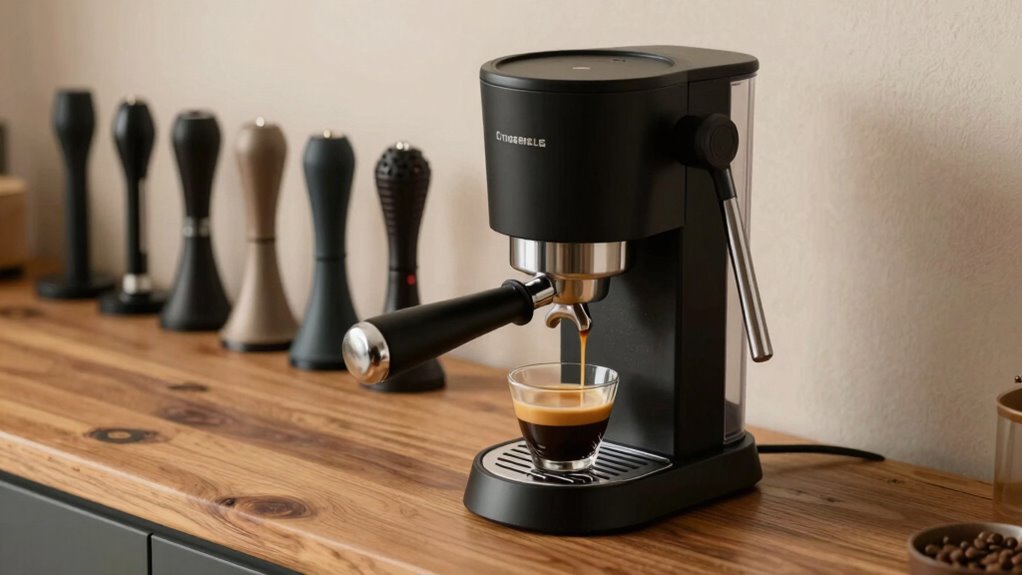
If you want true espresso — that dense, crema-topped, 9-bar shot that tastes nothing like moka pot coffee — you don’t need a $1,000 machine plugged into your wall. Manual espresso makers can hit genuine extraction pressure, but they differ wildly in how much control, effort, and counter space they demand. My top pick is the Flair 49 PRO, whose integrated pressure gauge and stainless steel brew path make it the closest thing to a barista’s lever machine without the barista’s budget. If you want espresso with milk drinks and don’t want a workout, the De’Longhi Stilosa covers the essentials. And if your shots happen at a campsite rather than a kitchen, the Wacaco Minipresso GR is the one that fits in a backpack. Here’s how the four compare, and where each one falls short.

Get coffee and tea gear delivered free — and shop member deals
- Fast, free delivery on millions of items
- Access to Prime Big Deal Days deals on October 6–7
- Prime Video, Amazon Music and more included
Complete the kit


Key Takeaways
- Only the two Flair models brew at fully controllable lever pressure; the Stilosa is pump-assisted and the Minipresso is fixed-pressure, so shot tuning differs sharply.
- The Flair 49 PRO’s integrated pressure gauge is the single biggest differentiator for learning repeatable espresso technique.
- The De’Longhi Stilosa is the only option here with a milk frother, making it the pick for cappuccino and latte drinkers.
- The Minipresso GR trades pressure control and capacity for portability — it’s a travel espresso maker first, a home machine second.
- The Flair Classic delivers the same hands-on lever brewing as the 49 PRO at a simpler spec, making it the value lever pick.
| Flair 49 PRO Manual Lever Espresso Maker with Pressure Gauge, Black |  | Best Overall | Type: Manual lever espresso maker | Color: Black | Portafilter size: 49 mm | VIEW ON AMAZON | See Our Full Breakdown |
| De’Longhi Stilosa Compact Manual Espresso Machine with Milk Frother | 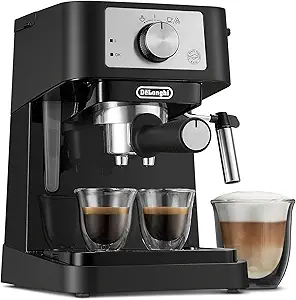 | Best Value For Milk Drinks | Type: Manual espresso machine | Milk frother: Manual steam wand | Boiler material: Stainless steel | VIEW ON AMAZON | See Our Full Breakdown |
| Flair Classic Manual Lever Espresso Maker |  | Best Value Lever | Operation mode: Manual lever, no electricity | Brewing capacity: 0.04 liters | Dose capacity: Up to 18 g | VIEW ON AMAZON | See Our Full Breakdown |
| Wacaco Minipresso GR – Portable Manual Espresso Machine for Ground Coffee |  | Best For Travel | Model: Minipresso GR | Power source: Manual — no battery or electricity | Coffee type: Ground coffee, any variety | VIEW ON AMAZON | See Our Full Breakdown |
| manual espresso makers for true espresso | Type | Footprint |
|---|---|---|
| Flair 49 PRO Manual Lever Espr | Manual lever espresso maker | Approximately 12 × 8 inches |
| De’Longhi Stilosa Compact Manu | Manual espresso machine | Compact counter design |
| Flair Classic Manual Lever Esp | — | — |
| Wacaco Minipresso GR | — | — |
More Details on Our Top Picks
Flair 49 PRO Manual Lever Espresso Maker with Pressure Gauge, Black
This is the option I’d point most serious home baristas toward, and the reason comes down to one word: feedback. The integrated pressure gauge with a marked 5–9 bar espresso zone turns every pull into a visible lesson — you can see when you’ve surged past 9 bar and choked the shot, or dropped too low and under-extracted it. Neither the Flair Classic below nor the Minipresso gives you this, which is why the 49 PRO earns the top spot despite costing more than both.
The stainless steel brew path is the other differentiator. With no plastic touching brew water, the machine appeals to anyone particular about materials and heat stability, and it feels closer to a commercial lever machine in spirit than anything else in this lineup. Compared with the Stilosa, you give up the milk frother and any electric convenience, but you gain full manual authority over pressure and flow — the difference between operating a machine and actually making espresso.
The included pressurized and bottomless baskets smartly bridge skill levels: start pressurized while your grinding and tucking improve, then graduate to the bottomless basket where every channeling flaw shows itself. The tradeoff is real, though — every shot requires muscle and attention, and the 49 mm portafilter means your 58 mm accessories and tutorials don’t transfer directly.
Pros:- Integrated pressure gauge makes extraction repeatable and teachable
- Full stainless steel brew path with no plastic contacting brew water
- Pressurized and bottomless baskets support progression from beginner to advanced
- Compact counter footprint despite professional-grade control
Cons:- Every shot demands physical effort and full attention
- 49 mm portafilter system doesn’t match the standard 58 mm accessories and guides
Best for: Hands-on enthusiasts who want to learn and repeat dial-quality shots with visible pressure feedback.
Not ideal for: Anyone who wants push-button morning convenience or milk drinks without separate gear.
- Type:Manual lever espresso maker
- Color:Black
- Portafilter size:49 mm
- Pressure gauge:Integrated; espresso zone marked 5–9 bar
- Brew path:Stainless steel cylinder, valve plunger, and stem
- Footprint:Approximately 12 × 8 inches
- Baskets:Pressurized and bottomless included
Our verdict“The most instructive and controllable manual espresso maker in this lineup, and the one that best earns the phrase true espresso.”
De’Longhi Stilosa Compact Manual Espresso Machine with Milk Frother
The Stilosa plays a completely different game from the Flairs, and that’s precisely why it belongs here. It’s a manual espresso machine in the traditional sense — you’re in charge of the shot, but a stainless steel boiler and pump handle the pressure for you. If you love espresso as a base for cappuccinos, lattes, and flat whites, its manual milk frother is something no other product in this roundup offers, and that alone justifies its slot.
Compared with the Flair 49 PRO, you sacrifice pressure control and the all-metal brew path, but you also skip the preheating rituals, the kettle, and the arm workout. For a household where one person drinks straight shots and another wants a milky latte by 7 a.m., this balance makes more sense than a pure lever. The compact footprint and easy cleaning further push it toward the everyday-user camp rather than the hobbyist camp.
Where it falls short of true espresso purists’ standards is consistency at the margins — it won’t match the 49 PRO’s tunable 5–9 bar extraction, and its stock pressurized-style filters are more forgiving but less revealing. Think of it as the sensible entry point that still produces a legitimately good shot, with milk texture as its party trick.
Pros:- Manual milk frother handles cappuccinos, lattes, and flat whites
- Durable stainless steel boiler built for steady daily use
- Compact design fits small counters and cleans easily
- Single and double filters included out of the box
Cons:- No direct control over extraction pressure like a lever machine
- Shot quality ceiling sits below the Flair models for straight espresso
Best for: Budget-minded drinkers who want espresso and textured milk drinks without lever technique.
Not ideal for: Purists chasing pressure-profile control and café-grade shot tuning.
- Type:Manual espresso machine
- Milk frother:Manual steam wand
- Boiler material:Stainless steel
- Included accessories:Portafilter with single and double filters
- Cup holder:Two-level, fits different cup sizes
- Footprint:Compact counter design
Our verdict“The smart value pick for milk-drink households, as long as pressure-nerd espresso isn’t the goal.”
Flair Classic Manual Lever Espresso Maker
The Flair Classic is the pure lever experience at its most affordable, and it brews a genuine espresso shot without a single wire or battery. What you give up versus the 49 PRO is the pressure gauge and pressurized basket training wheels — here, your hands and taste buds are the only feedback. For some buyers that’s a drawback; for others it’s the point, because the Classic teaches you to feel the puck’s resistance instead of watching a dial.
Its inclusion of two portafilters — a bottomless 2-in-1 and a flow-control version — gives it more brewing flexibility than the Minipresso could dream of, with doses up to 18 g. That’s enough for a proper double, whereas the Minipresso caps out around a smaller single-style serve. The detachable brewing head that rinses clean in seconds is a quiet advantage over machines with internal tubing and gunk traps.
The honest tradeoff: you’re boiling water separately, preheating the brew head, and doing physical work for every shot. It shares that labor with the 49 PRO but without the gauge to guide you, so expect a steeper learning curve. The three-year warranty on the press stand and brewing head softens the risk for a first lever purchase.
Pros:- Fully electricity-free brewing anywhere you can boil water
- Two portafilters (bottomless 2-in-1 and flow control) for different brew styles
- Detachable brewing head rinses clean in seconds
- Cast aluminum and stainless steel build with 3-year warranty coverage
Cons:- Requires boiled water and manual preheating for every session
- No pressure gauge means slower learning than the 49 PRO
Best for: Buyers who want genuine lever espresso and full-electric independence at the lowest lever price.
Not ideal for: Anyone who wants guided pressure feedback or fast, low-effort mornings.
- Operation mode:Manual lever, no electricity
- Brewing capacity:0.04 liters
- Dose capacity:Up to 18 g
- Portafilters:Bottomless 2-in-1 and flow control
- Materials:Cast aluminum and stainless steel
- Dimensions:6 × 12 × 10 in
- Weight:4.9 lb
- Warranty:3 years on press stand and brewing head
Our verdict“The best-value path into true hands-on lever espresso — rugged, simple, and honest about the effort involved.”
Wacaco Minipresso GR – Portable Manual Espresso Machine for Ground Coffee
The Minipresso GR isn’t trying to compete with the Flairs on shot quality — it’s trying to put espresso in your backpack, and nothing else here comes close on that mission. Weighing a fraction of the Flair Classic’s 4.9 pounds and needing no batteries or electricity, it brews up to 50 ml of authentic espresso with genuinely generous crema from any ground coffee you pack. For camping, hotel mornings, trailheads, and office drawers, that’s a capability the other three simply don’t have.
Compared with the Flair Classic, the compromises are obvious: no bottomless basket, no flow control, no dose flexibility up to 18 g, and pressure that’s fixed by the piston design rather than shaped by your arm. You can’t profile a shot the way a 49 PRO owner can — you add grounds and hot water and pump. But for a travel context, that simplicity is a feature; there’s less to break, lose, or fumble at 6 a.m. in a tent.
The frustrations are worth naming: you must carry a way to boil water, useful add-ons like the larger 100 ml setup are sold separately, and the pumping action takes real effort for such a small device. If your espresso happens at home, buy a Flair instead. If it happens everywhere else, this is the answer.
Pros:- Fully manual operation with no batteries or electricity
- Genuinely compact and lightweight for travel and outdoor use
- Works with any ground coffee or roast you bring along
- Produces authentic espresso with generous crema despite its size
Cons:- Requires you to source boiling water separately
- Accessories for larger shots and protection sold separately
- Fixed-pressure pumping offers no extraction control
Best for: Travelers, campers, hikers, and office-drawer espresso drinkers who need true portability.
Not ideal for: Home baristas who want shot control, larger doses, or repeatable tuning.
- Model:Minipresso GR
- Power source:Manual — no battery or electricity
- Coffee type:Ground coffee, any variety
- Capacity:Up to 50 ml espresso per brew
- Operation:Hand-pumped piston extraction
- Portability:Compact and lightweight travel design
Our verdict“The portable pick that delivers real espresso away from home, as long as you accept its fixed-pressure simplicity.”

How We Picked
Since the brief here is true espresso, I judged every option against one question: can it produce a genuine espresso shot with real crema, and how much control does the brewer have over that shot? That meant prioritizing achievable extraction pressure, brew-path material quality, dose flexibility, and how much the design lets you diagnose and repeat a good extraction. I also weighed the practical side — setup effort, cleaning, and whether the machine fits a kitchen counter or a carry-on — because the best espresso maker is the one you’ll actually use daily. Finally, I compared each model against the others in this lineup rather than in isolation, so the rankings below reflect which machine serves which kind of buyer best, warts included.
| manual espresso makers for true espresso | Type | Footprint |
|---|---|---|
| Flair 49 PRO Manual Lever Espr | Manual lever espresso maker | Approximately 12 × 8 inches |
| De’Longhi Stilosa Compact Manu | Manual espresso machine | Compact counter design |
| Flair Classic Manual Lever Esp | — | — |
| Wacaco Minipresso GR | — | — |
Factors to Consider When Choosing Manual Espresso Makers For True Espresso
Before choosing between these four, it helps to understand what actually separates a true espresso maker from a strong coffee maker, and which tradeoffs matter most for your routine.Pressure Is What Makes Espresso Espresso
True espresso requires roughly 9 bar of extraction pressure forced through a compacted coffee puck. Both Flair models put that pressure entirely in your hands, which means you can shape the shot but also ruin it. The Stilosa automates pressure via its pump, trading control for consistency, while the Minipresso uses a fixed piston design — reliable crema, but no tuning. Deciding how much control you actually want is the first and biggest fork in this decision.
Feedback And Learning Curve
If you’re new to espresso, the Flair 49 PRO’s pressure gauge dramatically shortens the learning curve because you can see your mistakes. The Flair Classic forces you to learn by taste and feel, which some brewers love and others find frustrating. The Minipresso barely requires learning at all, and the Stilosa sits in approachable middle ground with its forgiving filters.
Power, Water, And Where You’ll Brew
The Stilosa needs an outlet; the other three need nothing but boiled water and your hands. That makes the Flairs viable for off-grid cabins and power-outage mornings, and makes the Minipresso the only realistic trail option. If your brewing happens exclusively at a kitchen counter, power needs stop mattering and ergonomics start mattering more.
Milk Drinks And Accessories
Only the Stilosa includes a steam wand, so latte and cappuccino drinkers either choose it or budget for a separate milk frother alongside a Flair. Also check accessory ecosystems: the 49 PRO’s 49 mm system and the Minipresso’s separately sold add-ons both mean future purchases, while the Classic’s included two portafilters cover most needs from day one.
Frequently Asked Questions
Can a manual espresso maker really produce true espresso?
Yes, when the design can generate enough pressure — and all four options here can, in different ways. The Flair models use lever force you apply by hand to reach the 5–9 bar range where proper espresso lives, which is why they’re the picks for purists. The Stilosa uses an electric pump to hit that pressure for you, and the Minipresso’s piston builds fixed pressure through pumping. What none of them can do is fake it: if the pressure is too low, you get strong coffee rather than espresso, so technique and fresh grounds still matter with every option.
Is the Flair 49 PRO worth it over the Flair Classic?
It depends entirely on how you learn. The 49 PRO’s pressure gauge shows you exactly what your arm is doing, so dialing in a repeatable shot takes days instead of weeks, and its pressurized basket eases the transition for beginners. The Classic rewards you with the same hands-on brewing philosophy for less money, but you’re troubleshooting by taste alone. If you’re the type who wants data and faster progress, the 49 PRO justifies itself; if you enjoy slow trial and error, the Classic is the better-value route to the same skill.
Do I need a separate grinder for these machines?
For the best results, yes — all four benefit enormously from freshly ground coffee, and the lever models are especially sensitive to grind size because you’re supplying the pressure yourself. A grind too coarse will gush through the Flairs and produce weak shots; too fine and you’ll be fighting the lever. Pre-ground coffee works in a pinch, particularly in the Minipresso on the road, but a burr grinder is honestly the upgrade that will improve your espresso more than any machine swap in this lineup.
Which of these is best for milk drinks like lattes?
The De’Longhi Stilosa is the clear choice, because its manual steam wand is the only way in this group to texture milk for cappuccinos and lattes without buying extra gear. You can absolutely pair any of the others with a standalone milk frother, but that’s an added cost and counter item. If milk drinks are a daily habit rather than an occasional treat, building your setup around the Stilosa simply makes the morning routine smoother than a lever-plus-frother combination.
How much physical effort does manual espresso actually take?
More than a button, less than you probably fear — with variation across the lineup. The Flair models demand the most: preheating, loading, and a firm steady press that can feel like a workout for back-to-back shots. The Minipresso takes repeated smaller pumps, which is surprisingly taxing for its size but manageable for one shot. The Stilosa requires the least physical effort since it’s manual in technique rather than in power. If grip strength or joint issues are a concern, lean electric-assisted like the Stilosa.
Conclusion
The right pick here depends less on which machine is objectively best and more on what your mornings look like. If you want to master true espresso as a craft, the Flair 49 PRO is the machine that will grow with you — its gauge, stainless brew path, and dual baskets make it the deepest and most instructive option. If you want that same hands-on lever brewing for less money and don’t need the training wheels, the Flair Classic is the value champion and my pick for a first serious lever. If your espresso usually wears a milk mustache, skip the levers and choose the De’Longhi Stilosa, the only option with a frother built in. And if your shots happen at campsites, trailheads, or hotel rooms, the Wacaco Minipresso GR is the only one that travels like a water bottle while still pulling real crema. Whichever you choose, budget for fresh beans and a decent grinder — that’s the ingredient no machine on this list can supply for you.
Halloween Picks
halloween
As an affiliate, we earn on qualifying purchases.