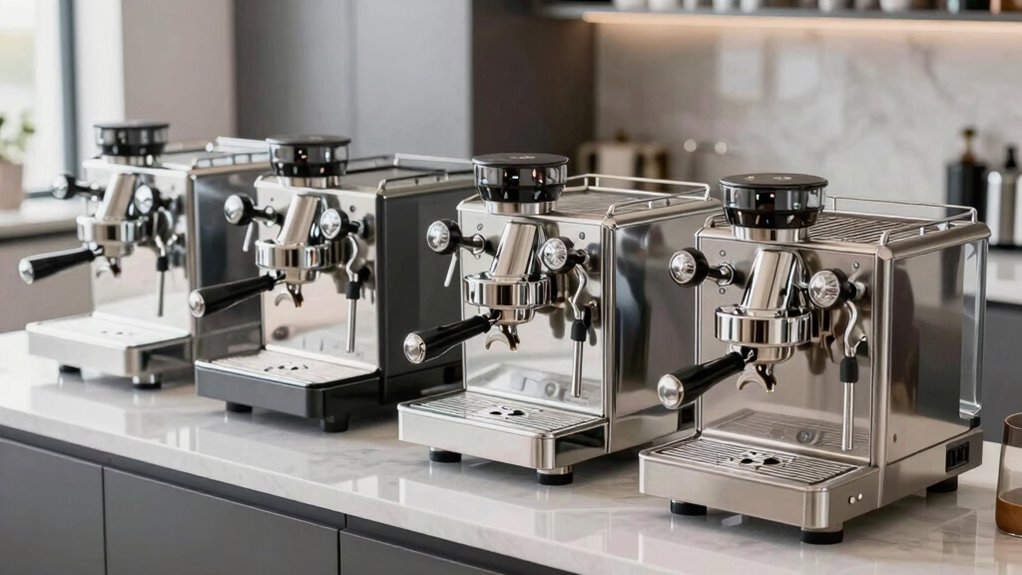

Manual espresso machines put you in control of pressure, extraction, and milk texture — but the gap between a great shot and a bitter one comes down to build quality, pump pressure, and temperature stability. After comparing 11 popular models, the Breville Barista Express stands out as the best overall pick thanks to its integrated conical burr grinder and precise extraction control, while the Breville Bambino is the strongest choice for small kitchens and the De’Longhi Stilosa wins on value for first-time buyers. The main tradeoff in this category is between price and control: budget machines under $150 get you workable espresso with compromises in steam power and durability, while premium models cost more upfront but deliver café-grade consistency. Read on for the full breakdown of what each machine does well, where it falls short, and which one fits your counter and your budget.

Get coffee and tea gear delivered free with Prime
- Fast, free delivery on millions of items
- Prime Video, Amazon Music and more included
- Member-only deals all year
Complete the kit


Key Takeaways
- The Breville Barista Express separated itself from the field with its integrated burr grinder — no other machine in this lineup grinds and brews in one unit, which removes the biggest variable in manual espresso quality.
- The De’Longhi Stilosa and CASABREWS CM5418 proved that solid entry-level espresso doesn’t require a big spend, but both trade away steam power, meaning textured milk drinks like flat whites take noticeably longer.
- Compact models like the Breville Bambino and CHULUX Slim sacrifice water reservoir capacity and drip tray size for counter space — a real tradeoff if you pull multiple shots back to back.
- Most budget machines advertise 20-bar pumps, but raw pressure numbers matter less than pressure regulation and temperature stability, which is where the two Breville models clearly outperformed the rest.
- Steam wand quality varied more than any other feature across this lineup — the difference between a panarello-style wand and a proper commercial-style wand determines whether you can actually learn latte art.





| manual espresso machine | Pump pressure | Water tank capacity | Power |
|---|---|---|---|
| 20-Bar Compact Espresso Machin | 20 bar | 34 oz | 1450 W |
| Aromaster 1400W Espresso Machi | 20 bar | 37 oz | 1400 W |
| Chefman CraftBrew Digital Espr | 15 bar | — | — |
| XIXUBX Espresso Machine with M | 20 bar | 42 oz | — |
| Breville Bambino Espresso Mach | — | — | 1560 W |
| CASABREWS 3700 Essential Stain | 20 bar | 43.9 oz, removable | 1350 watts |
| Atatix Espresso Machine with M | — | — | — |
| CASABREWS CM5418 Compact Espre | 20 bar | 34 oz, removable | — |
| Breville Barista Express Espre | — | 67 oz | 1600 W, 120 V |
| CHULUX Slim Espresso Machine w | 20 bar | 40 oz | 1350 watts |
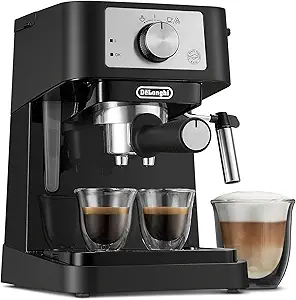
| De’Longhi Stilosa Compact Manu | — | — | — |
More Details on Our Top Picks
20-Bar Compact Espresso Machine with Milk Frother, Stainless Steel, Silver
For someone pulling their first shots at home, this machine makes the learning curve gentler than most. The visible pressure gauge gives instant feedback on whether your grind and tamp are in the right zone — something budget rivals like the De’Longhi Stilosa don’t offer — and the 20-second preheat means less waiting between deciding you want espresso and actually drinking it. Compared with the Aromaster further down this list, it trades away PID temperature control for a slimmer footprint, so temperature stability is adequate rather than precise. The real tradeoff is workflow: after steaming milk, you’ll need to let the boiler cool before brewing, which slows down back-to-back lattes.
Pros:- Pressure gauge gives beginners visible feedback on extraction
- Fast 20-second preheating reduces waiting
- Compact footprint with removable 34 oz tank and drip tray
- Steam wand covers basic latte and cappuccino frothing
Cons:- Must cool down after steaming before brewing espresso
- No PID temperature control, so shot consistency lags the Aromaster
Best for: Espresso newcomers who want visual feedback from a pressure gauge while learning grind and technique
Not ideal for: Anyone making multiple milk drinks in a row — the required cooling period between frothing and brewing makes back-to-back lattes tedious
- Pump pressure:20 bar
- Power:1450 W
- Preheat time:About 20 seconds
- Water tank capacity:34 oz
- Dimensions:5.3 × 12.2 × 11.5 inches
- Frother:Steam wand
- Type:Semi-automatic
Our verdict“A sensible first espresso machine for learners who want gauge-guided practice without a big investment.”
Aromaster 1400W Espresso Machine with Milk Frother
This model earns its spot by solving the most common cheap-espresso complaint: temperature drift. The PID temperature control keeps water at a stable brewing temperature shot after shot, which the 20-Bar Compact machine above can’t match, and one-touch descaling plus removable parts take the dread out of maintenance. The 37 oz tank edges out smaller rivals, and pre-infusion helps even out uneven tamping — a quiet advantage over the Chefman CraftBrew’s simpler 15-bar setup. The tradeoff is that it stays firmly semi-automatic: you’re grinding, dosing, tamping, and steaming by hand, and the vaguely listed capacity spec suggests modest internal boiler size rather than marathon drink sessions.
Pros:- PID temperature control delivers more consistent shots than similarly priced rivals
- Pre-infusion smooths out imperfect tamping
- One-touch descaling and removable parts simplify upkeep
- 37 oz tank and compact size balance capacity and counter space
Cons:- Fully hands-on semi-automatic workflow for every drink
- Listed capacity is unclear, hinting at a small boiler for extended sessions
Best for: Budget-conscious buyers who want PID-level temperature stability and easy maintenance without stepping up to Breville pricing
Not ideal for: Hands-off coffee drinkers who want press-and-forget convenience — every drink requires full manual preparation
- Power:1400 W
- Pump pressure:20 bar
- Operation mode:Semi-automatic
- Water tank capacity:37 oz
- Dimensions:13 × 7 × 14 in
- Features:Pre-infusion, PID control, auto shut-off, anti-dry burn protection
- Material:Stainless steel
Our verdict“The smartest value pick if temperature consistency and easy cleaning matter more than brand prestige.”
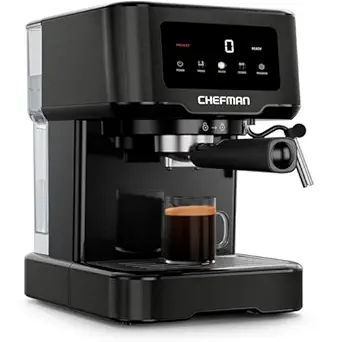
Chefman CraftBrew Digital Espresso Machine with Steam Wand
Where most machines here lean on analog dials, the CraftBrew stands out for its touch controls with adjustable shot volume — a genuine convenience for anyone tired of counting seconds over a naked spout. The included single and double shot baskets make it easy to scale up for guests, and the 1.5-liter reservoir sits near the top of this group, trailing only the XIXUBX’s 42 oz tank. Its 15-bar pump is technically lower-rated than the 20-bar claims elsewhere in this lineup, though in practice extraction quality depends far more on temperature control and technique. Note that milk steaming remains fully manual, and the 120-volt design limits it to North American outlets without a transformer.
Pros:- Touch controls with adjustable shot volume remove guesswork
- Single and double shot baskets included
- Large 1.5-liter removable reservoir
- Compact footprint fits tight counters
Cons:- Milk steaming is fully manual with no automated assistance
- 120-volt power limits use outside North America
Best for: Small-kitchen setups and home coffee bars where digital shot-volume control and a tidy footprint matter most
Not ideal for: International buyers or travelers — the 120-volt-only design won’t run safely overseas without conversion gear
- Pump pressure:15 bar
- Wattage:1350 W
- Voltage:120 V
- Water reservoir:1.5 liters
- Dimensions:10.8 × 8.9 × 11.9 inches (D × W × H)
- Operation mode:Semi-automatic
- Included:Single and double shot baskets
Our verdict“A neat fit for compact home bars where digital shot control beats raw pressure specs.”
XIXUBX Espresso Machine with Milk Frother, Silver
What separates this machine from the 20-Bar Compact pick is workflow speed: its fast heating is designed to move between brewing and frothing without long cooling gaps, which matters enormously if your household drinks three lattes before 8 a.m. The 360° rotating steam wand is the best frothing hardware in this budget tier — it’s built for microfoam and detaches for cleaning, outclassing the fixed wands on the Aromaster and Chefman. It also arrives with a stainless frothing pitcher, sparing you a separate accessory purchase, and its 42 oz tank is the largest here. On the flip side, the unpublished dimensions make pre-measuring your counter risky, and the 20-bar marketing figure still means you’re monitoring pressure yourself to land near the ideal 9-bar extraction.
Pros:- Fast heating allows brewing and frothing without long cooling waits
- 360° rotating, detachable steam wand targets true microfoam
- Class-leading 42 oz water tank
- Includes frothing pitcher and visible pressure gauge
Cons:- No published dimensions or weight, making fit planning difficult
- 20-bar system requires user monitoring to hit ideal extraction pressure
Best for: Latte and cappuccino drinkers who want fast brew-to-steam transitions and a complete starter bundle in one box
Not ideal for: Buyers with very tight or precisely measured counter space — dimensions and weight aren’t specified
- Pump pressure:20 bar
- Water tank capacity:42 oz
- Steam wand:360° rotating, detachable
- Body material:Stainless steel
- Included accessory:Stainless steel milk frothing pitcher
- Warranty:1 year
Our verdict“The most complete package for milk-based drink fans who hate waiting between shots and steam.”
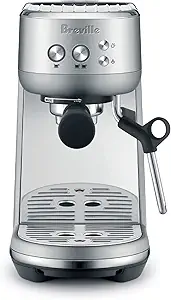
Breville Bambino Espresso Machine, Brushed Stainless Steel (BES450BSS)
The Bambino tops this roundup because it’s the only machine here with engineering that addresses both halves of espresso quality: a ThermoJet heater hitting extraction temperature in 3 seconds and PID-controlled, low-pressure pre-infusion for even extraction. No budget rival — the XIXUBX, the Aromaster, or the 20-Bar Compact — combines that heat-up speed with genuine temperature stability, and the temperature-controlled steam wand produces microfoam credible enough for latte art. Its generous accessory bundle (baskets, jug, tamper, descaling powder) also spares the add-on purchases cheaper machines demand. The honest tradeoff: you must own a decent grinder, since it accepts only ground coffee, and its fixed 1- and 2-cup settings offer less shot-volume flexibility than the Chefman’s adjustable touch controls.
Pros:- 3-second heat-up is unmatched in this lineup
- PID control plus low-pressure pre-infusion produces evenly extracted shots
- Temperature-controlled steam wand textures milk for microfoam
- Comprehensive accessory bundle included out of the box
Cons:- Requires a separate grinder for fresh grounds
- Fixed 1- and 2-cup settings limit shot-volume customization
Best for: Home baristas who already own (or will buy) a quality burr grinder and want café-grade temperature stability in a compact body
Not ideal for: Buyers expecting everything in one box — with no built-in grinder, it’s an incomplete purchase unless you already grind fresh beans
- Model:BES450BSS
- Heating system:ThermoJet
- Heat-up time:3 seconds
- Portafilter size:54 mm
- Dose:19 g
- Power:1560 W
- Settings:1 cup, 2 cups, hot water, steam
- Warranty:1-year limited
Our verdict“The best total package for anyone serious about espresso who already has a grinder — everyone else should budget for one.”
CASABREWS 3700 Essential Stainless Steel Espresso Machine with Steam Wand
This CASABREWS 3700 stands out as the straightforward entry point of the manual espresso category: no pressure gauge, no programmed shots, just a 20-bar pump, a solid steam wand, and a roomy 43.9 oz removable tank. Compared with its sibling, the CM5418, it trades away the pressure gauge and the smaller footprint for a larger water capacity, which means fewer refills if the whole household drinks espresso. Compared with the CHULUX Slim, it gives up pre-infusion and fast heat-up but gains a more traditional stainless build that feels less like an appliance and more like a coffee bar centerpiece. The tradeoff is real, though: without a pressure gauge, dialing in grind and tamp is guesswork, so expect a learning curve before shots taste consistent.
Pros:- Large 43.9 oz removable water tank means fewer refills for multi-drink households
- Steam wand produces microfoam suitable for latte art
- Compact stainless steel body fits home or office counters
- Includes both one-cup and two-cup filter baskets
Cons:- No pressure gauge, so troubleshooting extractions relies on taste alone
- Requires a full first-use rinse cycle before the first brew
Best for: First-time espresso buyers who want a simple, no-frills machine with a big water tank for multiple daily drinks
Not ideal for: Buyers who want shot-by-shot feedback — the lack of a pressure gauge makes it harder to diagnose weak or bitter extractions
- Operation mode:Semi-automatic
- Pump pressure:20 bar
- Power:1350 watts
- Water tank capacity:43.9 oz, removable
- Milk frothing:Steam wand
- Coffee input:Ground coffee
- Included filters:One-cup and two-cup
Our verdict“A dependable pick for beginners who prioritize capacity and simplicity over feedback and advanced control.”
Atatix Espresso Machine with Milk Frother, 20-Bar Pressure
What separates the Atatix from budget rivals like the CASABREWS 3700 is choice: it offers programmed single and double shots alongside a fully manual mode that runs up to 102 seconds. That flexibility makes this model better suited to brewers who want push-button consistency on busy mornings but still enjoy hand-pulling a lungo on weekends. The 30-second preheat also beats the CASABREWS machines, which take longer to reach brewing temperature. The catch is ambiguity: the manual mode’s listed output range (180–350 g) is far larger than a standard espresso serving, so newcomers may pull watery shots before calibrating their own stop point. Compared with the CHULUX Slim, it matches fast heating but adds programmed dosing — a genuine advantage for anyone who values repeatability over raw compactness.
Pros:- Automatic single and double shot programs plus fully manual extraction
- 30-second preheat time rivals faster premium machines
- Steam wand produces dense milk foam for cappuccinos
- Detachable water tank and drip tray simplify daily cleaning
Cons:- Manual mode requires the user to determine their own brewing time
- Listed beverage output amounts don’t map cleanly to standard espresso volumes
Best for: Brewers who split their time between quick automatic shots and slow, hands-on manual extraction
Not ideal for: Absolute beginners who want foolproof servings — the manual mode’s output ranges require experimentation to avoid over-extracted or watery shots
- Pressure:20 bar
- Temperature control:90–96°C
- Preheat time:30 seconds
- Automatic single shot:28 seconds; 25–40 g
- Automatic double shot:42 seconds; 55–85 g
- Manual extraction:Up to 102 seconds; 180–350 g
- Materials:ABS and stainless steel
- Water tank:Detachable
Our verdict“A smart choice for tinkerers who want both automation and hands-on control without paying for a premium brand.”
CASABREWS CM5418 Compact Espresso Machine with Milk Frothing Steam Wand
The CM5418 is essentially the CASABREWS 3700 with feedback: same 20-bar pump, same 1350 watts, same capable steam wand, but a built-in pressure gauge that shows whether your grind, dose, and tamp are actually on target. For anyone learning espresso, that gauge is worth more than the 3700’s extra ten ounces of tank capacity — it turns bad shots into diagnosable problems instead of mysteries. Against the CHULUX Slim, the CM5418 matches the pressure gauge but lacks pre-infusion and the 30-second heat-up, so CHULUX wins on speed while this model wins on tank size at 34 oz versus 40 oz being a wash. The meaningful drawback is temperature management: after steaming milk, the machine needs to cool before brewing again, which slows back-to-back latte rounds.
Pros:- Built-in pressure gauge helps diagnose grind, dose, and tamping problems
- Steam wand supports microfoam for latte art
- Compact stainless steel design suits small counters
- Includes both filter baskets and a tamper with spoon
Cons:- Requires a cool-down period after milk frothing before brewing again
- Low pressure readings may demand finer grounds, more coffee, or firmer tamping to fix
Best for: Budget-conscious beginners who want visual feedback from a pressure gauge while learning to dial in shots
Not ideal for: Households making multiple milk drinks in a row — the required cool-down after steaming makes batch drink-making slow
- Type:Semi-automatic espresso machine
- Pump pressure:20 bar
- Wattage:1350 W
- Water tank capacity:34 oz, removable
- Milk frothing:Steam wand
- Pressure gauge:Built-in
- Included components:Portafilter, one- and two-cup filters, tamper with spoon, manual
Our verdict“The best sub-premium learning machine here, provided you can live with its one-drink-at-a-time pace.”
Breville Barista Express Espresso Machine, Brushed Stainless Steel
The Barista Express is the only machine in this lineup that grinds its own beans, and that changes the entire workflow: an integrated conical burr grinder doses fresh coffee straight into the portafilter, eliminating the separate grinder every other pick here assumes you already own. Add PID temperature control and low-pressure pre-infusion, and it delivers a level of extraction stability that the CASABREWS CM5418’s pressure gauge can hint at but not enforce. Its 67 oz tank and half-pound bean hopper also dwarf the competition — nearly double the 3700’s capacity. The tradeoffs are a fully hands-on brewing process (no programmed shots like the Atatix) and a counter footprint and learning curve that dwarf entry-level picks. Buyers comparing it to the Breville Bambino should note this model replaces the Bambino’s speed with bean-to-cup completeness.
Pros:- Integrated conical burr grinder doses fresh grounds directly into the portafilter
- PID temperature control and low-pressure pre-infusion support balanced extraction
- Large 67 oz water tank and half-pound bean hopper reduce frequent refills
- Ships with portafilter, filter baskets, tamper, milk jug, and cleaning accessories
Cons:- Fully manual operation requires effort and skill for every drink
- Only a 1-year limited warranty on a premium-price machine
Best for: Coffee enthusiasts ready to upgrade from pre-ground coffee to a true bean-to-cup workflow in one machine
Not ideal for: Casual or impatient brewers — it demands hands-on grinding, dosing, and milk texturing, and its bulk overwhelms tight counters
- Model:BES870XL
- Finish:Brushed stainless steel
- Grinder:Integrated conical burr grinder
- Water tank capacity:67 oz
- Bean hopper capacity:1/2 lb
- Power:1600 W, 120 V
- Shot options:Single or double
- Warranty:1 year limited
Our verdict“The most complete package in this roundup for buyers who want café-quality, bean-to-cup espresso without buying a separate grinder.”
CHULUX Slim Espresso Machine with Milk Frother
At 5.5 inches wide, the CHULUX Slim is the narrowest machine in this roundup by a wide margin, and that single spec defines its appeal. Compared with the CASABREWS CM5418, it keeps the pressure gauge but adds pre-infusion and a 30-second heat-up — features that normally cost far more, as the Breville Barista Express’s pre-infusion demonstrates. The 40 oz tank is surprisingly generous for something this slim, beating the CM5418’s 34 oz. Automatic shut-off after 25 minutes is a practical touch for offices or forgetful brewers. The compromises are the ground-coffee-only input (no grinder, obviously, at this size) and vague documentation around the frother’s operation mode, which may frustrate buyers expecting a fully automatic milk system rather than a traditional steam wand.
Pros:- Ultra-narrow 5.5-inch width fits where no other machine here can
- Pre-infusion and pressure gauge at a compact-machine price point
- Heats up in about 30 seconds
- Automatic shut-off after 25 minutes of inactivity
Cons:- Requires pre-ground coffee — no grinder or pods
- Frother operation mode is underspecified, creating uncertainty for buyers expecting automation
Best for: Small-kitchen or office users who need full espresso capability in the narrowest possible footprint
Not ideal for: Buyers wanting automatic milk texturing or bean-to-cup convenience — this is a compact ground-coffee machine with a manual steam wand
- Pump pressure:20 bar
- Power:1350 watts
- Preheating time:About 30 seconds
- Water tank capacity:40 oz
- Width:5.5 inches
- Automatic shut-off:After 25 minutes of inactivity
- Features:Steam wand, pressure gauge, pre-infusion, removable drip tray
Our verdict“The pick for tight counters that refuse to compromise on gauge feedback, pre-infusion, and fast heat-up.”
De’Longhi Stilosa Compact Manual Espresso Machine with Milk Frother
At the entry end of this lineup, the De’Longhi Stilosa makes the most sense for someone who wants to learn espresso basics without committing serious money. Compared with the CASABREWS 3700, it offers a similar manual experience — a steam wand you actually operate yourself and filters for both single and double shots — but in a footprint that disappears on a crowded counter. The stainless steel boiler is a genuine step up in longevity compared with the CHULUX Slim, which favors compactness over build. The tradeoff is honest: with no grinder included (unlike the Breville Barista Express), you’ll need to buy pre-ground coffee or a separate grinder, and the manual workflow demands more patience than a one-touch machine.
Pros:- Compact footprint frees up counter space in tight kitchens
- Manual frother lets you build real cappuccino and latte skills
- Single- and double-shot filters included, so it grows with your technique
- Stainless steel boiler supports consistent heat and long-term durability
Cons:- Manual operation takes noticeably more effort and learning time than automatic rivals like the Chefman CraftBrew
- No integrated grinder means an extra purchase for anyone chasing fresh-ground flavor
Best for: First-time espresso drinkers in small apartments who want to practice milk texturing and shot-pulling on a real manual machine without a big spend
Not ideal for: Buyers who want an all-in-one setup — there’s no built-in grinder, so fresh-ground espresso requires a separate purchase
- Type:Manual espresso machine
- Milk frother:Manual steam wand
- Boiler:Stainless steel
- Included accessories:Portafilter with single- and double-espresso filters
- Cup holder:Two-level, accommodates different cup sizes
- Design:Compact, counter-friendly footprint
- Grinder:Not included
Our verdict“A sensible, low-risk entry point for beginners who value counter space and hands-on learning over convenience features.”

How We Picked
I evaluated each machine through the lens that matters most to manual espresso buyers: shot consistency, steam performance, build quality, ease of learning, and long-term value. Pressure claims were treated skeptically — a 20-bar rating means little without stable temperature and even extraction, so I prioritized machines with proven thermal systems, quality portafilters, and boilers that recover quickly between drinks. Usability weighed heavily too: how forgiving the machine is for a beginner pulling their first shot, how readable the controls are, and how much routine maintenance each model demands.
The ranking logic follows a simple principle: machines that produce repeatable, café-quality results with fewer compromises rank highest, while budget models earn their positions by delivering the best possible espresso at their price point rather than competing head-to-head with premium picks. The Breville Barista Express took the top spot because its built-in grinder solves the freshness problem every other machine leaves to you. Compact and value picks were ranked within their own weight class — the Bambino leads small-footprint machines, the Stilosa leads budget machines — so every reader, regardless of budget or counter space, has a clear starting point.
Factors to Consider When Choosing Manual Espresso Machines
Before settling on a specific model, it helps to understand what actually separates a satisfying manual espresso machine from an expensive disappointment. These are the factors that shaped this ranking — and the ones most buyers get wrong.Pump Pressure vs. Pressure Control
The single most misunderstood spec in this category is pump pressure. Nearly every budget machine advertises 15 or 20 bars, but espresso extracts properly at roughly 9 bars — what matters is whether the machine regulates that pressure consistently, not the peak number on the box. Over-pressurized extraction is a common cause of bitter, over-extracted shots, especially on cheap machines with no regulation. Premium models like the Breville units maintain stable pressure throughout the pull, which is a big part of why they produce more consistent espresso. A useful rule: treat pressure ratings as a minimum quality signal, not a differentiator. Two machines both claiming 20 bars can produce dramatically different espresso depending on the pump quality and gasket design behind that number.
Steam Wand Type and Milk Texture
If you drink lattes, cappuccinos, or any milk-based drink, the steam wand may matter more than the espresso system itself. There are two main types: panarello wands, which inject air automatically and are easy but produce stiff, soapy foam, and traditional wands, which require technique but let you texture silky microfoam suitable for latte art. Most machines under $150 ship with panarello or basic wands that get the job done without ever producing café-quality milk. A common mistake is buying a budget machine expecting to learn latte art — the wand simply won’t cooperate. If milk drinks are your priority, this single feature justifies stepping up to a mid-range or premium model.
Grinder Integration and Coffee Freshness
No espresso machine, at any price, can overcome stale or incorrectly ground coffee. Beans begin losing aromatic complexity within minutes of grinding, which is why pre-ground espresso rarely tastes as good as it should — even from an excellent machine. Most machines in this category assume you already own a grinder or will buy pre-ground, which quietly adds $100 or more to the real cost of ownership. The Breville Barista Express is the only machine in this lineup that solves this with a built-in conical burr grinder, and that integration explains its premium price. If you choose a machine without a grinder, budget for a quality burr grinder separately and grind immediately before brewing. Skipping this step is the most common reason new espresso owners blame their machine for disappointing shots.
Footprint, Reservoir Size, and Daily Workflow
Measure your counter space before buying, not after. Compact machines like the Bambino and CHULUX Slim are marketed for small kitchens, but a tight footprint usually means a smaller water reservoir, a shallower drip tray, and more frequent refills. If you make two or three drinks each morning, a 1.5-liter tank becomes a daily annoyance rather than a convenience. Height matters too — tall machines need clearance under cabinets for the water tank lid and portafilter access. Think about your actual routine: a single-shot drinker will be perfectly happy with a compact machine, while a household of multiple coffee drinkers will resent constant refilling within a week. Workflow friction is what turns an exciting new machine into an unused appliance.
Build Quality and Long-Term Ownership
Housing material predicts longevity better than almost any other feature. Stainless steel construction, as found on the CASABREWS 3700 and both Breville models, resists the warping, staining, and loose fittings that plague all-plastic machines after a year of daily use. Also look at the portafilter: commercial-style 54mm or 58mm portafilters made of metal hold heat better and produce more even extraction than small plastic ones, and they accept standard accessories like precision baskets. Descaling requirements vary widely — machines with simpler thermoblock systems are usually easier to maintain than dual-boiler designs. Read the maintenance demands honestly against your own habits, because an espresso machine that needs weekly attention will get neglected, and a neglected machine makes bad coffee regardless of what it cost.
Matching the Machine to Your Skill Trajectory
Be honest about whether you want convenience or a hobby. A beginner who wants one good cappuccino before work will be better served by an intuitive, forgiving machine like the De’Longhi Stilosa or Chefman CraftBrew than by a tool that rewards technique they haven’t developed yet. Conversely, an aspiring home barista will outgrow a panarello wand and plastic portafilter within months and end up upgrading — buying a more capable machine early can be cheaper than buying twice. The mistake to avoid is assuming the most expensive machine is automatically right for you; skill and machine capability need to match. Ask yourself whether you’ll enjoy dialing in grind size, distribution, and extraction timing, or whether you just want a lever or button that produces a reliable shot. This roundup includes machines at every point on that spectrum for exactly this reason.
Frequently Asked Questions
Do I need a separate grinder if my espresso machine doesn’t have one built in?
For the best results, yes — and this is the cost most buyers underestimate. Espresso requires a grind far finer than drip coffee, and it needs to be adjusted in small increments to dial in a shot, which pre-ground supermarket espresso simply cannot do. Only the Breville Barista Express in this lineup includes a grinder, so owners of every other model here should plan on a quality burr grinder, which typically adds a meaningful amount to the total investment. Blade grinders are not a substitute; they produce uneven particles that cause simultaneous over- and under-extraction. If buying a grinder isn’t in the budget right away, start with freshly ground beans from a local roaster ground specifically for espresso, and use them within a week. It’s a workable stopgap, but freshness fades fast once the bag is opened.
Is a 20-bar pump actually better than a 15-bar or 9-bar pump?
Mostly no — this is marketing more than engineering. Proper espresso extracts at around 9 bars of pressure, and machines with higher-rated pumps use a valve or regulator to bring the pressure down to that range during extraction. A 20-bar rating tells you the pump can exceed what’s needed, but it says nothing about how stably the machine holds pressure or how consistent the water temperature is, which matter far more. That’s why several budget machines in this roundup with big pressure claims don’t match the shot quality of the Breville models with more modest specs. Judge machines by their temperature stability, portafilter size, and user reports on shot consistency instead of the pressure number on the box. If two machines differ mainly in pump rating and nothing else, treat that difference as noise.
Can I make latte art with an entry-level machine like the De’Longhi Stilosa?
You can learn the fundamentals, but you’ll hit a ceiling quickly. The Stilosa ships with a basic plastic steam wand that produces acceptable frothed milk, but it lacks the steam pressure and tip design needed to create the fine, glossy microfoam that latte art requires. Machines with proper steam systems — like the Breville Bambino, whose steam wand reaches temperature in seconds and texturizes milk like a commercial unit — make the learning process dramatically easier. If latte art is a genuine goal rather than a curiosity, factor steam performance into your decision from day one rather than upgrading later. Alternatively, some entry-level machines accept third-party wand upgrades, though modifying a machine affects warranty coverage. For most beginners, a milk frothing pitcher and practice matter more than the wand itself at first, so don’t let this single feature push you far beyond your budget.
How much counter space and clearance do these machines actually need?
More than the listed dimensions suggest. Beyond the machine’s footprint, you need clearance on top for the water tank lid, room to lock the portafilter in place, and space for a cup underneath — tall travel mugs won’t fit under most machines in this category without removing the drip tray. Compact models like the CHULUX Slim and Breville Bambino measure well under 8 inches wide, which is their whole appeal, but the tradeoff is smaller reservoirs and drip trays that need emptying after just a few drinks. If your machine sits under a cabinet, check the total height including the tank lid, since many models need several inches of overhead clearance for filling. A good habit is to tape out the machine’s dimensions on your counter before ordering. The most common regret among espresso buyers isn’t performance — it’s discovering the machine doesn’t fit their daily layout.
What’s the realistic maintenance commitment for a manual espresso machine?
Plan on a few small daily habits and a deeper clean every few weeks. Daily, you’ll knock out the puck, rinse the portafilter and basket, and wipe the steam wand immediately after each use — dried milk inside a wand is the fastest way to ruin milk texture and harbor bacteria. Weekly, backflush machines with a three-way valve and soak the portafilter basket to remove coffee oils, which turn rancid and flavor your shots. Every one to three months, depending on water hardness, you’ll need to descale; hard water areas shorten that interval considerably, and using filtered water reduces scale buildup substantially. Machines with simpler thermoblock heating systems, like most budget models in this roundup, are generally easier and cheaper to maintain than premium units with more complex internals. Fifteen minutes of weekly care is the difference between a machine that lasts three years and one that lasts ten.
Conclusion
The right pick here depends entirely on who you are as a buyer. For the best overall experience, the Breville Barista Express is the clear choice — its integrated grinder and stable extraction control produce the most consistent espresso in the lineup and remove the need for a separate grinder purchase. For best value, the De’Longhi Stilosa delivers genuinely drinkable espresso and workable milk frothing at a price that makes it easy to discover whether the espresso hobby is for you. For best premium performance, the Barista Express again leads, with the Breville Bambino as the smarter premium choice if counter space is tight — it sacrifices the grinder but keeps the excellent extraction and steam quality.
For beginners, the Stilosa and CASABREWS CM5418 are the most forgiving starting points, while the Chefman CraftBrew suits buyers who prefer digital controls over manual guesswork. For small kitchens, the CHULUX Slim and Bambino are the standout space-savers. And for buyers who want solid mid-range capability without premium pricing, the CASABREWS 3700 balances stainless build quality with a capable steam wand. Whichever direction you take, remember that fresh beans and a little practice will improve your shots more than any single feature — the machine just needs to get out of your way.
Columbus Day / Indigenous Peoples' Day Picks
long weekend sales
As an affiliate, we earn on qualifying purchases.