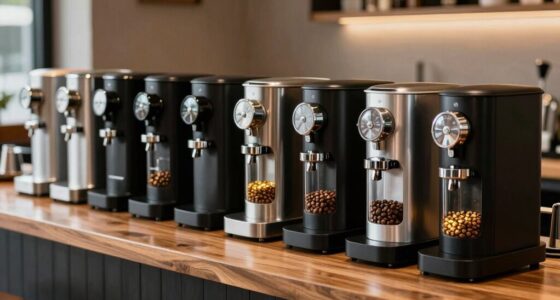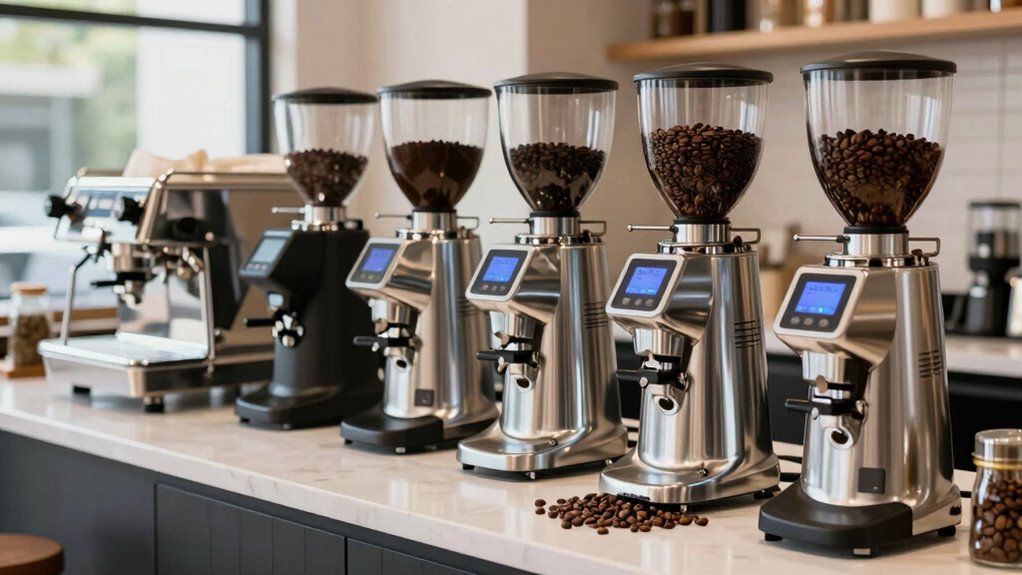
For a cafe, the Huanyu Commercial Coffee Grinder is my best overall pick because its built-in auto tamper pairs grinding and puck preparation in one workflow. The Commercial Grind-by-Weight Grinder stands out for dose consistency, while the SHARDOR 64mm offers a broad range of grind settings for operators who want more adjustment. The main tradeoff is whether your bar benefits most from easier dosing, finer control, or a simpler setup that staff can learn quickly. Burr size alone does not determine service speed or consistency, so daily volume and drink menu matter too. Read on for how the ten options differ and which cafe needs each one best.

Get coffee and tea gear delivered free with Prime
- Fast, free delivery on millions of items
- Prime Video, Amazon Music and more included
- Member-only deals all year
Complete the kit


Key Takeaways
- The Huanyu‘s built-in auto tamper gives it the clearest workflow distinction; cafes should still check that its integrated approach suits their preferred puck preparation.
- The grind-by-weight model prioritizes repeatable dosing, which can help reduce dose variation, though staff still need to set and maintain the target dose.
- SHARDOR and MOKKOM offer 100 grind settings, giving adjustment flexibility, but more settings do not automatically mean faster service or better espresso.
- Several picks share 64mm flat burrs, so the meaningful differences in this lineup are controls, dosing features, and workflow rather than burr diameter.
- Flyseago has two distinct approaches here: one model emphasizes touchscreen control and 19 settings, while another pairs grinding with a built-in tamper.
| Flyseago Touch Screen Commercial Coffee Grinder with 64mm Flat Burr and 19 Grind Settings |  | Best for High-Volume All-Day Service | Burr size and type: 64 mm flat burr | Burr material: 304 food-grade stainless steel | Grind settings: 19 | VIEW ON AMAZON | See Our Full Breakdown |
| SHARDOR 64mm Burr Coffee Grinder, Electric Espresso Grinder with 100 Grind Settings, Die-Cast Aluminum Housing |  | Best for Espresso Dial-In Range | Model: CG305B | Burr size and type: 64 mm flat burr | Burr material: SUS420 stainless steel | VIEW ON AMAZON | See Our Full Breakdown |
| Huanyu Commercial Coffee Grinder with 64 mm Flat Burrs and Built-In Auto Tamper |  | Best for Integrated Tamping Workflow | Burr type: 64 mm stainless steel flat burrs | Motor speed: 2,800 r/min | Built-in tamper: 58 mm, adjustable from 10 to 30 kg | VIEW ON AMAZON | See Our Full Breakdown |
| 64mm Commercial Electric Coffee Grinder with Stainless Steel Flat Burrs and Touchscreen |  | Best for Straightforward Cafe Controls | Burr type: 64 mm food-grade stainless steel flat burr | Hopper capacity: 35 oz, removable | Grind settings: 19 adjustable levels | VIEW ON AMAZON | See Our Full Breakdown |
| Commercial Coffee Grinder with 64mm Stainless Steel Flat Burrs and Touch Control |  | Best for Small Cafes Seeking Simplicity | Burr type: 64 mm stainless steel flat burrs | Grind settings: 18 | Hopper capacity: 35 oz | VIEW ON AMAZON | See Our Full Breakdown |
| Tuni G3 Commercial 64 mm Flat Burr Coffee Grinder, Ivory |  | Best for Flexible Dosing | Burrs: 64 mm stainless steel flat burrs | Grind adjustment: 100 settings; stepless adjustment | Hopper capacities: 250 g and 50 g | VIEW ON AMAZON | See Our Full Breakdown |
| Commercial Grind-by-Weight Coffee Grinder with 64mm Flat Burrs |  | Best for Dose Consistency | Burrs: 64 mm stainless steel flat burrs | Motor power: 350 W | Dosing: Programmable weight-based and time-based | VIEW ON AMAZON | See Our Full Breakdown |
| Flyseago Commercial Espresso Grinder with Built-In Tamper and 64 mm Flat Burrs |  | Best for Streamlined Espresso Service | Burrs: 64 mm SUS420 stainless steel flat burrs | Tamper: Built-in adjustable pressure, 10–30 kg | Grind settings: 14 | VIEW ON AMAZON | See Our Full Breakdown |
| MOKKOM 64mm Flat Burr Coffee Grinder with 100 Grind Settings |  | Best Premium Build | Model: BD-CG308 | Burrs: 64 mm stainless steel flat burrs | Grind settings: 100 | VIEW ON AMAZON | See Our Full Breakdown |
| AMZCHEF Commercial Espresso Grinder with 64 mm Flat Burrs, Black and Silver |  | Best for Broad Brew Menus | Burrs: 64 mm flat burrs | Grind settings: 90 | Espresso setting range: 4–15 | VIEW ON AMAZON | See Our Full Breakdown |
| commercial coffee grinders for cafe | Grind settings | Hopper capacity | Controls | Burrs |
|---|---|---|---|---|
| Flyseago Touch Screen Commerci | 19 | 35.2 oz | Digital touch screen with one-touch presets | — |
| SHARDOR 64mm Burr Coffee Grind | 100 levels | 17.6 oz | LED touch screen | — |
| Huanyu Commercial Coffee Grind | — | — | — | — |
| 64mm Commercial Electric Coffe | 19 adjustable levels | 35 oz, removable | Touchscreen with digital display | — |
| Commercial Coffee Grinder with | 18 | 35 oz | Touch control with single- and double-dose timing | — |
| Tuni G3 Commercial 64 mm Flat | — | — | LED touchscreen | 64 mm stainless steel flat burrs |
| Commercial Grind-by-Weight Cof | 14 | 35 oz | — | 64 mm stainless steel flat burrs |
| Flyseago Commercial Espresso G | 14 | 35 oz (1 kg) | One- and two-cup buttons with time control | 64 mm SUS420 stainless steel flat burrs |
| MOKKOM 64mm Flat Burr Coffee G | 100 | — | — | 64 mm stainless steel flat burrs |
| AMZCHEF Commercial Espresso Gr | 90 | — | — | 64 mm flat burrs |
More Details on Our Top Picks
Flyseago Touch Screen Commercial Coffee Grinder with 64mm Flat Burr and 19 Grind Settings
The Flyseago pairs a 35 oz hopper with 19 settings, making it a practical fit for a cafe that switches between espresso and batch brew while serving a steady stream of customers. Its touch screen offers one-touch presets and 0.1-second timing adjustments, which can make repeat dosing easier for a rotating staff. Compared with the SHARDOR CG305B, it gives up fine-grained choice across 100 settings and a portafilter holder, but offers roughly twice the hopper capacity. The tradeoff is that timing-based doses need calibration and do not measure coffee by weight. Its large footprint may also be hard to justify at a low-volume bar. I’d shortlist it for cafes that value fewer refills and straightforward controls over extensive grind adjustment.
Pros:- 35 oz airtight hopper can reduce refills during busy service.
- 19 settings cover Turkish, espresso, pour-over, drip, cold brew, and French press.
- Touch-screen presets and 0.1-second adjustments support repeatable timed doses.
- Low-noise motor and stainless steel burrs suit shared cafe spaces.
Cons:- Timed dosing requires calibration and does not weigh each dose.
- Large hopper and commercial build take up substantial counter space.
Best for: Busy cafes serving several brew styles that want a large hopper and simple timed presets for staff.
Not ideal for: Small counters or espresso bars that need grind-by-weight dosing, hands-free portafilter grinding, or a compact machine.
- Burr size and type:64 mm flat burr
- Burr material:304 food-grade stainless steel
- Grind settings:19
- Hopper capacity:35.2 oz
- Controls:Digital touch screen with one-touch presets
- Dose adjustment:0.1-second increments
- Body materials:Aluminum, food-grade plastic, and food-grade stainless steel
- Power source:Electric
Our verdict“Choose the Flyseago if your cafe needs high hopper capacity and accessible timed controls across multiple brew methods.”
SHARDOR 64mm Burr Coffee Grinder, Electric Espresso Grinder with 100 Grind Settings, Die-Cast Aluminum Housing
For a cafe where espresso adjustment takes priority, the SHARDOR CG305B offers 100 grind settings, an adjustable portafilter holder, and programmable single or double shots. That combination gives baristas more adjustment steps than the 19-setting Flyseago Touch Screen Commercial Coffee Grinder, while its 17.6 oz hopper means more frequent refills during heavy service. The 64 mm SUS420 flat burrs and anti-static system are aimed at consistent grinding with less mess, and the direct-to-portafilter setup can keep the workflow tidy. Its appeal is strongest at a focused espresso station rather than a cafe that wants one large hopper for several brew styles. I’d skip it if bulk capacity matters more than fine adjustment or if the station has little counter room.
Pros:- 100 grind settings give baristas extensive adjustment range.
- Adjustable portafilter holder supports hands-free direct grinding.
- Anti-static system and stainless steel grounds bin are designed to limit mess and clumping.
- Programmable single and double shots support a repeatable espresso workflow.
Cons:- 17.6 oz hopper holds substantially less than the 35 oz hoppers on several alternatives.
- Large 64 mm burrs and die-cast housing may be bulky for tight work areas.
Best for: Espresso-focused cafes and small bar teams that want many adjustment steps and direct portafilter grinding.
Not ideal for: High-throughput cafes needing a large bean hopper or operators seeking a compact grinder for a crowded counter.
- Model:CG305B
- Burr size and type:64 mm flat burr
- Burr material:SUS420 stainless steel
- Grind settings:100 levels
- Hopper capacity:17.6 oz
- Housing:Die-cast aluminum
- Controls:LED touch screen
- Features:Anti-static system, adjustable portafilter holder, and shot programming
Our verdict“Pick the SHARDOR for an espresso bar that values fine grind adjustment and direct portafilter workflow over hopper capacity.”
Huanyu Commercial Coffee Grinder with 64 mm Flat Burrs and Built-In Auto Tamper
The Huanyu stands apart from the SHARDOR CG305B by putting an adjustable 58 mm auto tamper into the grinder workflow. For a cafe training newer baristas or trying to standardize puck preparation, adjustable pressure from 10 to 30 kg may reduce the number of separate steps and tools at the station. It also supports timed single or double shots and manual dosing, with a 35 oz lockable hopper suited to longer service runs. The listed grind adjustment is described as both 14 settings and stepless, so the exact adjustment behavior is unclear from the supplied product data. Compared with the SHARDOR’s stated 100 settings, this makes the Huanyu harder to judge for precise espresso dialing. I’d favor it where integrated tamping matters more than clearly specified grind increments.
Pros:- Built-in 58 mm tamper has adjustable pressure from 10 to 30 kg.
- 35 oz lockable hopper supports longer runs between refills.
- Timed single and double dosing plus manual operation offer workflow flexibility.
- 2,800 r/min motor is specified for efficient, low-temperature grinding.
Cons:- Grind adjustment is described inconsistently as 14 settings and stepless.
- Product data does not provide dimensions or weight, making counter planning difficult.
Best for: Cafe owners who want an integrated adjustable tamper and a large hopper to simplify espresso station workflow.
Not ideal for: Baristas who need clearly documented grind increments or a grinder with stated dimensions for a tight counter layout.
- Burr type:64 mm stainless steel flat burrs
- Motor speed:2,800 r/min
- Built-in tamper:58 mm, adjustable from 10 to 30 kg
- Dosing modes:Timed single or double shot and manual
- Bean hopper capacity:35 oz
- Grind adjustment:Described as 14 settings with stepless adjustment
Our verdict“Choose the Huanyu if integrated, adjustable tamping is a higher priority than a clearly specified grind adjustment range.”
64mm Commercial Electric Coffee Grinder with Stainless Steel Flat Burrs and Touchscreen
This grinder focuses on a simple combination: 19 grind settings, a 35 oz removable hopper, and a digital screen with 0.1-second timing adjustments. For a cafe that wants a clear control panel and room for a substantial bean supply, that is easier to assess than the Huanyu, whose grind adjustment is described as both 14 settings and stepless. It shares much of the Flyseago’s stated setup, including its capacity and timed control increments, so the choice between them may come down to the Flyseago’s listed one-touch presets and 304 stainless steel burr material. This model’s supplied data does not specify a burr grade or dosing presets. Its wide brewing range is useful, though 19 settings offer fewer adjustment points than the SHARDOR’s 100. Expect to give it meaningful counter space.
Pros:- 35 oz removable hopper limits interruptions for refills.
- 19 settings cover espresso, cold brew, French press, and pour-over.
- Touchscreen display with 0.1-second adjustments makes timed dosing accessible.
- Low-noise operation is suited to customer-facing spaces.
Cons:- 19 settings provide fewer adjustment points than the SHARDOR CG305B’s 100.
- Large commercial format can crowd a small counter.
- Supplied specifications do not identify the stainless steel burr grade.
Best for: Small and midsize cafes seeking a removable high-capacity hopper and uncomplicated timed controls for several brew methods.
Not ideal for: Espresso bars that need many grind adjustment points, weight-based dosing, or detailed documentation of burr material.
- Burr type:64 mm food-grade stainless steel flat burr
- Hopper capacity:35 oz, removable
- Grind settings:19 adjustable levels
- Controls:Touchscreen with digital display
- Time adjustment:0.1-second increments
- Noise:Low-noise operation
- Brew compatibility:Espresso, cold brew, French press, and pour-over
Our verdict“Pick this model for a cafe that wants simple timed controls and a removable 35 oz hopper across common brew styles.”
Commercial Coffee Grinder with 64mm Stainless Steel Flat Burrs and Touch Control
The B0DHZHLSD5 keeps its feature set centered on practical service needs: 18 grind settings, a 35 oz hopper, touch controls, and an anti-static silicone pad. That makes it a plausible small-cafe pick for operators who want a large bean supply and basic timed single or double doses without paying for an extensive adjustment scale like the SHARDOR CG305B’s 100 settings. The extra hopper capacity may suit a steady stream of coffee, but it can be wasteful at a low-volume bar where beans sit between shifts. Its 18 settings are one fewer than the 19 on the Flyseago Touch Screen Commercial Coffee Grinder, and the supplied data gives less detail about control presets and materials. I’d choose it for an uncomplicated setup, while seeking more documented adjustment and dosing options for a demanding espresso program.
Pros:- 35 oz hopper reduces the need for frequent bean refills.
- 18 settings cover brewing from espresso to French press.
- Touch controls allow single- and double-dose timing adjustments.
- Silicone anti-static pad is designed to reduce stray grounds and mess.
Cons:- Large hopper may be unnecessary for occasional or low-volume service.
- Fewer settings than the Flyseago and far fewer than the SHARDOR CG305B.
- Supplied product details omit burr grade and specific timing increments.
Best for: Small cafes and office coffee bars that want a large hopper, touch-based timed dosing, and a simple range of brew settings.
Not ideal for: Low-volume shops with limited counter space or espresso programs that need a broad, well-documented adjustment range.
- Burr type:64 mm stainless steel flat burrs
- Grind settings:18
- Hopper capacity:35 oz
- Controls:Touch control with single- and double-dose timing
- Anti-static feature:Silicone pad
- Brew range:Espresso to French press
Our verdict“Choose this grinder for a small cafe that values a large hopper and simple timed controls over extensive espresso adjustment.”
Tuni G3 Commercial 64 mm Flat Burr Coffee Grinder, Ivory
The Tuni G3 suits a café that switches between espresso service and coarser brew methods, with 100 grind settings and interchangeable 250 g and 50 g hoppers. The smaller hopper supports single dosing when staff rotate beans, while the larger one reduces refills during regular service. Timed single, double, and continuous modes give it a more varied workflow than the simpler timed controls on the AMZCHEF Commercial Espresso Grinder. Anti-static technology is intended to limit grounds scattering around the station.
Its touchscreen and portafilter holder add convenience, but the listed one-year warranty and lack of stated motor power or throughput leave less to judge about long-shift demands. Compared with the MOKKOM BD-CG308, the Tuni offers similar hopper flexibility but less detail about its construction. It makes the most sense for a café that values grind range and dosing options over documented heavy-duty capacity.
Pros:- 100 settings cover espresso through French press
- Interchangeable 250 g and 50 g hoppers suit bulk and single-dose workflows
- Timed single, double, and continuous modes offer flexible dosing
- Anti-static technology is designed to reduce scattered grounds
Cons:- Motor power and café throughput are not specified
- One-year warranty offers less stated coverage than a longer commercial warranty
- Touchscreen and many settings may add steps for staff who need a simple shared workflow
Best for: Small cafés that alternate between espresso and batch or manual brew, and want both bulk and single-dose hopper options.
Not ideal for: High-volume espresso bars that need documented motor output, throughput, or durability for long continuous shifts.
- Burrs:64 mm stainless steel flat burrs
- Grind adjustment:100 settings; stepless adjustment
- Hopper capacities:250 g and 50 g
- Controls:LED touchscreen
- Timing increments:0.5 seconds
- Grind modes:Timed single, double, and continuous
- Portafilter compatibility:51–58 mm holder included
- Warranty:1 year; lifetime tech support
Our verdict“Choose the Tuni G3 for a varied café menu that benefits from two hopper sizes and broad grind adjustment, provided documented high-volume capacity is not a priority.”
Commercial Grind-by-Weight Coffee Grinder with 64mm Flat Burrs
For a café where repeatable espresso doses matter more than a huge adjustment range, this grinder’s defining feature is its integrated scale, with stated accuracy of ±0.1 g and both weight- and time-based dosing. That gives staff a direct way to portion grounds without relying only on grind time, a distinction from the Flyseago Commercial Espresso Grinder, which instead emphasizes a built-in tamper and timed cup buttons. The 35 oz hopper also suits steady service with fewer bean refills.
The tradeoff is a narrower 14-setting range than the 90- and 100-setting options from AMZCHEF and MOKKOM, which may limit fine adjustment across varied brew methods. The listed 350 W motor is useful context, though dimensions and durability details are absent. This pick fits cafés that prioritize measured dosing and routine cleaning over broad experimentation with grind settings.
Pros:- Weight-based and time-based dosing support different service routines
- Integrated scale has stated ±0.1 g accuracy
- 35 oz hopper reduces refill frequency
- Detachable food-contact parts and lockable hopper support routine handling and cleaning
Cons:- 14 grind settings offer less adjustment range than the Tuni G3 or MOKKOM BD-CG308
- Dimensions and grinder weight are not specified
- Durability details for sustained café use are not provided
Best for: Espresso-focused cafés that want weight-based portions and a large hopper for repeatable service.
Not ideal for: Cafés that frequently switch among brewing methods and need many fine grind adjustments or verified long-term durability.
- Burrs:64 mm stainless steel flat burrs
- Motor power:350 W
- Dosing:Programmable weight-based and time-based
- Scale accuracy:±0.1 g
- Grind settings:14
- Hopper capacity:35 oz
- Portafilter stand:Height-adjustable
- Brewing methods:Turkish coffee, espresso, drip, cold brew, and French press
Our verdict“Pick this grinder when measured dose consistency is more useful to your café than a wide range of grind adjustments.”
Flyseago Commercial Espresso Grinder with Built-In Tamper and 64 mm Flat Burrs
The Flyseago pairs grinding with an adjustable built-in tamper, making it the lineup’s clearest choice for a café trying to reduce separate steps at the espresso station. Its height-adjustable portafilter holder and one- and two-cup buttons support hands-free dosing, while the 1 kg hopper can keep beans ready through a busy stretch. Compared with the Commercial Grind-by-Weight Grinder, this model gives more attention to tamping workflow; that other pick provides stated scale accuracy and weight-based dosing instead.
The Flyseago’s 14 settings are relatively limited beside the AMZCHEF’s 90 or the MOKKOM’s 100, so it is less appealing for cafés with a broad brew menu. Plastic is among its listed materials, and the claim of extended daily use comes without supporting durability details. I’d choose it for a focused espresso bar that values fewer manual steps, not for a shop seeking proven all-day heavy-duty performance.
Pros:- Adjustable built-in tamper combines two espresso station steps
- 1 kg hopper can reduce refills during busy service
- Height-adjustable holder supports hands-free grinding
- One- and two-cup timed buttons provide straightforward portions
Cons:- 14 settings provide less grind adjustment than the Tuni G3 or MOKKOM BD-CG308
- Plastic is listed among the construction materials
- Extended daily-use claim lacks supporting durability details
Best for: Espresso bars and hotel coffee stations that want hands-free grinding and tamping with a large bean supply.
Not ideal for: Cafés serving many brew styles or buyers who need documented long-shift durability and a mostly metal construction.
- Burrs:64 mm SUS420 stainless steel flat burrs
- Tamper:Built-in adjustable pressure, 10–30 kg
- Grind settings:14
- Hopper capacity:35 oz (1 kg)
- Controls:One- and two-cup buttons with time control
- Portafilter holder:Height-adjustable
- Materials:Plastic and stainless steel
- Included components:Cleaning brush, hopper with baffle, grinder, and grounds tray
Our verdict“Choose the Flyseago for an espresso-led café that values an integrated tamping workflow more than broad grind range or documented durability.”
MOKKOM 64mm Flat Burr Coffee Grinder with 100 Grind Settings
The MOKKOM BD-CG308 is the strongest fit here for a café that wants a metal-bodied grinder with both bulk and single-dose workflows. Its stainless steel body, aluminum alloy chamber, and brass adjustment ring give it a more substantial listed construction than the plastic-and-steel Flyseago. With 100 grind settings, a 350 g hopper, and a silicone-bellow single-dose hopper, it can move between regular service and bean changes without requiring a separate grinder. A plasma generator in the exit chute is designed to help reduce static.
The tradeoff is that a full-metal build may be heavy for a station where equipment is moved often, and the supplied data gives no motor power or throughput figure. The Tuni G3 also offers two hopper sizes and broad adjustment, while the MOKKOM’s 0.1-second timer and stated materials make its case more about build and dosing flexibility. It suits cafés willing to prioritize construction over portability.
Pros:- Stainless steel body, aluminum alloy chamber, and brass adjustment ring
- 100 settings accommodate a wide range of brew methods
- Includes 350 g bulk and silicone-bellow single-dose hoppers
- Plasma generator is designed to reduce static at the exit chute
Cons:- Full-metal construction may make the grinder heavy to reposition
- Motor power and café throughput are not specified
- Single-dose and bulk hopper changes may add handling steps during service
Best for: Cafés that want a metal-bodied 64 mm grinder for both bulk service and occasional single-dose bean changes.
Not ideal for: Mobile coffee setups or small counters where low weight and a compact footprint are priorities.
- Model:BD-CG308
- Burrs:64 mm stainless steel flat burrs
- Grind settings:100
- Timer precision:0.1 seconds
- Large hopper capacity:350 g (12.35 oz)
- Hoppers:Large hopper and single-dose silicone-bellow hopper
- Construction:Stainless steel body, aluminum alloy base, and brass adjustment ring
- Anti-static feature:Plasma generator in exit chute
Our verdict“Choose the MOKKOM if metal construction and two dosing workflows matter more to your café than easy repositioning or documented throughput.”
AMZCHEF Commercial Espresso Grinder with 64 mm Flat Burrs, Black and Silver
The AMZCHEF is a practical match for cafés that serve espresso alongside pour-over, French press, or cold brew and want one grinder with a clearly mapped 90-setting range. Its stated ranges—espresso at 4–15, moka and pour-over at 16–55, and French press and cold brew at 56–90—give staff a useful starting point when changing brew styles. The 0.1-second timer supports small dose adjustments, while the anti-static system is designed to keep the station tidier. Compared with the 14-setting Flyseago, it offers far more adjustment, though it lacks that model’s integrated tamper.
The tradeoffs are a 200 W DC motor with no stated throughput figure and a 58 mm portafilter sold separately. At 12.6 lb, it is also substantial for a compact station. The MOKKOM adds 100 settings and dual hoppers, but the AMZCHEF spells out brew ranges and weighs less than some full-metal builds may. It suits a multi-method café that can supply its own portafilter.
Pros:- 90 settings span espresso through French press and cold brew
- Published setting ranges help staff switch between brew methods
- 0.1-second timer supports fine time adjustments
- Stainless steel body and anti-static system are designed for tidy daily use
Cons:- 58 mm portafilter is sold separately
- At 12.6 lb, it may be awkward to move around a compact counter
- 200 W motor is listed without a throughput figure
Best for: Independent cafés serving espresso and several manual or batch brew styles that want mapped settings for each range.
Not ideal for: Espresso bars seeking an included 58 mm portafilter, integrated tamping, or documented high-volume throughput.
- Burrs:64 mm flat burrs
- Grind settings:90
- Espresso setting range:4–15
- Moka and pour-over setting range:16–55
- French press and cold brew setting range:56–90
- Motor:200 W DC
- Timer precision:0.1-second increments
- Portafilter compatibility:58 mm; portafilter sold separately
- Weight:12.6 lb
Our verdict“Pick the AMZCHEF for a multi-method café that wants a broad, mapped grind range and already has a compatible portafilter.”

How We Picked
I compared the ten grinders through a cafe buyer’s lens: how each design may fit espresso service, how clearly an operator can set and repeat a grind, and whether features such as touch controls, built-in tamping, or grind-by-weight address a real bar workflow need. I also weighed the practical implications of the listed build and burr details, while treating a high setting count as flexibility rather than proof of better results. Product descriptions alone cannot establish grind consistency, throughput, or long-term durability, so I avoid claims that require hands-on testing.
The ranking gives priority to features that can make daily cafe work more repeatable, then to adjustment range and ease of operation. That puts the Huanyu first for its combined grinding and tamping workflow, and the grind-by-weight model high for measured dosing. SHARDOR and MOKKOM rank as adjustment-focused alternatives, while models with fewer stated distinctions sit lower because the available details provide less evidence of a cafe-specific advantage. Each pick carries a tradeoff: integrated features can constrain workflow, and more controls can ask more of staff during setup.
| commercial coffee grinders for cafe | Controls |
|---|---|
| Flyseago Touch Screen Commerci | Digital touch screen with one-touch presets |
| SHARDOR 64mm Burr Coffee Grind | LED touch screen |
| Huanyu Commercial Coffee Grind | — |
| 64mm Commercial Electric Coffe | Touchscreen with digital display |
| Commercial Coffee Grinder with | Touch control with single- and double-dose timing |
| Tuni G3 Commercial 64 mm Flat | LED touchscreen |
| Commercial Grind-by-Weight Cof | — |
| Flyseago Commercial Espresso G | One- and two-cup buttons with time control |
| MOKKOM 64mm Flat Burr Coffee G | — |
| AMZCHEF Commercial Espresso Gr | — |
Factors to Consider When Choosing Commercial Coffee Grinders For Cafe
Choosing a cafe grinder starts with the work it must do across a full service day. I would map your drink menu, expected rushes, staffing, and cleaning routine before comparing feature lists. These broader questions help reveal when a specialized function earns its place on the bar and when a simpler grinder is the better fit.
Match the Grinder to Your Menu
Begin by listing the drinks that drive your service: espresso, batch brew, or a mix of both. A cafe focused on espresso needs repeatable adjustment as beans age and conditions change, while a mixed menu may need a grinder that can move between settings without disrupting service. Avoid assuming one grinder will cover every task just because its controls show many settings. Switching between brew methods can mean dial-in waste and staff confusion, especially during a rush. If you serve substantial volumes of both espresso and filter coffee, consider whether separate grinders would keep each station ready. Choose around the work your team repeats most often.
Plan for Rush-Hour Throughput
Think through your busiest fifteen minutes rather than relying on an average daily cup count. The number of drinks, shot timing, and how often staff refill or adjust the grinder all shape whether the workflow feels manageable. A built-in tamper may reduce one handoff, but it does not by itself establish how quickly the grinder can keep up. Ask suppliers for comparable throughput information and clarify the conditions behind it. Also check hopper capacity and how easily staff can access beans during service. A feature that saves a step matters most when it removes a repeated bottleneck.
Decide How Much Dose Control You Need
Timer-based, manual, and weight-based dosing ask staff to manage consistency in different ways. Grind-by-weight can reduce variation in the amount dispensed, but it does not remove the need to dial in the recipe or check the result in the cup. A timer can be straightforward for a stable menu, though changes in grind or bean behavior may affect the delivered dose. Before paying for automation, estimate how often doses drift and how much that disrupts service. Agree on a simple routine for checking and correcting doses. The best method is the one your team can repeat reliably under pressure.
Treat Adjustment Range as a Workflow Choice
A large number of grind settings can provide finer control, but it can also make training and recipe handover more involved. What matters is whether staff can return to a known espresso setting and make small, understandable changes as needed. Ask how adjustments are marked and whether moving between settings affects the grind already in the chamber. During a trial, have more than one staff member dial in the same coffee and compare how easily they reach a consistent result. Do not choose by the setting count alone. Clear, repeatable adjustments often matter more than a long menu of increments.
Account for Cleaning and Service
Coffee oils and grounds build up wherever beans pass through the grinder, so access for routine cleaning should be part of the purchase decision. Ask what staff can clean without tools, how burr access works, and how often the maker recommends deeper service. A touchscreen or integrated tamper can simplify one task while adding components that need their own care. Check parts availability and warranty support in your region before committing a grinder to daily cafe use. Plan who will handle cleaning and when it fits into opening or closing duties. A maintenance routine that the team can follow protects consistency over time.
Set a Budget Around the Whole Station
Compare the grinder as part of a working espresso station, including the space it occupies and any accessories or service arrangements it requires. Paying more for weight-based dosing or a combined tamping workflow makes sense when that function solves a recurring staffing or consistency problem. It is harder to justify when your menu is small or the team already follows a reliable manual routine. Leave room in the budget for training, cleaning supplies, and replacement parts. Check the grinder’s footprint and clearance against your counter before ordering. A good fit for the station can be more useful than a longer feature list.
Frequently Asked Questions
Is a 64mm flat-burr grinder enough for a busy cafe?
Burr diameter alone cannot tell you whether a grinder will keep pace with your service. The ten options here mostly use 64mm flat burrs, so their listed differences center on dosing and controls rather than size. Ask the maker for throughput figures and the conditions used to measure them, then compare that information with your rush-hour demand. Consider how often staff need to adjust, refill, or clean the machine as well. A cafe with sustained high volume should seek service and durability details before relying on the burr specification.
Does grind-by-weight make espresso dosing consistent without staff checks?
Grind-by-weight can help deliver a more consistent amount of coffee, but it does not verify that the espresso tastes right or that the grind is dialed in. Beans change as they age, and staff may still need to adjust the recipe and confirm dose and yield. Establish a routine for checking shots and recalibrating when the coffee or conditions change. Ask how the grinder handles retained grounds and what cleaning the weighing mechanism needs. It is a useful control for cafes that value measured dosing, not a substitute for barista judgment.
Should I choose 100 grind settings over 19?
A higher setting count can offer smaller adjustment steps, which may help a team fine-tune a recipe. It does not guarantee that the grinder is more accurate or easier to use. A 19-setting control may be simpler for a narrow menu, while a larger range can suit operators who adjust often or want more room to experiment. Check how the settings are presented and whether staff can reliably return to a saved grind point. Choose based on your dialing-in process rather than the number printed in the product name.
Is a built-in tamper a good fit for a cafe bar?
An integrated tamper may reduce a separate step and make a compact station easier to organize. The tradeoff is that it ties puck preparation to the grinder’s workflow, which may not match every barista’s preferred technique or pace. Before choosing one, confirm how the tamper is adjusted and cleaned, and whether staff can use it consistently across the menu. Compare the time saved with your current tamping setup during a realistic service period. Cafes that prioritize standardized steps may welcome the integration; teams that prefer separate tools may value flexibility more.
What should I verify before putting one of these grinders into daily cafe service?
Confirm the grinder’s expected throughput, warranty terms, local parts availability, and cleaning instructions with the seller or maker. Check dimensions and hopper access against the counter where it will sit, including room for staff to work around it. Ask whether the listed controls support your menu’s grind range and how adjustments are recorded for shift handover. If possible, arrange a demonstration using your beans and have more than one operator try the workflow. Those checks can reveal practical fit issues that a feature list cannot answer.
Conclusion
For a cafe seeking a joined-up grinding and tamping workflow, I would start with the Huanyu as my best overall pick. The Commercial Grind-by-Weight Grinder is my choice for cafes that put measured doses first, while SHARDOR and MOKKOM suit teams that want a broad adjustment range. For a beginner-friendly shortlist, I would compare the simpler controls of the Flyseago touchscreen model with 19 settings against the team’s training needs; its smaller setting range may feel easier to manage, though it offers less stated adjustment flexibility. The Flyseago built-in-tamper model is the specific-workflow pick for a bar that wants grinding and tamping combined. Before deciding, confirm service support and throughput for your expected volume, since those details are not established by the listed features alone.
Fall Picks
fall essentials
As an affiliate, we earn on qualifying purchases.