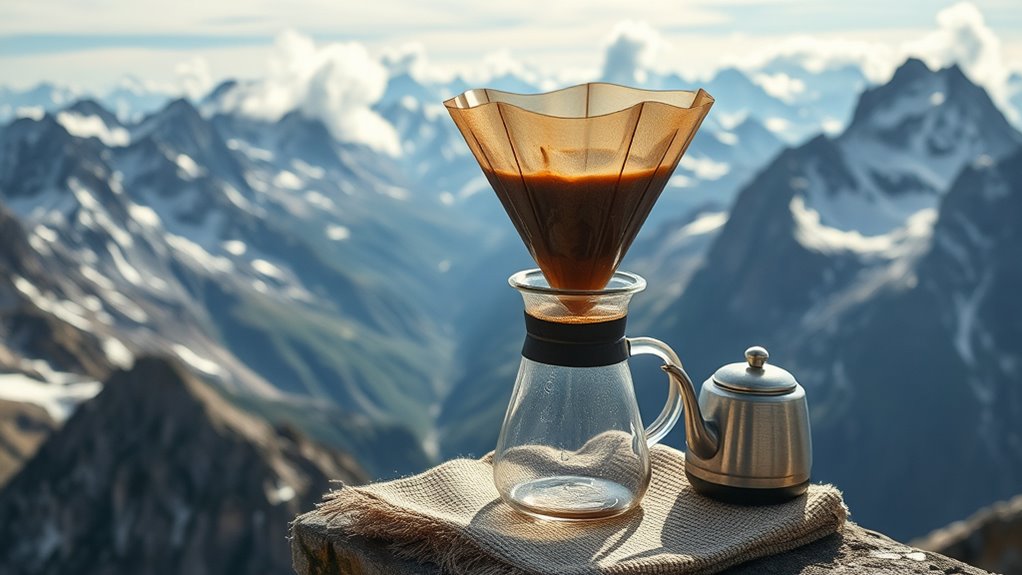

When brewing coffee at high altitudes, you need to adjust for lower boiling temperatures, which can lead to under-extraction and weaker flavor. To counter this, increase your brew time, use a finer grind, and consider equipment that retains heat better, like French presses or vacuum brewers. These tweaks help guarantee your coffee fully develops its flavor despite the altitude. Keep exploring to discover more tips for perfect high-altitude coffee.
Key Takeaways
- Adjust brewing time and grind size to compensate for lower boiling temperatures at high altitudes.
- Use brewing equipment that retains heat, like French presses or vacuum brewers, for better extraction.
- Brew immediately after boiling to maximize temperature and flavor extraction.
- Extend steeping or brewing duration to offset reduced water temperature.
- Understand that lower boiling points still allow effective brewing with proper technique adjustments.
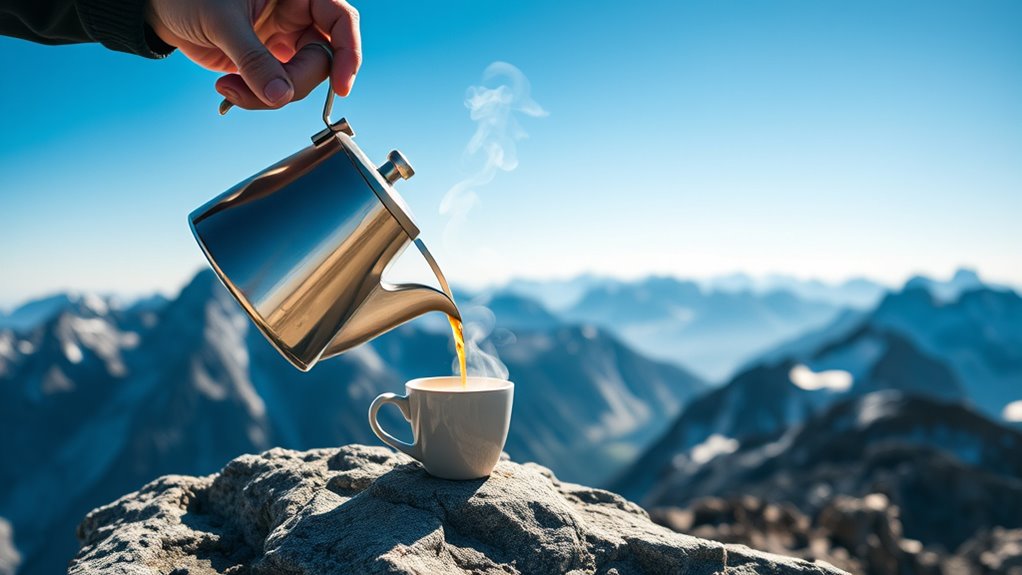
Brewing coffee at high altitudes presents unique challenges because water boils at lower temperatures, often around 192°F at 7,000 feet. This reduced boiling point directly impacts the brewing temperature, which is vital for proper extraction. When water reaches its boiling point at sea level (212°F), it guarantees ideal extraction of flavors from your coffee grounds.
At high altitudes, water boils at lower temperatures, impacting optimal coffee extraction.
However, at high altitude, the lower boiling point means the water isn’t as hot, so it mightn’t extract all the desirable compounds unless you make specific adjustments. Since the brewing temperature is lower, you might notice that the brew time needs to be extended. Longer steeping allows the water more time to extract flavors from the coffee grounds despite the reduced temperature.
Using a finer grind helps compensate for the lower water temperature because it increases the surface area, leading to better extraction. Without these adjustments, your coffee could taste weak or under-extracted, lacking the full flavor profile it should have.
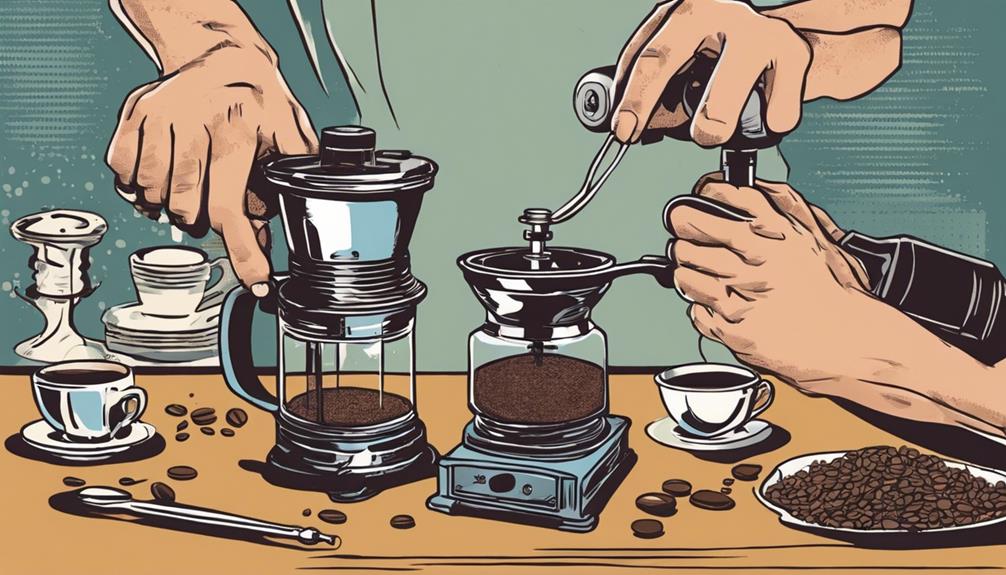
Temperature loss during brewing can also be a concern. Equipment like vacuum brewers and French presses are advantageous because they help maintain a more consistent temperature throughout the process. These devices help counteract the effects of temperature loss, guaranteeing the water stays hot enough for proper extraction.
Many high-altitude brewers find that brewing immediately after boiling works well, as the lower boiling point still provides sufficient heat for good flavor extraction, especially when combined with a finer grind and longer brew time.
Empirical community observations at high elevations suggest you don’t have to compromise on flavor quality. As long as you adjust your brewing parameters—such as using a finer grind, increasing brew time, and choosing equipment that minimizes temperature loss—you can achieve a satisfying cup.
Additionally, understanding temperature control and how it affects extraction helps optimize your brewing process in high-altitude environments. The key is recognizing that the lower boiling point doesn’t prevent good flavor; it just requires you to adapt your technique. By making these small but impactful adjustments, you guarantee that your coffee grounds are properly extracted despite the high-altitude environment, resulting in a rich, flavorful brew that rivals those made at sea level.
Frequently Asked Questions
How to Brew Coffee at High Altitude?
When brewing coffee at high altitude, you need to modify your process. Use a thermometer to monitor water temperature, aiming for about 192°F to 197°F.
Preheat your equipment and opt for brewing methods like French press or vacuum pot that hold heat well.
Grind your beans finer and extend steeping time to ensure proper extraction.
Manual adjustments are key, especially with drip machines or pour-over setups, to get the best flavor.
What Is Considered High Altitude for a Coffee Maker?
You ask what counts as high altitude for a coffee maker. Generally, if you’re above 3,000 feet, it’s considered high altitude because water boils at lower temperatures there.
As you go over 4,500 feet, brewing becomes trickier since boiling points drop further. Standard coffee machines are made for sea level, so at these elevations, you’ll need to make adjustments to get the best brew.
What Does High Altitude Do to Coffee?
High altitude substantially impacts coffee by producing beans with denser structures and complex sugars, which enhance flavor and acidity.
When you grow coffee above 4,500 feet, you’ll notice brighter, more nuanced tastes thanks to slower ripening. Cooler temperatures promote richer aromas and higher concentrations of desirable compounds.
As a result, your high-altitude coffee will be more aromatic, with pronounced citrus, floral, and fruity notes, making every sip more vibrant and complex.
Can You Use a High Altitude Coffee Maker in a Low Altitude?
You can definitely use a high altitude coffee maker at low altitude. Since these machines are designed to work with lower boiling points, they often produce standard brewing temperatures when used at lower elevations. This usually results in ideal extraction and flavor.
Just check if your machine has adjustable temperature controls, so you can guarantee it operates correctly and consistently, delivering great coffee regardless of altitude.
Conclusion
Brewing coffee at high altitudes can be tricky, but with the right adjustments, you’ll enjoy a flavorful cup every time. Remember, the lower boiling point means you might need to tweak your grind size, water temperature, or brewing time. Don’t be discouraged if it takes a bit of trial and error. Keep experimenting, and soon you’ll find the perfect method for your altitude. Enjoy your freshly brewed high-altitude coffee!