
If you want the most consistent espresso, grind-by-weight is your best choice. It guarantees you dose the same amount of coffee every time, relying on precise scales for accuracy. Timed dosing depends on grind performance and can vary, leading to less reliability. By using weight-based methods, you’ll get more predictable results over time. To find out how to optimize your setup and get the best shots, look further into these techniques.

Get coffee and tea gear delivered free — and shop member deals
- Fast, free delivery on millions of items
- Access to Prime Big Deal Days deals on October 6–7
- Prime Video, Amazon Music and more included
Key Takeaways
- Grind-by-weight offers higher consistency due to precise measurement, reducing shot variability.
- Timed dosing depends on grinder performance and timing accuracy, leading to potential inconsistencies.
- Regular calibration of grinders enhances the reliability of timed dosing for consistent espresso.
- Weight-based dosing simplifies calibration and maintains uniform grounds, ensuring reproducible results over time.
- For maximum consistency and predictability, grind-by-weight generally outperforms timed dosing.

When it comes to achieving the perfect brew, choosing between grind-by-weight and timed dosing can considerably impact your results. Both methods aim to deliver consistent espresso shots, but they do so through different approaches that influence grind calibration and dosing accuracy. Understanding how each method works helps you select the one that best suits your needs and improves your overall coffee quality.
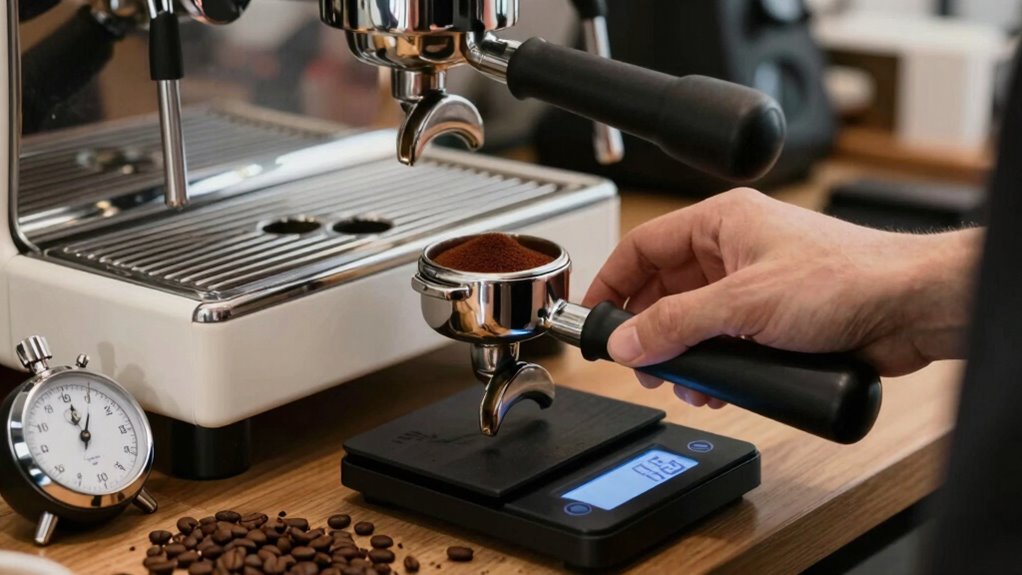
With grind-by-weight dosing, you measure out a specific amount of coffee by weight before brewing. This method relies on a precise scale to ensure each dose is consistent, making it easier to calibrate your grinder accurately. When you focus on grind calibration, you know that your coffee grounds are uniform, which directly affects the extraction process. Precise grind calibration ensures the coffee particles are of similar size, minimizing variables that could cause inconsistent extraction. Dosing accuracy is at the core of this approach because every shot starts with the same amount of coffee, reducing variability from shot to shot. Over time, this consistency makes it easier to dial in your grinder and recipe, leading to a more predictable and high-quality espresso.
Grind-by-weight dosing ensures consistent, uniform grounds for better extraction and more reliable espresso shots.
Timed dosing, on the other hand, involves running your grinder for a set amount of time to produce a desired volume of grounds. While quick and straightforward, this method’s accuracy depends heavily on your grinder’s consistency and timing. If your grinder’s performance fluctuates or if you don’t account for variables like bean density or grind settings, your dose may vary from shot to shot. As a result, achieving perfect dosing accuracy can be more challenging. Without proper calibration, timed dosing may produce inconsistent results because even slight variations in grind time or grinder performance can alter the amount of coffee dispensed. This makes it harder to maintain uniformity unless you manually verify and adjust your doses regularly.
In terms of consistency, grind-by-weight dosing typically offers more reliable results, especially when combined with regular grind calibration. It minimizes human error and ensures each shot starts with an exact coffee amount, making the process more repeatable. Timed dosing can work well for quick, casual brews, but it demands diligent monitoring and adjustments to stay precise. If your goal is long-term consistency and precision, grind-by-weight dosing gives you the edge because it emphasizes dosing accuracy and precise calibration, reducing the margin for error. Ultimately, choosing the right method depends on your equipment, workflow, and how much you prioritize reproducibility in your espresso shots. Additionally, understanding the importance of projector calibration can be crucial when setting up a home cinema to ensure optimal image quality and color fidelity.
As an affiliate, we earn on qualifying purchases.
Frequently Asked Questions
How Does Grind Size Affect Consistency in Both Methods?
You’ll find that grind size plays a vital role in consistency for both methods. When your grind is uniform, it guarantees even particle distribution, leading to more predictable extraction. Fine-tuning the grind size helps control flow rates and extraction time, reducing variability. Consistent grind size minimizes channeling and over-extraction, giving you a steadier, more reliable espresso shot every time.
Can Ambient Temperature Influence Dosing Accuracy?
Did you know that fluctuations in ambient temperature can reduce dosing accuracy by up to 15%? Ambient temperature impacts your grinder and coffee beans, causing them to expand or contract. This makes it harder to measure doses precisely. To maintain consistency, keep your environment stable and avoid sudden temperature changes. Properly managing ambient temperature helps ensure your dosing remains accurate, leading to more consistent espresso shots every time.
Which Method Requires Less Skill to Master?
Timed dosing requires less skill to master because it relies on simple timing, making it easier during barista training. You just need to keep your equipment well-calibrated and practice consistent timing. Grind-by-weight demands more precision and attention to detail, which takes more experience to perfect. With proper equipment calibration, timed dosing offers a more straightforward approach, helping you produce consistent espresso without extensive training.
How Do These Methods Impact Shot Flavor Over Time?
Using grind-by-weight enhances dose precision, leading to more consistent shot flavor over time. It minimizes variations, helping you maintain flavor stability with each pull. Timed dosing can introduce inconsistencies as grind size and tamping pressure change, affecting flavor. By focusing on precise weights, you guarantee your espresso’s flavor remains stable, even as conditions fluctuate. This method ultimately offers better control for achieving a reliably great espresso shot.
Are There Specific Coffee Types Better Suited for Each Method?
Think of your coffee like a chameleon—you’ll want different approaches for different types. For example, light roasts with complex flavors often shine with grind-by-weight, as precise dosing highlights their nuances. Dark roasts, with bold and straightforward profiles, respond well to timed dosing for consistency. Your bean selection and roast level play key roles; adjust your method based on these factors to get the best shot every time.
Conclusion
Ultimately, whether you choose grind-by-weight or timed dosing, consistency comes down to your commitment and control. Grind-by-weight wins with its precise, persistent precision, providing a dependable, dopamine-driven dose of deliciousness. Timed dosing, though simpler, can stumble with variability. So, decide which method best suits your skill and style, and stay steadfast in your pursuit of superb shots. Because in the end, mastery matters more than method, turning each espresso into an artful achievement.
Fall Picks
fall essentials
As an affiliate, we earn on qualifying purchases.