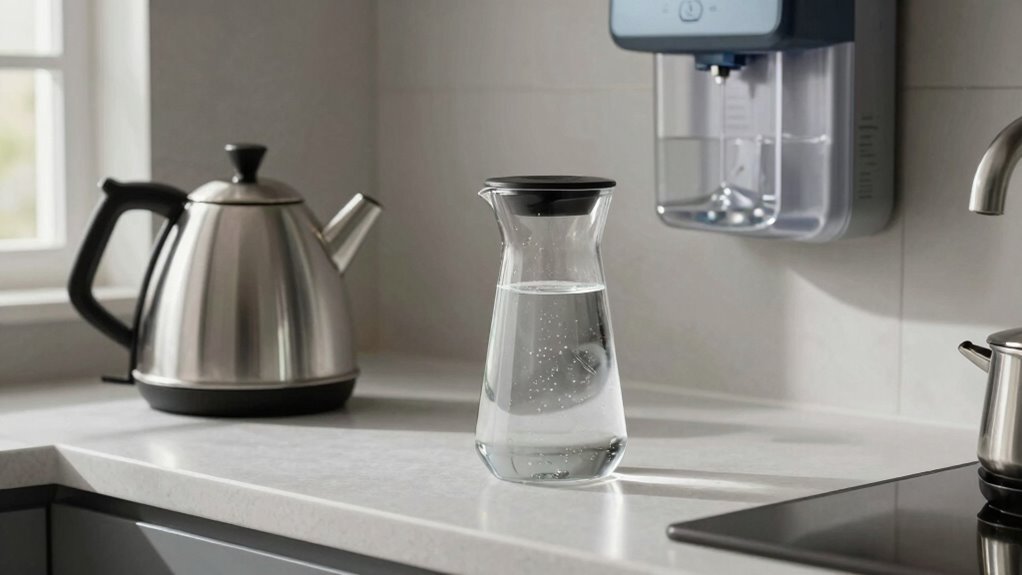

The frequency of descaling your appliances depends on your water’s mineral content and how often you use them, not a set schedule. Hard water with high calcium and magnesium ions causes quicker buildup and may require descaling every 1-2 months. Moderate or soft water might need descaling every few months or less often. By monitoring your appliance’s performance and testing your water, you can determine an effective schedule—keep going to learn more.
Key Takeaways
- Descaling frequency depends on your water’s mineral content, not fixed calendar intervals.
- Hard water requires more frequent descaling, typically every 1-2 months.
- Soft water may only need descaling twice a year or less.
- Regularly monitor appliance performance and signs of buildup to adjust scheduling.
- Use water test strips to accurately determine mineral levels and plan descaling accordingly.

How often should you descale your coffee machine or kettle? The answer isn’t a one-size-fits-all schedule but depends largely on your water hardness. Water hardness refers to the mineral content—mainly calcium and magnesium—that’s dissolved in your water. If your water is hard, those minerals build up faster inside your appliances, leading to limescale deposits. These deposits can clog pipes, reduce heating efficiency, and eventually impair your appliance’s performance. Conversely, if your water is soft, mineral buildup occurs more slowly, and you can stretch out the time between descaling sessions.
Descale more frequently with hard water to prevent buildup and appliance damage.
Your appliance’s lifespan is directly influenced by how well you manage this mineral buildup. Ignoring descaling can cause your coffee machine or kettle to work harder, which increases wear and tear over time. The internal heating elements and pipelines are particularly vulnerable, as limescale insulates heating surfaces, forcing appliances to consume more energy and operate less efficiently. Regular descaling removes these deposits and helps maintain essential functioning, ultimately prolonging the life of your equipment.
The key to determining how often you should descale isn’t based on a fixed calendar date but on the water’s mineral content and your usage habits. If you live in an area with very hard water, you might need to descale every one to two months. For moderate water hardness, every three to four months is usually sufficient. If your water is soft, twice a year or even less frequent descaling might be enough. It’s essential to observe how your appliance performs over time—if you notice longer brewing times, reduced water flow, or a change in taste, those are signs it’s time to descale.
You can also use test strips to measure your water hardness and get a more precise idea of your descaling needs. This way, you’re not relying solely on a vague schedule but making informed decisions based on actual mineral levels. Additionally, understanding water treatment methods can help you manage mineral levels more effectively. Remember, the more mineral-rich your water, the more often you should descale. By staying proactive, you prevent buildup before it causes significant damage, saving money on repairs or replacements.
In the end, the goal is to tailor your descaling routine around your specific water conditions and appliance use. Regularly checking mineral levels, paying attention to appliance performance, and understanding your local water hardness will keep your coffee machine or kettle running smoothly for years to come. You’re not just cleaning—you’re actively extending the life of your appliances by descaling at the right times, based on what your water needs.
Frequently Asked Questions
How Can I Test My Water Hardness at Home?
To test your water hardness at home, you can use DIY test kits or digital meters. DIY kits are simple—you add a reagent to a water sample and compare the color change to a chart. Digital meters provide quick, accurate readings by submerging the probe in water. Both methods help you determine if you need to descale, saving you money and ensuring your appliances stay in top shape.
Does Using Filtered Water Reduce Descaling Needs?
Using filtered water can markedly reduce your descaling needs, even if your water quality has a high mineral content. Many people worry that filtering won’t make a difference, but it actually removes minerals responsible for scale buildup. By improving your water quality with a good filter, you lower mineral content, which in turn helps prevent scale formation, saving you time and effort on frequent descaling.
Are Descaling Products Safe for All Appliances?
Descaling products are generally safe for most appliances if you check their appliance compatibility first. Always read the label for instructions and warnings to guarantee chemical safety. Some appliances, like coffee makers or kettles, are more compatible with specific descaling agents, while others may require specialized products. Using the right descaler prevents damage and maintains your appliance’s efficiency, so always verify compatibility and safety before applying any descaling solution.
Can Mineral Buildup Damage My Appliance Long-Term?
If mineral buildup isn’t managed, it can cause long-term damage to your appliance. For example, mineral accumulation can lead to appliance corrosion, shortening its lifespan. Over time, this corrosion weakens internal parts, increasing the risk of leaks or breakdowns. Regular descaling helps prevent such damage by removing mineral deposits early, ensuring your appliance stays efficient and lasts longer, even if your water is hard.
How Often Should Commercial Water Softeners Be Maintained?
You should maintain your commercial water softener based on water mineralization levels and treatment methods. Typically, check and service it every 3 to 6 months, but if your water has high mineral content, more frequent maintenance might be necessary. Regularly inspect the system, clean filters, and replenish salt or treatment agents. This guarantees peak performance, prevents mineral buildup, and extends the lifespan of your equipment.
Conclusion
Remember, descaling isn’t about following a strict calendar; it’s about paying attention to your water’s hardness. Did you know that hard water can cause 30% more mineral buildup in appliances? By adjusting your descaling schedule based on your water’s quality, you can extend your appliances’ lifespan and save money. Stay proactive, and your appliances will thank you with smooth, efficient performance—no matter where you live.