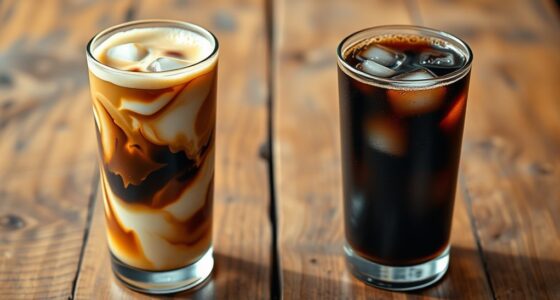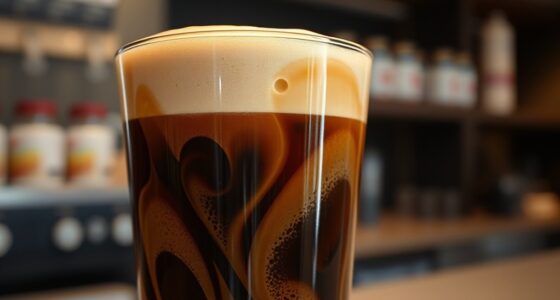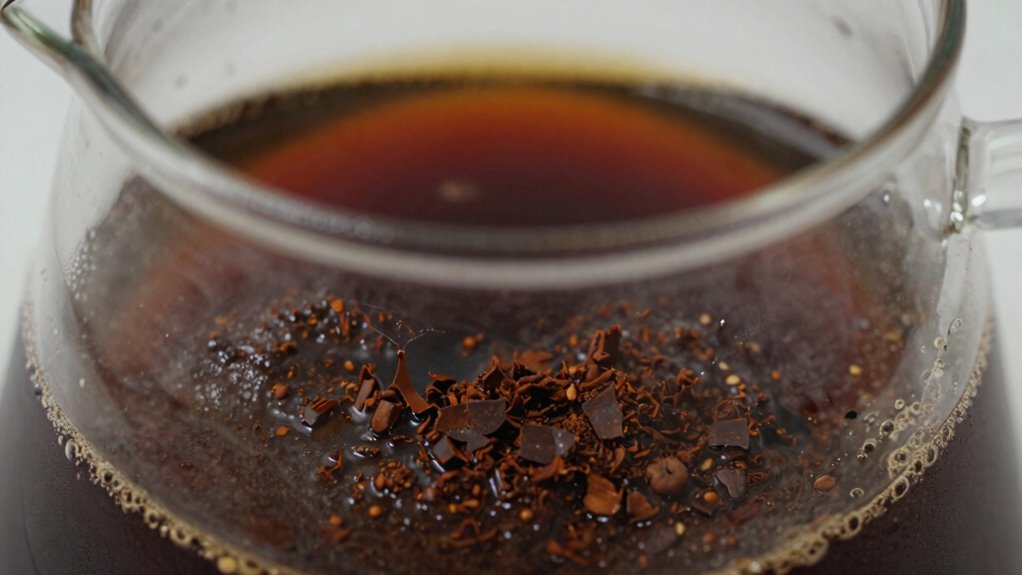

Many believe a coarse grind is essential for making great cold brew, but this isn’t always true. Relying solely on coarse grind can lead to weak or uneven extraction, which affects flavor and consistency. A slightly finer or medium-coarse grind often brings better results by balancing extraction and flavor clarity. If you want to improve your cold brew, understanding the real impact of grind size is key—and there’s more to discover if you keep exploring.

Get coffee and tea gear delivered free with Prime
- Fast, free delivery on millions of items
- Prime Video, Amazon Music and more included
- Member-only deals all year
Key Takeaways
- The belief that coarse grind is always best for cold brew oversimplifies optimal extraction and flavor development.
- Using only a coarse grind can cause under-extraction, resulting in weak or flat flavors.
- Proper cold brew quality depends on adjusting grind size based on beans, equipment, and brewing time.
- An overly fine grind may lead to over-extraction, bitterness, and a harsh taste.
- Consistent, appropriately sized grind improves flavor clarity and overall cold brew success.
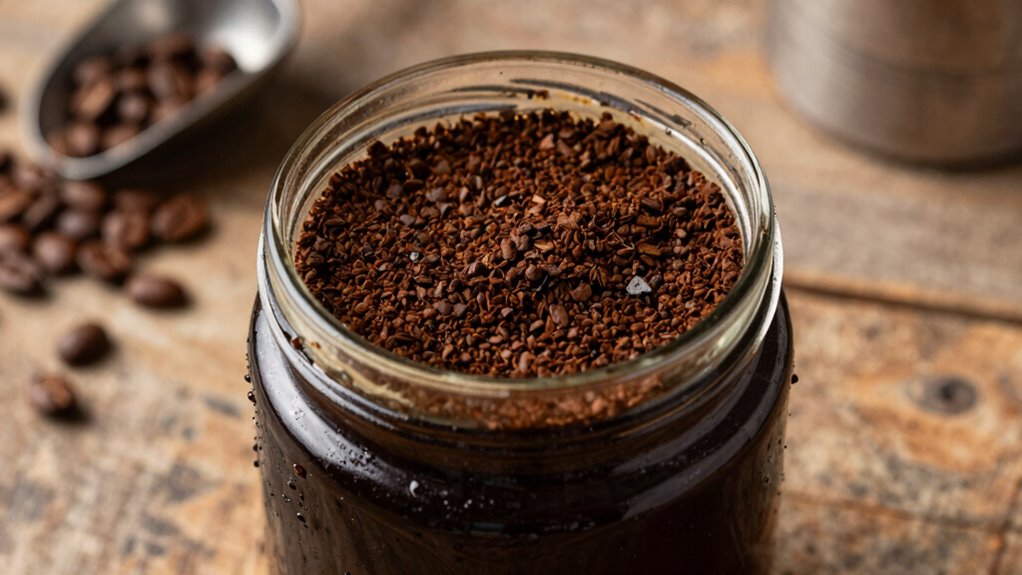
Many coffee enthusiasts believe that using a coarse grind is vital for making the perfect cold brew, but this myth can actually hinder your brewing process. The idea that a coarse grind guarantees better results oversimplifies what’s really at stake: brewing consistency and the importance of grind size. If you rely solely on a coarse grind, you might find yourself struggling to achieve the flavors and strength you’re after. The truth is, grind size impacts extraction, flavor clarity, and overall quality more than many realize.
When you use the right grind size, you’re better equipped to control brewing consistency. Cold brew requires a slow, even extraction to reveal the coffee’s full potential, and that depends heavily on how uniformly the coffee grounds are ground. A grind that’s too coarse can lead to under-extraction, resulting in a weak, flat brew with muted flavors. Conversely, grinding too fine can cause over-extraction, making your cold brew overly bitter and harsh. The key is finding that ideal grind size that balances extraction, which varies depending on your specific beans, equipment, and brewing time. Grind size adjustment can significantly influence the final flavor, emphasizing the importance of tailoring your grind to your desired results.
Understanding grind size importance means recognizing that it’s not just about making the coffee coarse or fine. It’s about tailoring the grind to your brewing method and desired outcome. For cold brew, a medium-coarse grind often works better because it offers a more controlled extraction. When your grind is too coarse, the water may flow too quickly through the grounds, reducing contact time and leading to inconsistent extraction. This inconsistency can ruin your cold brew’s flavor profile, leaving you with a product that’s either too weak or unevenly brewed. Additionally, using a consistent grind size** helps ensure more predictable results and simplifies troubleshooting if your brew doesn’t turn out as expected. Paying attention to grind uniformity can significantly improve your overall brewing success and flavor clarity. Recognizing the importance of grind size** can help you develop a more refined and enjoyable cold brew process.
cold brew coffee maker with adjustable grind size
As an affiliate, we earn on qualifying purchases.
As an affiliate, we earn on qualifying purchases.
Frequently Asked Questions
Does Grind Size Affect Cold Brew Extraction Time?
Yes, grind size affects cold brew extraction time. When you use a more uniform grind, extraction speed becomes more consistent, leading to a balanced flavor. Coarser grinds generally slow down extraction, resulting in a smoother, less bitter brew, while finer grinds speed it up, potentially over-extracting and making it bitter. Achieving grind uniformity helps control extraction time, ensuring your cold brew develops the desired flavor profile without overdoing it.
Can Using a Finer Grind Improve Cold Brew Flavor?
Did you know that using a finer grind can actually improve cold brew flavor? By choosing the right grind size, you enhance flavor extraction and preserve the coffee’s rich aroma. Finer grounds increase surface area, allowing more oils and compounds to infuse into your brew, resulting in a more vibrant taste. Just be careful—too fine, and you might end up with over-extraction, bitterness, and a less enjoyable cold brew experience.
How Does Grind Consistency Influence Cold Brew Clarity?
Grind consistency directly impacts cold brew clarity by ensuring uniform particle size, which promotes even extraction. When your grind has consistent particle distribution, the brew filters more smoothly, resulting in a cleaner, clearer cold brew. Conversely, uneven particle sizes create turbulence and clog filters, leading to cloudiness. Focus on achieving grind uniformity for ideal clarity, and you’ll notice a smoother, more visually appealing cold brew with balanced flavor.
Is It Okay to Use Different Grind Sizes for Cold Brew?
Yes, you can use different grind sizes for cold brew, but keep in mind that it may affect the clarity and flavor extraction. Experimenting with a mix can sometimes produce a richer taste, but inconsistent grind sizes might lead to murky results. Proper coffee storage and maintaining ideal brewing temperature help guarantee your cold brew turns out smooth, regardless of grind variation. Just be prepared for some trial and error.
Does the Type of Coffee Bean Impact Grind Size Choice?
Yes, the type of coffee bean impacts your grind size choice. For example, beans from different origins, like African or South American, have unique flavor profiles and moisture contents that influence grind consistency. Additionally, roasting level matters; dark roasts often require a slightly coarser grind to prevent over-extraction, while light roasts benefit from a finer grind to enhance flavor extraction. Adjusting based on bean origin and roast helps optimize your cold brew.
Conclusion
Don’t let this myth destroy your cold brew dreams! If you stick with a coarse grind, you might as well be pouring muddy water and calling it coffee. Your perfect cold brew is just one grind size away—so stop sabotaging it. Break free from the myth, embrace the right grind, and discover a cold brew experience so smooth and rich, it’ll blow your mind and make every sip worth every second of your effort.
Halloween Picks
halloween
As an affiliate, we earn on qualifying purchases.