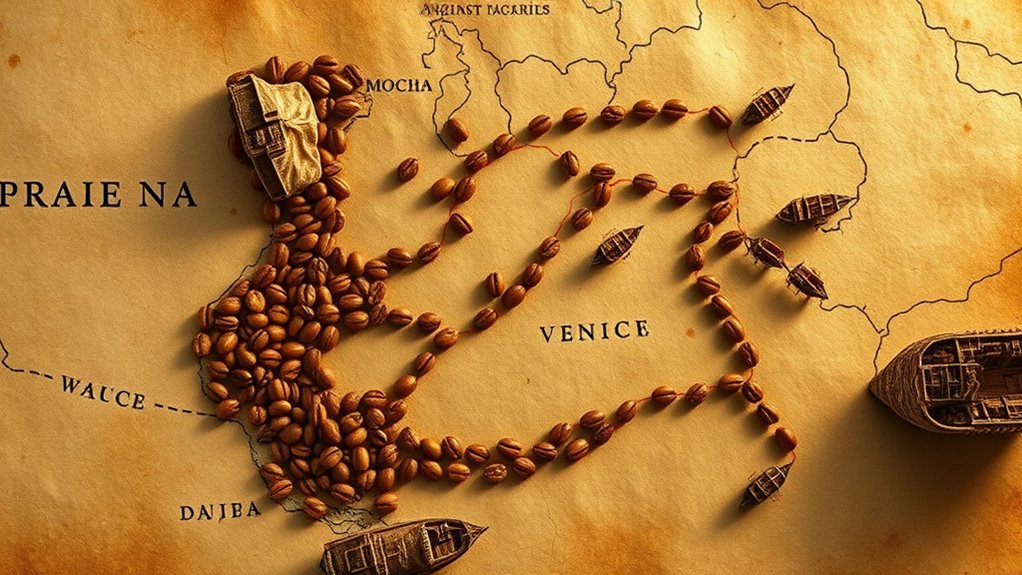

You can trace coffee’s journey from Ethiopia, its birthplace, to European markets through essential trade routes. Arab traders cultivated coffee in Yemen, establishing links that connected Africa, the Middle East, and Europe via ports like Mocha. These routes expanded with European expansion, with Venice becoming a key hub for introducing coffee to the continent. As demand grew, plantations spread to the Caribbean and South America, shaping coffee’s global industry. Continue exploring to uncover how these routes transformed coffee into a worldwide phenomenon.

Get coffee and tea gear delivered free with Prime
- Fast, free delivery on millions of items
- Prime Video, Amazon Music and more included
- Member-only deals all year
Key Takeaways
- Coffee was first cultivated in Ethiopia and Yemen, forming the initial origins of global trade routes.
- Arab traders established maritime routes through the Red Sea and Indian Ocean, connecting Mocha to port cities like Venice.
- The port of Mocha in Yemen became a key hub for coffee trade before spreading to Europe.
- European demand, especially in Venice, accelerated the development of trade routes and the distribution of coffee across Europe.
- These early routes facilitated cultural exchange and laid the foundation for the modern global coffee industry.
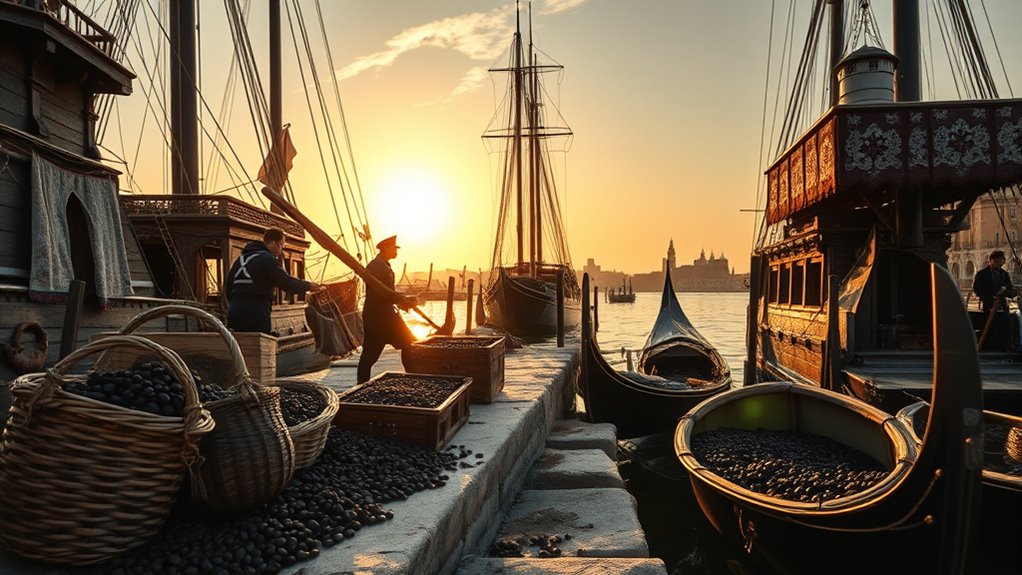
Coffee, which originated in Ethiopia, quickly became a sought-after commodity as traders began to establish the first global routes to share its invigorating effects. As demand grew, so did the need for effective coffee cultivation and distribution. Traders recognized early on that controlling the trade routes was essential to ensuring a steady supply of coffee to distant markets. These routes connected the coffee-producing regions in Africa and the Middle East with Europe, forming the backbone of the early global coffee trade. By traversing these trade routes, merchants could move coffee from its birthplace to bustling port cities, where it would be shipped across continents. Initially, coffee cultivation was limited to Ethiopia and surrounding areas, but it didn’t take long for the plant to be cultivated elsewhere. Arab traders, who were among the first to recognize coffee’s commercial potential, began cultivating it in Yemen and other parts of the Arabian Peninsula. These regions became key hubs along the trade routes, facilitating the flow of coffee to the broader Middle Eastern markets. From there, the trade routes expanded, and coffee found its way into the heart of Europe. The port of Venice, in particular, emerged as a major hub due to its strategic location and thriving trade networks. Coffee, arriving via ships, was highly prized by Europeans and quickly gained popularity among the elite, fueling demand that encouraged further expansion of the trade routes. The development of trade routes was not just about moving coffee efficiently; it also shaped the economic and cultural landscape of the regions involved. Merchant ships, often competing for control of these routes, helped establish a global network that connected distant lands. These routes, traversing the Red Sea, the Indian Ocean, and across the Mediterranean, became essential arteries for the exchange of goods, ideas, and innovations. As coffee became more popular in Europe, demand prompted traders to establish more direct and reliable trade routes, reducing transit times and increasing the volume of coffee traded. This growth influenced coffee cultivation practices, encouraging plantations in new colonies, such as those in the Caribbean and South America, which further diversified the global coffee supply chain. The establishment of these trade routes also played a crucial role in the spread of coffee cultivation techniques, allowing for the development of plantations in new regions. In essence, the story of coffee’s first global trade routes is a story of exploration, commerce, and cultural exchange. From its humble beginnings in Ethiopia, coffee’s journey across trade routes transformed it into a worldwide phenomenon. You can trace its path from local cultivation to international trade hubs, illustrating how these routes not only moved coffee but also interconnected nations, cultures, and economies, laying the foundation for the global coffee industry we know today.
Frequently Asked Questions
How Did Coffee Influence European Social Customs?
You see, coffee substantially shaped European social customs by fostering coffee culture and social rituals. When you gather in cafes, you participate in a tradition that encourages conversation, relaxation, and community. Coffee’s popularity led to the development of social spaces where people connect, debate, and share ideas. These rituals transformed daily routines and created a sense of belonging, making coffee an integral part of European social life.
What Were the Key Technological Advancements in Trade Routes?
Marvelous maritime navigation methods and sturdy caravan routes substantially sped up trade, making coffee’s journey possible. You see, innovations like the compass and astrolabe enhanced sailors’ skills, while improved camels and caravan formations boosted overland transport. These technological advancements transformed trade routes, allowing coffee to travel farther, faster, and more efficiently, connecting distant lands and cultivating global commerce that shaped societies and cultures worldwide.
Which Regions First Cultivated Coffee Outside the Arab World?
You should know that coffee cultivation first spread outside the Arab world to Ethiopia and Yemen, where local traditions began growing the beans. Arab influence was strong in these regions, shaping early coffee practices. As trade expanded, other areas like Southeast Asia and the Caribbean adopted coffee cultivation, influenced by Arab techniques. This shift helped establish coffee as a global commodity, connecting diverse cultures through shared coffee traditions.
How Did Coffee Trade Impact Local Economies Historically?
You see, coffee trade historically boosted local economies through innovations in trade routes and coffee taxation. As merchants developed new routes, more regions gained access to coffee, increasing demand and profits. Governments often taxed coffee exports, generating revenue that supported infrastructure and growth. These trade route innovations made coffee more accessible, fueling economic development in producing areas and turning coffee into a crucial global commodity that shaped local economies worldwide.
What Role Did Political Alliances Play in Trade Expansion?
Political alliances played a vital role in trade expansion by facilitating diplomatic negotiations and signing trade treaties. You see, these alliances often opened new markets and reduced barriers, making it easier to move coffee across borders. When nations collaborated, they fostered trust and stability, which encouraged merchants to expand their routes. Fundamentally, strategic partnerships helped establish the infrastructure for global trade routes, boosting coffee’s reach and economic influence worldwide.
Conclusion
As you trace coffee’s journey from Mocha’s bustling markets to Venice’s elegant cafes, you see how a humble bean shaped worlds. Today, centuries later, its trade still connects distant lands—reminding you that what starts as a simple brew can forge complex global ties. Just as the trade routes once crossed oceans, your daily cup now unites continents, blending history with modernity in every sip, a proof to coffee’s enduring, intricate legacy.
Fall Picks
fall essentials
As an affiliate, we earn on qualifying purchases.