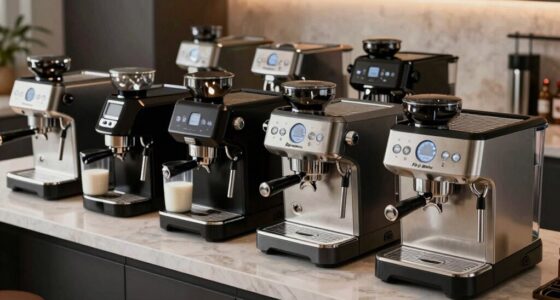
The Breville Barista Express stands out as the best home espresso machine for most buyers because it balances manual control with built-in grinding convenience. For those prioritizing speed and consistency, the Nespresso Vertuo offers unmatched capsule simplicity, while the De’Longhi Dedica Maestro Plus delivers professional-grade features in a slim footprint. Choosing the right machine requires weighing the tradeoff between hands-on brewing rituals and automated convenience. This guide breaks down the top fifteen options to help you match a machine to your kitchen space, budget, and desired coffee quality.

Get coffee and tea gear delivered free with Prime
- Fast, free delivery on millions of items
- Prime Video, Amazon Music and more included
- Member-only deals all year
Complete the kit


Key Takeaways
- Integrated grinders, found in models like the Breville Barista Express, provide the freshest shots but require more counter space and maintenance than separate grinder setups.
- Semi-automatic machines with PID temperature control offer superior shot consistency compared to basic thermoblock units that fluctuate in heat.
- Capsule systems like Nespresso sacrifice flavor complexity for speed and zero cleanup, making them ideal for busy households but poor for purists.
- Compact machines under 6 inches wide often compromise on steam power, resulting in weaker microfoam for milk-based drinks.
- Milk frothing wands vary widely in ease of use; automatic frothers reduce skill requirements but limit texture control compared to manual steam wands.
| De’Longhi Dedica Maestro Plus Espresso Machine |  | Best for Milk-Drink Customization | Operation mode: Semi-automatic | Pump pressure: 15 bar | Power: 1450 watts | VIEW LATEST PRICE | See Our Full Breakdown |
| AERCANA 20-Bar Compact Espresso Machine with Milk Frother, 34 oz Removable Tank, Silver |  | Best Compact Budget-Style Pick | Operation mode: Semi-automatic | Pump pressure: 20 bar | Power: 1450 watts | VIEW LATEST PRICE | See Our Full Breakdown |
| Breville Barista Express Espresso Machine with Built-In Grinder, Brushed Stainless Steel |  | Best for Hands-On Bean-to-Cup Brewing | Machine type: Manual espresso machine | Grinder: Integrated precision conical burr grinder | Temperature control: Digital PID | VIEW LATEST PRICE | See Our Full Breakdown |
| Nespresso Vertuo Coffee and Espresso Maker by De’Longhi |  | Best for One-Touch Convenience | Operation mode: Fully automatic | Coffee input: Nespresso Vertuo capsules | Brew sizes: 5 oz and 8 oz coffee; single and double espresso | VIEW LATEST PRICE | See Our Full Breakdown |
| De’Longhi Classic Matte Black Espresso Machine with Milk Frother |  | Best for Straightforward Ground-Coffee Espresso | Operation mode: Fully automatic | Pressure: 9 bar | Power: 1350 watts | VIEW LATEST PRICE | See Our Full Breakdown |
| CASABREWS CM5418 Compact Espresso Machine with Milk Frothing Wand |  | Best Compact Manual Pick | Machine type: Semi-automatic espresso machine | Pump pressure: 20 bar | Power: 1350 W | VIEW LATEST PRICE | See Our Full Breakdown |
| AMZCHEF Semi-Automatic Espresso Machine with Grinder |  | Best Built-In Grinder Controls | Machine type: Semi-automatic espresso machine | Grind settings: 44 | Brewing temperature: 190°F–201°F | VIEW LATEST PRICE | See Our Full Breakdown |
| De’Longhi Classic Signature Espresso Machine with Adjustable Milk Frother |  | Best for Preset Simplicity | Operation mode: Fully automatic | Pump pressure: 15 bar | Power: 1350 W | VIEW LATEST PRICE | See Our Full Breakdown |
| De’Longhi COM630BK All-in-One Combination Coffee and Espresso Machine |  | Best for Drip Coffee and Espresso | Machine type: Drip coffee and espresso machine | Carafe capacity: 12 cups | Espresso pump pressure: 15 bar | VIEW LATEST PRICE | See Our Full Breakdown |
| Breville Bambino Plus Espresso Machine, Brushed Stainless Steel |  | Best Compact Milk-Drink Upgrade | Machine type: Semi-automatic espresso machine | Heating system: ThermoJet | Water capacity: 64 fl oz | VIEW LATEST PRICE | See Our Full Breakdown |
| Breville Bambino Espresso Machine, Brushed Stainless Steel |  | Best Compact Starter | Heating System: ThermoJet (3-second heat-up) | Dimensions: 13.7 × 6.3 × 12 in | Water Capacity: 47 fl oz | VIEW LATEST PRICE | See Our Full Breakdown |
| De’Longhi La Specialista Touch Semi-Automatic Espresso Machine with Grinder |  | Best Guided Experience | Display: 3.5-inch high-resolution touch display | Grinder: Italian-made conical burr grinder | Preset Recipes: 10 customizable drinks | VIEW LATEST PRICE | See Our Full Breakdown |
| Breville Barista Touch Espresso Machine, Brushed Stainless Steel |  | Best All-Rounder | Heating System: ThermoJet (3-second heat-up) | Grinder: Integrated precision conical burr | Display: Touchscreen | VIEW LATEST PRICE | See Our Full Breakdown |
| Breville Barista Pro Espresso Machine with Grinder, Brushed Stainless Steel |  | Best for Skill Development | Operation Mode: Manual | Grinder: Integrated conical burr (34 settings) | Heating System: ThermoJet (3-second heat-up) | VIEW LATEST PRICE | See Our Full Breakdown |
| Atatix Semi-Automatic Espresso Machine with Milk Frother |  | Best Budget Compact | Pump Pressure: 20 bar | Temperature Control: PID at 198°F (92°C) | Water Tank: 44 fl oz (Removable) | VIEW LATEST PRICE | See Our Full Breakdown |
| home espresso machine | Dimensions | Power | Water tank |
|---|---|---|---|
| De’Longhi Dedica Maestro Plus | 13.62 × 8.15 × 12.9 in (D × W × H) | 1450 watts | 54 oz, removable |
| AERCANA 20-Bar Compact Espress | 12.2 × 5.32 × 11.5 in | 1450 watts | 34 oz (1 liter), removable |
| Breville Barista Express Espre | 13.8 × 12.5 × 15.9 in | 1600 watts | 67 oz |
| Nespresso Vertuo Coffee and Es | 8.97 × 12.22 × 12.33 in (D × W × H) | 1350 watts | — |
| De’Longhi Classic Matte Black | 11.22 × 13.98 × 15.94 in (D × W × H) | 1350 watts | Removable |
| CASABREWS CM5418 Compact Espre | — | 1350 W | 34 oz, removable |
| AMZCHEF Semi-Automatic Espress | 12.5 × 10.82 × 13.38 in | 1500 W | 60 oz, removable |
| De’Longhi Classic Signature Es | 11.22 × 13.98 × 15.94 in | 1350 W | — |
| De’Longhi COM630BK All-in-One | 12.6 × 11.26 × 14.84 in | 1500 W | — |
| Breville Bambino Plus Espresso | 7.6 × 12.5 × 12.2 in | 1560 W | — |
| Breville Bambino Espresso Mach | 13.7 × 6.3 × 12 in | — | — |
| De’Longhi La Specialista Touch | — | — | — |
| Breville Barista Touch Espress | — | — | 67 fl oz |
| Breville Barista Pro Espresso | — | — | 67 oz |
| Atatix Semi-Automatic Espresso | 12.24 × 7.5 × 11.18 in | — | 44 fl oz (Removable) |
More Details on Our Top Picks
De’Longhi Dedica Maestro Plus Espresso Machine
The Dedica Maestro Plus is a strong fit for home espresso drinkers who want control over milk drinks without taking on every step by hand. Its automatic steam wand offers three temperature and three texture settings, making it less hands-on for frothing than the manual wand on the Breville Barista Express. The 54-ounce removable tank also means fewer refills than the AERCANA’s 34-ounce tank, while the machine’s compact footprint suits counters where the larger Breville may be a stretch.
The tradeoff is that this is still a semi-automatic, ground-coffee machine: you handle the espresso preparation, and it cannot grind beans for you. I’d choose it for customizable milk texture and easier cleanup, but skip it if you want capsule convenience or a built-in grinder. Dishwasher-safe detachable parts help with upkeep, though the machine still involves more preparation than the Nespresso Vertuo.
Pros:- Automatic steam wand has three temperature and three milk-texture settings.
- 54-ounce removable tank reduces refill frequency compared with the AERCANA’s 34-ounce tank.
- Compact stainless steel design with dishwasher-safe detachable parts.
- Includes a portafilter, tamper, milk jug, and filters for single and double shots.
Cons:- Ground coffee is required; there is no built-in grinder.
- Semi-automatic brewing still calls for hands-on preparation.
- Milk customization is more involved than the Nespresso Vertuo’s button-operated brewing.
Best for: Home latte and cappuccino drinkers who want adjustable automatic milk frothing, use ground coffee, and have limited counter space.
Not ideal for: Buyers who want freshly ground beans from an integrated grinder or one-button capsule brewing with minimal preparation.
- Operation mode:Semi-automatic
- Pump pressure:15 bar
- Power:1450 watts
- Water tank:54 oz, removable
- Temperature settings:3
- Milk texture settings:3
- Coffee input:Ground coffee
- Dimensions:13.62 × 8.15 × 12.9 in (D × W × H)
Our verdict“Choose the Dedica Maestro Plus if adjustable, low-effort milk frothing matters more to you than an integrated grinder or fully automatic brewing.”
AERCANA 20-Bar Compact Espresso Machine with Milk Frother, 34 oz Removable Tank, Silver
The AERCANA 20-Bar Compact Espresso Machine is aimed at buyers who need a narrow footprint and want basic espresso and milk drinks from ground coffee. At just 5.32 inches wide, it takes up less counter width than the De’Longhi Dedica Maestro Plus, and its pressure gauge gives you a visible brewing reference that the Dedica description does not specify. The steam wand, hot-water dispenser, and cup warmer add useful functions without a built-in grinder or a capsule system.
Its compromises matter for daily routines: the 34-ounce tank is smaller than the Dedica’s 54-ounce reservoir, and the machine needs cooling after frothing before brewing again. The product information also recommends manual preheating, so its roughly 20-second heating claim does not make every step hands-off. This is a better match for a tight counter and occasional drinks than for back-to-back milk beverages or a buyer seeking a more guided setup.
Pros:- Narrow 5.32-inch width suits counters where wider machines are difficult to place.
- Pressure gauge provides a visible brewing reference.
- Steam wand, hot-water dispenser, and cup warmer broaden its drink-making options.
- Removable water tank and drip tray simplify refilling and cleaning.
Cons:- The 34-ounce tank is smaller than the Dedica Maestro Plus’s 54-ounce reservoir.
- Requires cooling after frothing milk before brewing again.
- Manual preheating is recommended, adding preparation despite the quick stated preheat.
Best for: Apartment dwellers or office users with very limited counter width who make occasional espresso drinks from ground coffee.
Not ideal for: Households making several milk drinks in a row, or buyers who want a large reservoir, built-in grinder, or minimal temperature-management steps.
- Operation mode:Semi-automatic
- Pump pressure:20 bar
- Power:1450 watts
- Water tank:34 oz (1 liter), removable
- Preheat time:About 20 seconds
- Coffee input:Ground coffee
- Dimensions:12.2 × 5.32 × 11.5 in
- Material and color:Stainless steel, silver
Our verdict“Pick the AERCANA if saving counter width is your priority and you can accept a smaller tank and pauses between milk frothing and brewing.”
Breville Barista Express Espresso Machine with Built-In Grinder, Brushed Stainless Steel
The Breville Barista Express is the most complete choice here for buyers who want to start with whole beans and control the espresso-making process. Its integrated conical burr grinder doses coffee into the portafilter, while PID temperature control and low-pressure pre-infusion support more deliberate extraction. That makes it a different proposition from the ground-coffee De’Longhi Dedica Maestro Plus and the compact AERCANA: those save space or simplify milk frothing, while the Breville puts more of the workflow in the user’s hands.
That control comes with a learning curve. Grinding, extraction, and manual milk texturing all require attention, so the Nespresso Vertuo is a far easier fit for people who value one-touch drinks. The 22.1-pound steel machine also needs more room than the compact options. I’d rank it for aspiring home baristas, not for anyone seeking a quick, low-effort espresso routine.
Pros:- Integrated conical burr grinder grinds beans directly into the portafilter.
- PID temperature control and low-pressure pre-infusion support controlled extraction.
- Manual steam wand can texture microfoam for latte art.
- Includes a portafilter, filter baskets, tamper, milk jug, and cleaning tools.
Cons:- Grinding, pulling shots, and texturing milk require hands-on practice.
- Larger and heavier than the AERCANA and De’Longhi Dedica Maestro Plus.
- The 67-ounce tank and half-pound hopper still need refilling as supplies run low.
Best for: Home coffee enthusiasts who want an integrated grinder, hands-on espresso control, and the ability to texture milk for latte art.
Not ideal for: Buyers who want fast one-button drinks, a small and lightweight machine, or automatic milk frothing.
- Machine type:Manual espresso machine
- Grinder:Integrated precision conical burr grinder
- Temperature control:Digital PID
- Pre-infusion:Low-pressure
- Bean hopper:1/2 lb
- Water tank:67 oz
- Power:1600 watts
- Dimensions:13.8 × 12.5 × 15.9 in
- Weight:22.1 lb
Our verdict“Choose the Barista Express if you want a grinder and room to develop barista skills, rather than the simplicity of capsule brewing or automatic frothing.”
Nespresso Vertuo Coffee and Espresso Maker by De’Longhi
The Nespresso Vertuo is the simplest option in this group for making a range of coffee and espresso sizes with minimal preparation. It brews 5-ounce and 8-ounce coffee as well as single and double espresso at the touch of a button, and heats in about 15–25 seconds. Compared with the manual Breville Barista Express, there is no grinding, tamping, or milk texturing; compared with the ground-coffee De’Longhi Classic, it also avoids handling loose coffee.
That ease narrows its appeal: the machine depends on Nespresso Vertuo capsules, so it is not the pick for someone who wants to use their own ground coffee or practice espresso technique. It also has no milk frother listed, unlike the Dedica Maestro Plus and AERCANA, and its plastic construction is less substantial than the Breville’s steel exterior. I’d choose it for quick, consistent single-serve drinks, not for a traditional hands-on espresso setup.
Pros:- Brews two coffee sizes and single or double espresso with one-touch operation.
- Heats up in about 15–25 seconds.
- 54-ounce reservoir supports multiple drinks before refilling.
- Automatic capsule ejection and shutoff reduce routine handling and energy use.
Cons:- Requires Nespresso Vertuo capsules rather than ground coffee.
- No milk frother is listed, unlike the Dedica Maestro Plus and AERCANA.
- Plastic construction feels less substantial than the Breville Barista Express’s steel body.
Best for: Busy single-serve coffee and espresso drinkers who want several drink sizes at a button press and prefer capsule cleanup.
Not ideal for: Buyers who want to use ground coffee, texture milk on the machine, or control grinding and extraction.
- Operation mode:Fully automatic
- Coffee input:Nespresso Vertuo capsules
- Brew sizes:5 oz and 8 oz coffee; single and double espresso
- Water reservoir:54 oz (1597 ml)
- Used capsule container:17 capsules
- Heat-up time:15–25 seconds
- Power:1350 watts
- Dimensions:8.97 × 12.22 × 12.33 in (D × W × H)
Our verdict“Choose the Vertuo if one-touch capsule drinks matter more than ground-coffee flexibility, manual control, or built-in milk frothing.”
De’Longhi Classic Matte Black Espresso Machine with Milk Frother
The De’Longhi Classic Matte Black suits buyers who want a simple ground-coffee machine with single- and double-shot presets, an automatic stop function, and a built-in milk frother. Its 9-bar pressure and Thermoblock temperature control are framed around straightforward espresso preparation rather than the adjustment-focused setup of the Breville Barista Express. Compared with the capsule-based Nespresso Vertuo, it lets you use ground coffee; compared with the Dedica Maestro Plus, its described controls are more basic and do not include adjustable milk-texture settings.
The compact, 9.3-pound body is easier to move than the heavier Breville, but the listed dimensions are still deeper and taller than the narrow AERCANA. This machine also has no grinder, so beans need to be ground separately. I’d favor it for a simple espresso routine with milk drinks, while buyers seeking fine control, whole-bean convenience, or the widest drink-size range should look elsewhere.
Pros:- Single- and double-shot presets with automatic stopping simplify routine brewing.
- 9-bar pressure and Thermoblock temperature control are specified for espresso preparation.
- Milk frother supports dairy and plant-based alternatives.
- Adjustable drip tray accommodates different glass sizes.
Cons:- Uses ground coffee and has no built-in grinder.
- Offers less milk-texture customization than the Dedica Maestro Plus.
- Its listed 15.94-inch height and 13.98-inch width take more room than the AERCANA’s narrow body.
Best for: Ground-coffee users who want preset single or double espresso and a built-in frother without a large, heavy machine.
Not ideal for: Whole-bean enthusiasts who want an integrated grinder, or milk-drink makers who want adjustable frothing settings and more control.
- Operation mode:Fully automatic
- Pressure:9 bar
- Power:1350 watts
- Coffee input:Ground coffee
- Temperature control:Thermoblock
- Water tank:Removable
- Dimensions:11.22 × 13.98 × 15.94 in (D × W × H)
- Weight:9.3 lbs
Our verdict“Pick the De’Longhi Classic if you want preset ground-coffee espresso and a frother, but not the grinder or extra customization of a more involved setup.”
CASABREWS CM5418 Compact Espresso Machine with Milk Frothing Wand
The CASABREWS CM5418 suits buyers who want a small-footprint machine with a traditional steam wand, rather than built-in grinding or automatic milk texturing. Its 34-ounce removable tank and brushed stainless steel body make it practical for a home or office counter, while the pressure gauge offers some visible feedback as you learn to dial in a shot. Compared with the Breville Bambino Plus, it takes more patience: after steaming milk, this model must cool before brewing, and extraction may call for adjustments to grind, dose, or tamp. The Bambino Plus heats faster and automates milk texture, but the CASABREWS keeps the process straightforward and provides hands-on control without taking up much room. Choose it for compactness and manual practice; skip it if you want a quick latte routine with minimal pauses.
Pros:- Compact brushed stainless steel design fits smaller counters.
- Steam wand allows hands-on milk texturing.
- Removable 34-ounce tank simplifies refilling.
- Pressure gauge provides feedback while brewing.
Cons:- Must cool down after frothing before brewing another shot.
- Extraction may require a finer grind, more coffee, or firmer tamping.
- No built-in grinder, so whole-bean users need separate equipment.
Best for: Espresso beginners or office users with limited counter space who want to practice pulling shots and steaming milk manually.
Not ideal for: People who make back-to-back milk drinks or want automatic milk texturing, since it needs to cool after steaming and may require shot adjustments.
- Machine type:Semi-automatic espresso machine
- Pump pressure:20 bar
- Power:1350 W
- Water tank:34 oz, removable
- Milk frother:Steam wand
- Finish:Brushed stainless steel
- Included filters:One-cup and two-cup
Our verdict“Choose the CASABREWS CM5418 for compact, hands-on espresso making, but pick the Bambino Plus for faster, more automated milk drinks.”
AMZCHEF Semi-Automatic Espresso Machine with Grinder
The AMZCHEF combines a built-in grinder with 44 grind settings, adjustable brew temperature, and touchscreen controls, making it the most settings-focused option in this group. That range can help a curious home barista adapt to different beans without buying a separate grinder, and the 60-ounce tank reduces how often it needs refilling compared with the CASABREWS CM5418. It also adds a one-touch cold brew mode, though its central purpose here remains espresso and milk drinks. This machine asks more of the user than the preset-driven De’Longhi Classic Signature: grind, brew time, and temperature are adjustable, but that flexibility means more decisions during setup. The tradeoff is a larger learning curve and semi-automatic involvement; choose it for control in one appliance, not for a fully hands-off cup.
Pros:- Built-in grinder offers 44 settings for dialing in beans.
- Brew temperature adjusts from 190°F to 201°F.
- 60-ounce removable tank supports multiple drinks between refills.
- Touchscreen includes grind, brew-time, and temperature adjustments.
Cons:- Semi-automatic brewing requires user involvement and setup.
- Many adjustment options may feel demanding to beginners seeking simple operation.
- The provided data does not specify a compact footprint advantage over smaller machines.
Best for: Home baristas who want an integrated grinder and like adjusting grind size and brew temperature for different beans.
Not ideal for: Buyers who prefer simple, repeatable button-led drinks or want fully automatic espresso with little setup.
- Machine type:Semi-automatic espresso machine
- Grind settings:44
- Brewing temperature:190°F–201°F
- Water tank:60 oz, removable
- Steam wand:8 mm stainless steel
- Power:1500 W
- Dimensions:12.5 × 10.82 × 13.38 in
- Special features:Built-in grinder, cold brew mode, touchscreen, descaling function
Our verdict“Choose the AMZCHEF if grinder and temperature control matter more than a simple, preset-driven espresso routine.”
De’Longhi Classic Signature Espresso Machine with Adjustable Milk Frother
The De’Longhi Classic Signature is the easiest fit for buyers who want espresso with less manual measuring and repeatable single- or double-shot settings. Its one-touch dose presets and Thermoblock heating put routine convenience ahead of the AMZCHEF’s extensive grind and temperature adjustments; it uses ground coffee, so there is no built-in grinder to tune. The adjustable dual-mode frother is a useful distinction for households that switch between dairy and plant-based milk, while the visual pressure gauge offers feedback without requiring a fully manual workflow. Compared with the CASABREWS CM5418, this model is better suited to quick, consistent button-led preparation, though the CASABREWS offers a more traditional hands-on steam-wand experience. It is a practical home or office choice, but not for buyers who want to grind beans inside the machine.
Pros:- One-touch presets save single and double espresso doses.
- Thermoblock heating supports quick, stable temperature control.
- Adjustable dual-mode frother handles dairy and plant-based milk.
- Adjustable drip tray accommodates different cup heights.
Cons:- Uses ground coffee and has no built-in grinder.
- Fully automatic operation offers less manual extraction control than the CASABREWS CM5418.
- 120-volt design limits use to compatible power supplies.
Best for: Households or office users who want saved single- and double-espresso doses and a frother compatible with dairy and plant-based milk.
Not ideal for: Whole-bean enthusiasts who want an integrated grinder or hands-on control over every part of extraction.
- Operation mode:Fully automatic
- Pump pressure:15 bar
- Power:1350 W
- Coffee input:Ground coffee
- Milk frother:Adjustable dual-mode
- Dimensions:11.22 × 13.98 × 15.94 in
- Weight:9.3 lb
- Special features:Auto shut-off, removable tank, visual pressure gauge
Our verdict“Pick the Classic Signature for repeatable espresso presets and flexible milk frothing, not for integrated grinding or highly hands-on brewing.”
De’Longhi COM630BK All-in-One Combination Coffee and Espresso Machine
The De’Longhi COM630BK earns its place for households that need a drip coffee maker as much as an espresso machine. Its 12-cup carafe handles batch coffee, while the 15-bar espresso side, dual-mode milk frother, and retractable cold frother broaden the menu to include hot and iced specialty drinks. That range separates it from the dedicated Breville Bambino Plus, which is the more focused choice for compact espresso preparation and milk texture control. The COM630BK instead prioritizes variety and shared use through programmable touchscreen controls and adjustable shelves. The cost of that versatility is a larger counter commitment and plastic construction, and it uses ground coffee rather than whole beans. Choose it when one appliance needs to serve different coffee routines; skip it if espresso quality and a compact setup take priority over drip capacity.
Pros:- Combines a 12-cup drip brewer with a 15-bar espresso machine.
- Offers drip, espresso, cold brew, and hot or iced milk drinks.
- Dual-mode and retractable cold frothers extend drink options.
- Touchscreen programming and adjustable shelves support varied servings.
Cons:- Plastic construction feels less substantial than stainless-steel espresso machines.
- The carafe and combined machine take meaningful counter space.
- Uses ground coffee rather than whole beans.
Best for: Households with both drip-coffee drinkers and espresso or iced-drink fans who want several coffee styles in one appliance.
Not ideal for: Espresso-focused buyers with limited counter space or those who prefer a stainless-steel, dedicated espresso machine.
- Machine type:Drip coffee and espresso machine
- Carafe capacity:12 cups
- Espresso pump pressure:15 bar
- Drip coffee sizes:6
- Drip coffee recipes:Classic, Bold, Cold Brew, Over Ice
- Frothers:Dual-mode milk frother and retractable cold frother
- Power:1500 W
- Dimensions:12.6 × 11.26 × 14.84 in
Our verdict“Choose the COM630BK when a household needs batch drip coffee and espresso drinks from one machine, rather than a compact espresso specialist.”
Breville Bambino Plus Espresso Machine, Brushed Stainless Steel
The Breville Bambino Plus is the strongest fit here for buyers who want compact espresso with notably less waiting and milk-steaming effort. Its ThermoJet system reaches extraction temperature in about three seconds, while PID temperature control and low-pressure pre-infusion support more even brewing. The automatic steam wand also adjusts milk temperature and texture, a clear convenience advantage over the manual-wand CASABREWS CM5418. Unlike the AMZCHEF, it has no built-in grinder, so users need ground coffee or a separate grinder; it also keeps shot preparation semi-automatic rather than fully hands-off. Its small footprint suits crowded counters, but the 64-ounce capacity may still call for refills with frequent use. Choose it for a fast, compact espresso routine and easier milk drinks, not an all-in-one bean-to-cup setup.
Pros:- ThermoJet reaches extraction temperature in about three seconds.
- PID control and low-pressure pre-infusion support even extraction.
- Automatic steam wand adjusts milk temperature and texture.
- Compact 7.6-inch width fits counters with limited space.
Cons:- Requires ground coffee and hands-on shot preparation.
- No built-in grinder, unlike the AMZCHEF.
- 64-ounce water capacity may need frequent refilling for regular use.
Best for: Small-kitchen owners who make espresso-based milk drinks and want fast heating with automatic milk temperature and texture control.
Not ideal for: Buyers who want a built-in grinder or a fully automatic machine that handles the entire drink with minimal involvement.
- Machine type:Semi-automatic espresso machine
- Heating system:ThermoJet
- Water capacity:64 fl oz
- Portafilter size:54 mm
- Coffee input:Ground coffee
- Power:1560 W
- Dimensions:7.6 × 12.5 × 12.2 in
- Settings:1 or 2 cups; adjustable milk temperature and texture
Our verdict“Choose the Bambino Plus for fast, compact espresso and automated milk texturing, provided you are comfortable sourcing and preparing ground coffee.”
Breville Bambino Espresso Machine, Brushed Stainless Steel
This machine stands out for its incredible footprint, fitting easily into tight kitchen counters where larger units like the Breville Barista Pro would struggle. The ThermoJet heating system eliminates the wait time common in traditional machines, allowing you to pull a shot just three seconds after powering on. While it lacks the integrated grinder found in the De’Longhi La Specialista Touch, this omission keeps the price and size down. It is a semi-automatic unit, meaning you still control the grind and tamping externally. The automatic steam wand is a significant upgrade over basic manual wands, offering consistent microfoam without the steep learning curve of latte art. However, the 47 oz water tank is small for households that brew multiple drinks consecutively, requiring frequent refills. It is an excellent entry point for those who want serious espresso performance without the bulk.Pros:- Extremely compact 13.7-inch width fits tight spaces
- 3-second heat-up time via ThermoJet system
- Automatic steam wand simplifies milk texturing
- PID control ensures consistent extraction temperature
Cons:- No integrated grinder requires separate equipment
- Small 47 oz water tank needs frequent refilling
Best for: Apartment dwellers or beginners with limited counter space who want high-quality espresso without the footprint of a grinder-integrated machine.
Not ideal for: High-volume households or those who want an all-in-one solution with a built-in grinder.
- Heating System:ThermoJet (3-second heat-up)
- Dimensions:13.7 × 6.3 × 12 in
- Water Capacity:47 fl oz
- Portafilter:54 mm
- Steam Wand:Automatic with temperature/texture control
- Weight:10.9 lb
Our verdict“Ideal for space-conscious beginners who prioritize speed and ease of use over all-in-one convenience.”
De’Longhi La Specialista Touch Semi-Automatic Espresso Machine with Grinder
This model differentiates itself through its guided Bean Adapt Technology, which simplifies the dialing-in process more effectively than the manual adjustments required by the Breville Barista Pro. The 3.5-inch touch display walks you through grind, dose, and pre-infusion settings, making it accessible for users who find traditional espresso machines intimidating. Unlike the Breville Bambino, which requires you to manage milk texture manually or via a simpler auto-wand, the Specialista offers five distinct froth levels and four temperature settings, catering to varied milk preferences including plant-based options. It also features a unique Cold Extraction Technology that prepares cold brew in under five minutes, a feature absent in most competitors. The tradeoff is complexity; the sheer number of customizable variables can be overwhelming for purists who prefer a streamlined workflow. It is a powerful machine, but it demands more cognitive load than simpler semi-automatics.Pros:- Guided Bean Adapt settings simplify dialing in beans
- Cold brew capability in under 5 minutes
- Extensive milk frothing customization for dairy and plant-based milks
- Touchscreen interface with saved drink profiles
Cons:- Complex menu system may overwhelm simple users
- Larger footprint than compact semi-automatics
Best for: Users who want a built-in grinder and automated guidance but still desire control over milk texture and drink customization.
Not ideal for: Minimalists who prefer a simple, two-button interface and do not want to manage multiple drink profiles.
- Display:3.5-inch high-resolution touch display
- Grinder:Italian-made conical burr grinder
- Preset Recipes:10 customizable drinks
- Cold Brew Time:Under 5 minutes
- Milk Froth Levels:5
- Bean Profiles:6 saved profiles
Our verdict“A versatile choice for tech-oriented users who want automation and cold brew capabilities in one unit.”
Breville Barista Touch Espresso Machine, Brushed Stainless Steel
The Breville Barista Touch occupies a sweet spot between manual control and automated convenience, offering a more refined experience than the Breville Barista Pro thanks to its automatic steam wand. While the Pro requires you to manually texture milk, the Touch handles this automatically, allowing you to adjust temperature and texture via the touchscreen. It includes an integrated conical burr grinder, similar to the Pro and the De’Longhi La Specialista Touch, but distinguishes itself with a more intuitive interface for saving up to 8 personalized coffees. The ThermoJet heating system ensures rapid readiness, matching the speed of the Breville Bambino. However, the 1/2 lb bean hopper is relatively small for a machine of this size, requiring frequent refills in busy households. It is a premium option that reduces the skill floor for milk drinks, making it ideal for those who want cafe-quality lattes without mastering manual steaming techniques.Pros:- Automatic steam wand with adjustable texture and temperature
- Touchscreen with 8 personalized coffee settings
- Integrated conical burr grinder with dose control
- Fast 3-second heat-up time
Cons:- Small 1/2 lb bean hopper capacity
- Higher price point than manual-only alternatives
Best for: Enthusiasts who want a built-in grinder and automated milk texturing but still enjoy some hands-on extraction control.
Not ideal for: Budget-conscious buyers or those who already own a high-end separate grinder.
- Heating System:ThermoJet (3-second heat-up)
- Grinder:Integrated precision conical burr
- Display:Touchscreen
- Personalized Coffees:Save up to 8
- Water Tank:67 fl oz
- Bean Hopper:1/2 lb
Our verdict“The best choice for latte lovers who want automated milk texturing alongside a built-in grinder.”
Breville Barista Pro Espresso Machine with Grinder, Brushed Stainless Steel
This machine is designed for those who want to master the craft of espresso rather than rely on automation. Unlike the Breville Barista Touch, which automates milk texturing, the Barista Pro features a manual steam wand, requiring you to learn the techniques for creating microfoam and latte art. It shares the ThermoJet heating system and PID temperature control with its automated siblings, ensuring professional-grade extraction consistency. The LCD interface is simpler than the touchscreens found on the De’Longhi La Specialista Touch, appealing to users who prefer tactile button controls. The integrated grinder offers 34 grind settings, providing more granularity than many competitors. However, the manual workflow means every drink requires active participation, from grinding to tamping to steaming. This is not a set-and-forget machine; it rewards patience and practice with superior control over the final cup.Pros:- Manual steam wand allows for advanced latte art
- 34 grind settings for precise extraction control
- Fast 3-second heat-up with ThermoJet
- LCD display with clear volumetric settings
Cons:- Requires significant practice to master milk texturing
- Manual operation slows down drink preparation
Best for: Aspiring baristas who want to learn milk texturing and manual extraction techniques with high-quality equipment.
Not ideal for: Users seeking convenience or those who find manual milk steaming frustrating.
- Operation Mode:Manual
- Grinder:Integrated conical burr (34 settings)
- Heating System:ThermoJet (3-second heat-up)
- Interface:LCD with buttons
- Water Tank:67 oz
- Bean Hopper:1/2 lb
Our verdict“A rewarding choice for those dedicated to learning the hands-on skills of traditional espresso making.”
Atatix Semi-Automatic Espresso Machine with Milk Frother
The Atatix offers a compelling entry point for budget-conscious buyers, providing PID temperature control and a 20-bar pump in a compact, stainless steel package. While it lacks the brand heritage and extensive accessory ecosystem of the Breville Bambino, it delivers core functionality at a lower barrier to entry. The 44-ounce water tank is smaller than the Breville Barista Pro‘s 67-ounce tank, making it better suited for occasional use rather than high-volume households. It uses ground coffee only, meaning you must purchase a separate grinder, similar to the Bambino but without the same level of pre-infusion refinement. The detachable parts simplify cleaning, a practical advantage over machines with fixed internal components. It is a straightforward machine that prioritizes basic espresso and milk frothing capabilities without the advanced digital interfaces found in the De’Longhi La Specialista Touch.Pros:- PID temperature control for consistent extraction
- Compact design with anti-fingerprint finish
- Removable water tank and detachable parts for easy cleaning
- Affordable entry point with stainless steel build
Cons:- Small 44 oz water tank requires frequent refills
- No built-in grinder or advanced pre-infusion settings
Best for: Budget-focused beginners who want a compact machine with PID control and easy cleaning features.
Not ideal for: Users who need a built-in grinder or high-volume capacity for multiple drinks.
- Pump Pressure:20 bar
- Temperature Control:PID at 198°F (92°C)
- Water Tank:44 fl oz (Removable)
- Dimensions:12.24 × 7.5 × 11.18 in
- Material:Stainless Steel
- Certifications:ETL certified, UL tested
Our verdict“A practical, low-cost option for those testing the waters of home espresso without committing to expensive features.”
How We Picked
I evaluated these machines based on extraction consistency, steam power, build quality, and long-term maintenance requirements. The ranking logic prioritizes machines that deliver cafe-quality espresso without requiring professional barista skills, while still offering room for growth. I also considered footprint and noise levels, as home kitchens impose stricter constraints than commercial environments.
Value was assessed by comparing feature sets against price tiers, ensuring that premium picks justify their cost through tangible benefits like PID controllers or integrated grinders. I excluded models with poor reliability records or those that rely heavily on proprietary consumables without offering sufficient flavor flexibility. This approach ensures the recommendations serve both beginners seeking ease of use and enthusiasts demanding manual control.
Factors to Consider When Choosing Best Home Espresso Machines
Selecting the right espresso machine involves more than just picking the most expensive model. Your lifestyle, kitchen layout, and willingness to learn brewing techniques play larger roles than brand reputation alone.Manual vs. Automatic Control
Understanding the spectrum of control is the first step. Fully automatic machines grind, tamp, and brew with a button press, offering convenience but limiting customization. Semi-automatic machines require you to grind and tamp beans yourself, giving you control over dose and distribution. This manual intervention is what separates a mediocre shot from a great one. If you enjoy the ritual of coffee making, a semi-automatic unit is worth the learning curve. If you need coffee in under a minute, an automatic or capsule machine is the practical choice.
The Importance of Temperature Stability
Espresso extraction is highly sensitive to temperature. Machines with single thermoblocks often experience temperature drops during back-to-back shots, leading to sour or bitter tastes. Models equipped with PID (Proportional Integral Derivative) controllers maintain steady heat, ensuring consistent extraction. This feature is often found in mid-to-high-end machines and is a key differentiator between entry-level and enthusiast gear. If you plan to pull multiple shots or experiment with different beans, temperature stability should be a priority over aesthetic features like color options or digital displays.
Steam Wand Power and Milk Texture
Not all steam wands are created equal. Some produce dry, weak steam that struggles to create microfoam, resulting in bubbly milk rather than silky latte art. Look for machines with powerful boilers or high-wattage thermoblocks specifically designed for steaming. Manual steam wands require practice but offer the best texture control. Automatic milk frothers are convenient but often produce foam that is too stiff for latte art. Consider whether you drink mostly black espresso or milk-heavy drinks, as this dictates how much steam power you actually need.
Counter Space and Footprint
Espresso machines are bulky appliances. Before purchasing, measure your available counter space and cabinet clearance. Integrated grinder models are wider and deeper than standalone brewers. Slim machines like the De’Longhi Dedica fit in tight spaces but may lack the steam power of larger units. Consider the workflow: do you have room for a separate grinder, tamper, and knock box? A machine that fits physically but leaves no room for accessories will hinder your daily routine. Always account for the drip tray height if your cabinets are low.
Maintenance and Longevity
Espresso machines require regular cleaning to prevent scale buildup and clogged group heads. Machines with removable water tanks are easier to refill and clean. Descaling cycles vary by brand; some require specific proprietary tablets, while others work with generic solutions. Consider the cost and availability of replacement parts like portafilter baskets and steam wand tips. A machine with a simple design is often easier to repair and maintain over ten years than a complex unit with numerous electronic components. Long-term ownership costs should be factored into the initial price.
Frequently Asked Questions
Do I really need an integrated grinder, or can I buy one separately?
An integrated grinder saves counter space and reduces initial setup complexity, making it ideal for beginners. However, integrated grinders are often harder to clean thoroughly and may have limited burr quality compared to dedicated units. If you plan to upgrade your brewing skills significantly, a separate high-quality grinder offers better consistency and easier maintenance. For most home users, the convenience of an all-in-one machine like the Breville Barista Express outweighs the marginal quality gain of a separate setup, provided you are willing to clean the internal hopper regularly.
Is a capsule machine a good starter option for espresso?
Capsule machines are excellent for consistency and speed, but they do not produce true espresso in the traditional sense. The pressure and extraction methods differ, often resulting in a less complex flavor profile. They are best suited for households where convenience is the absolute priority and cleanup is a pain point. If you want to learn the craft of espresso, starting with a capsule machine may discourage you from upgrading to a semi-automatic model later because the skill gap is significant. Choose capsules only if you value time over taste nuance.
How does PID temperature control affect the taste of my coffee?
PID control allows you to adjust the brewing temperature by the degree, which directly impacts extraction yield and flavor balance. Lighter roasts often benefit from higher temperatures to extract sweetness, while darker roasts require lower temperatures to avoid bitterness. Without PID, machines rely on fixed settings that may not suit your specific beans. This feature is particularly useful if you plan to experiment with different coffee origins. If you stick to one brand of dark roast, you may not notice the difference, but for enthusiasts, it is a game-changer for shot consistency.
What is the difference between a pressurized and non-pressurized portafilter?
Pressurized portafilters create artificial pressure, allowing you to make espresso-like shots with pre-ground coffee or inconsistent grinds. They are forgiving for beginners but limit flavor complexity. Non-pressurized portafilters rely on the coffee puck itself to create resistance, requiring fresh beans and a precise grind size. This demands more skill but yields superior crema and flavor. Many entry-level machines come with a switchable portafilter, letting you start with pressurized baskets and switch to non-pressurized as your skills improve. This versatility is a valuable feature for new buyers.
How often should I descale my espresso machine?
Descaling frequency depends on your water hardness, typically every one to three months. Hard water causes mineral buildup that clogs heating elements and reduces heating efficiency, eventually killing the machine. Most modern machines have indicator lights, but these are often based on usage time rather than actual scale levels. If you live in an area with hard water, consider using a water filter jug or installing a tap filter to extend the time between descaling cycles. Neglecting this maintenance voids warranties and leads to premature failure, so it is a non-negotiable part of ownership.
Conclusion
The Breville Barista Express remains the best overall choice for most home baristas due to its balance of integrated grinding and manual control. For those seeking maximum convenience, the Nespresso Vertuo is the best value, eliminating cleanup entirely. If you have limited counter space, the De’Longhi Dedica Maestro Plus is the best compact option without sacrificing core espresso quality. Enthusiasts who want to refine their skills should look toward the Breville Barista Pro for its faster heat-up time and superior steam wand. Beginners should prioritize machines with pressurized portafilters to ease the learning curve before committing to high-end gear. Choose the machine that matches your daily routine, not just your aspirational coffee goals.