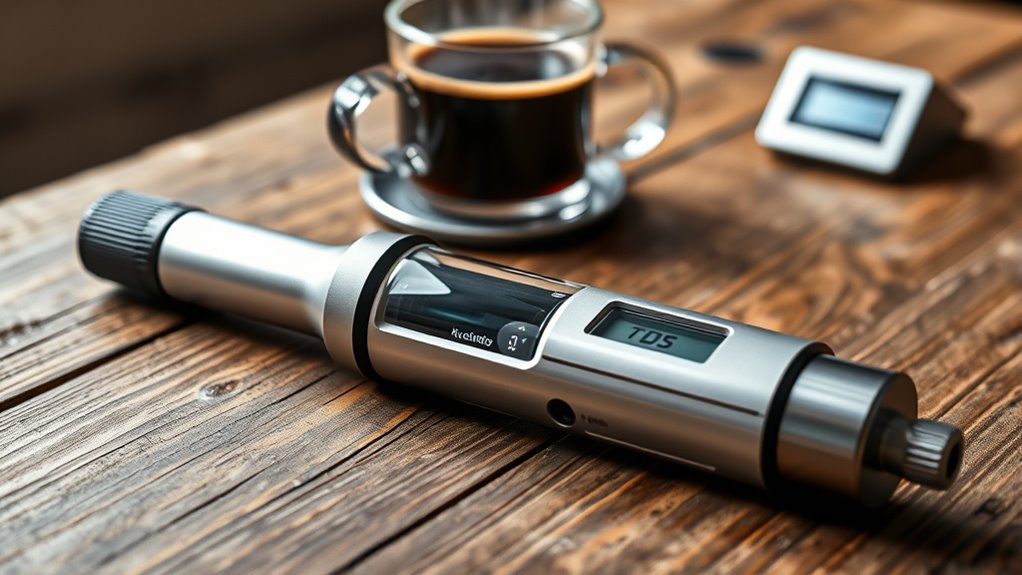

Refractometers help you measure the Total Dissolved Solids (TDS) in your coffee, giving you insight into the strength and extraction level of your brew. By tracking TDS and calculating extraction yield, you can fine-tune your grind size, brew time, and ratio to achieve consistent, flavorful results. Using these tools makes your brewing process more precise and predictable. Keep exploring to discover how mastering these measurements can elevate your coffee experience.

Get coffee and tea gear delivered free with Prime
- Fast, free delivery on millions of items
- Prime Video, Amazon Music and more included
- Member-only deals all year
Key Takeaways
- Refractometers measure TDS to evaluate coffee strength and extraction efficiency.
- TDS readings guide adjustments in brew ratio for optimal flavor profiles.
- Calculating extraction yield from TDS helps ensure consistent and efficient brewing.
- Refractometers enable precise control over brewing variables and flavor development.
- Using TDS and extraction data promotes reproducibility and high-quality coffee production.

Refractometers have become vital tools for coffee enthusiasts and professionals alike, helping you measure the quality and consistency of your brew. By analyzing the Total Dissolved Solids (TDS) in your coffee, they provide valuable insight into how your brew ratios and extraction processes influence flavor profiling. When you use a refractometer, you’re not just guessing whether your coffee is strong or weak—you’re quantifying the extraction, guaranteeing each cup hits the desired profile. Moreover, understanding how AI tools can assist in analyzing brewing data opens new possibilities for precision. Understanding brew ratios is essential because they determine how much coffee grounds you use relative to water. A precise brew ratio results in a balanced extraction, where the flavors are neither underdeveloped nor over-extracted. When you measure TDS with a refractometer, you get an immediate snapshot of how well your chosen brew ratio is working. For example, if your TDS reading is too low, it suggests your extraction might be underwhelming, leading to a bland cup. Conversely, a high TDS could indicate over-extraction, which can make the coffee taste bitter or harsh. Armed with this data, you can tweak your brew ratios to fine-tune the flavor profile, guaranteeing consistency across batches. Flavor profiling is all about understanding how different variables impact taste. With a refractometer, you can see how changes in grind size, brew time, or water temperature influence extraction. This feedback loop allows you to experiment confidently, adjusting your brewing parameters to optimize flavor. For instance, if you aim for a specific flavor note, measuring TDS helps you reach that target more reliably. Over time, you’ll develop an intuitive sense for balancing brew ratios and extraction levels, but the refractometer provides a scientific foundation to support your palate. Using a refractometer also helps you achieve reproducibility. Once you identify the ideal TDS for a particular coffee, you can consistently replicate it by maintaining the same brew ratio and extraction parameters. This consistency is especially important if you’re serving coffee professionally or want to enjoy your favorite beans at their best. Additionally, measuring extraction yield—how much of the coffee’s solubles are extracted—gives you a detailed view of your brewing efficiency. Optimizing extraction yield ensures you maximize flavor while avoiding wasteful over- or under-extraction. In essence, a refractometer empowers you to go beyond guesswork. It enables precise control over brew ratios and enhances flavor profiling, leading to a more consistent, enjoyable coffee experience. Whether you’re a barista honing your craft or a home brewer passionate about perfecting each cup, understanding and applying TDS measurements will elevate your coffee game profoundly.
coffee refractometer for TDS measurement
As an affiliate, we earn on qualifying purchases.
As an affiliate, we earn on qualifying purchases.
Frequently Asked Questions
How Often Should I Calibrate My Coffee Refractometer?
You should calibrate your coffee refractometer regularly to guarantee accurate readings. A good rule of thumb is to calibrate before each use or at least daily if you’re working continuously. Follow proper maintenance tips, like cleaning the prism after each measurement, to keep it in top condition. Regular calibration helps maintain measurement precision, so your TDS and extraction yield calculations stay reliable and consistent over time.
Can Refractometers Measure Other Beverage TDS Accurately?
Yes, refractometers can measure TDS in other beverages, but keep in mind their limitations. They’re most accurate with liquids similar to water, like juice or wine, but less precise with viscous or complex drinks like milk or soda. You should calibrate your device for each beverage type to guarantee accurate measurement, and remember that refractometer limitations may affect results, especially with beverages containing solids or oils.
What Is the Ideal TDS Range for Different Coffee Brewing Methods?
For brewing consistency and quality control, aim for a TDS range of 1.15-1.35% for pour-over and drip coffee, 1.3-1.5% for espresso, and 1.2-1.4% for French press. These ranges help guarantee balanced extraction and ideal flavor. Adjust your grind size and brew time accordingly, using your refractometer to monitor TDS accurately and maintain consistent quality across different brewing methods.
How Does Temperature Affect Refractometer Readings in Coffee?
Temperature affects refractometer readings because it influences the light refraction in your coffee sample. To guarantee accuracy, you should perform temperature correction, adjusting your TDS measurements based on the actual sample temperature. Always calibrate your refractometer before use, especially if your sample’s temperature differs from the calibration temperature. Proper temperature correction and calibration help you get precise readings, leading to better extraction control and coffee consistency.
Are Digital Refractometers More Accurate Than Analog Ones?
Digital refractometers offer superior digital precision, making them more accurate than analog ones. While analog devices boast reliable, straightforward readings, they can be affected by user interpretation and environmental factors. You benefit from digital tools’ consistent, quick, and precise measurements, especially in variable conditions. So, if pinpoint accuracy matters most, digital refractometers are your best choice, combining modern technology with dependable results.
Conclusion
By now, you realize that using a refractometer for coffee isn’t just helpful—it’s a game-changer. Measuring TDS and extraction yield with precision can elevate your brewing to legendary status. Don’t underestimate the power of these tools; they’re like a secret weapon in your barista arsenal. Mastering them can transform your coffee from good to mind-blowingly perfect, making every cup an extraordinary masterpiece that leaves others in awe.
Halloween Picks
halloween
As an affiliate, we earn on qualifying purchases.